







Question: please dont answer U JUDrundleu i another debt issue. 7-9 Why is a call provision advantageous to a bond issuer? When would the issuer be
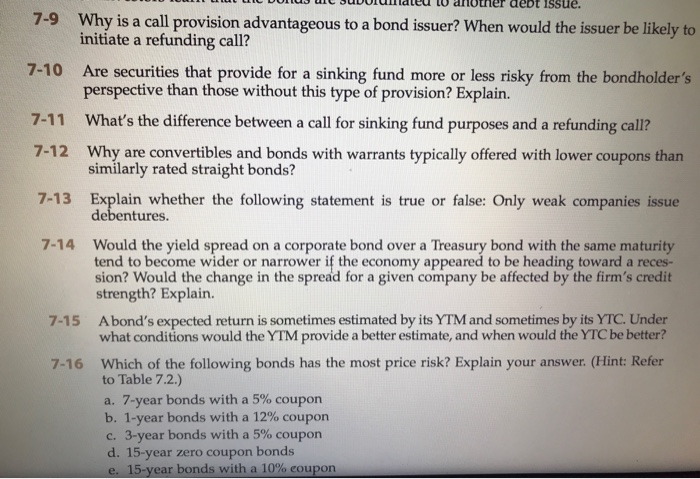
U JUDrundleu i another debt issue. 7-9 Why is a call provision advantageous to a bond issuer? When would the issuer be likely to initiate a refunding call? 7-10 Are securities that provide for a sinking fund more or less risky from the bondholder's perspective than those without this type of provision? Explain. 7-11 What's the difference between a call for sinking fund purposes and a refunding call? 7-12 Why are convertibles and bonds with warrants typically offered with lower coupons than similarly rated straight bonds? 7-13 Explain whether the following statement is true or false: Only weak companies issue debentures. 7-14 Would the yield spread on a corporate bond over a Treasury bond with the same maturity tend to become wider or narrower if the economy appeared to be heading toward a reces- sion? Would the change in the spread for a given company be affected by the firm's credit strength? Explain. A bond's expected return is sometimes estimated by its YTM and sometimes by its YTC. Under what conditions would the YTM provide a better estimate, and when would the YTC be better? 7-16 Which of the following bonds has the most price risk? Explain your answer. (Hint: Refer to Table 7.2.) a. 7-year bonds with a 5% coupon b. 1-year bonds with a 12% coupon c. 3-year bonds with a 5% coupon d. 15-year zero coupon bonds e. 15-year bonds with a 10% coupon U JUDrundleu i another debt issue. 7-9 Why is a call provision advantageous to a bond issuer? When would the issuer be likely to initiate a refunding call? 7-10 Are securities that provide for a sinking fund more or less risky from the bondholder's perspective than those without this type of provision? Explain. 7-11 What's the difference between a call for sinking fund purposes and a refunding call? 7-12 Why are convertibles and bonds with warrants typically offered with lower coupons than similarly rated straight bonds? 7-13 Explain whether the following statement is true or false: Only weak companies issue debentures. 7-14 Would the yield spread on a corporate bond over a Treasury bond with the same maturity tend to become wider or narrower if the economy appeared to be heading toward a reces- sion? Would the change in the spread for a given company be affected by the firm's credit strength? Explain. A bond's expected return is sometimes estimated by its YTM and sometimes by its YTC. Under what conditions would the YTM provide a better estimate, and when would the YTC be better? 7-16 Which of the following bonds has the most price risk? Explain your answer. (Hint: Refer to Table 7.2.) a. 7-year bonds with a 5% coupon b. 1-year bonds with a 12% coupon c. 3-year bonds with a 5% coupon d. 15-year zero coupon bonds e. 15-year bonds with a 10% coupon
Step by Step Solution
There are 3 Steps involved in it

Get step-by-step solutions from verified subject matter experts
 Study Help