



Question: Please dont answer with the previous answers that is already at chegg. (dont copy and paste from other people's answer) Please dont answer with the
Please dont answer with the previous answers that is already at chegg. (dont copy and paste from other people's answer)
 Please dont answer with the previous answers that is already at chegg. (dont copy and paste from other people's answer)
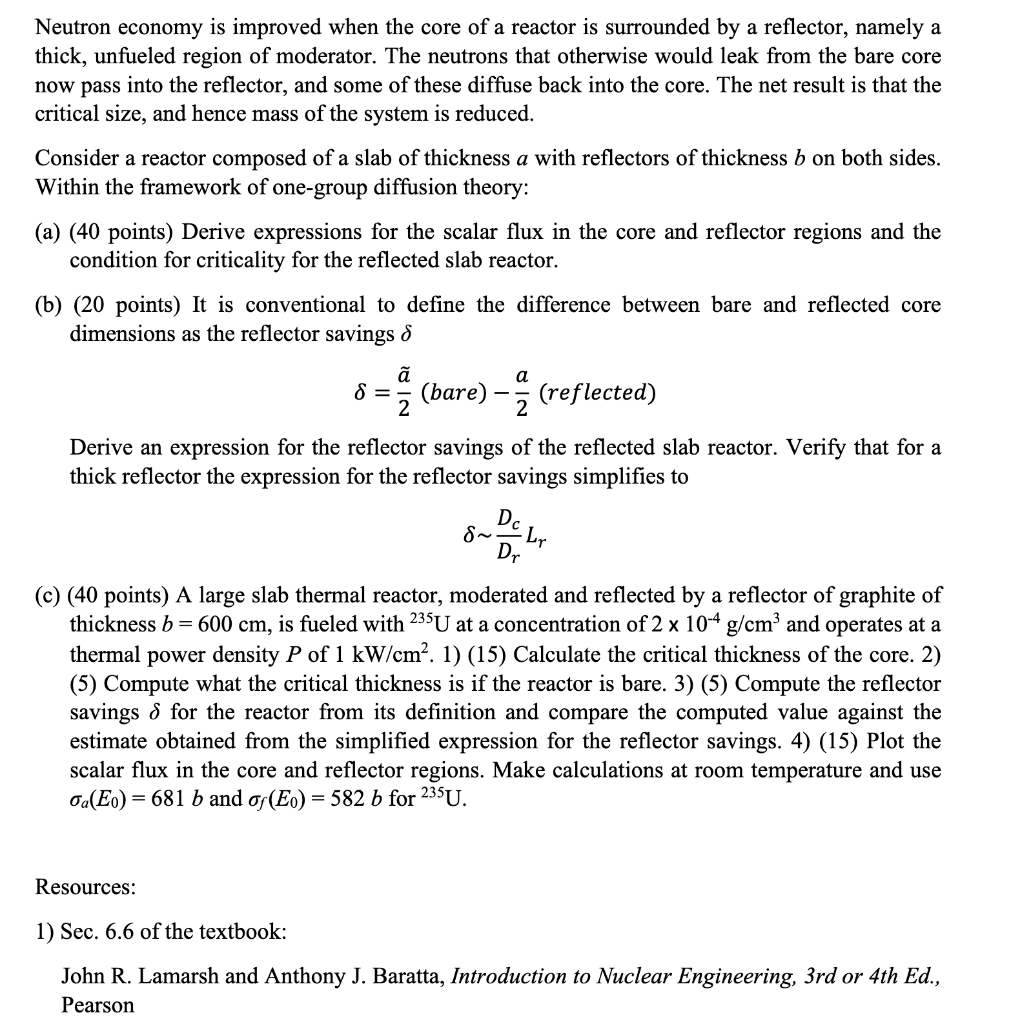
Neutron economy is improved when the core of a reactor is surrounded by a reflector, namely a thick, unfueled region of moderator. The neutrons that otherwise would leak from the bare core now pass into the reflector, and some of these diffuse back into the core. The net result is that the critical size, and hence mass of the system is reduced. Consider a reactor composed of a slab of thickness a with reflectors of thickness b on both sides. Within the framework of one-group diffusion theory: (a) (40 points) Derive expressions for the scalar flux in the core and reflector regions and the condition for criticality for the reflected slab reactor. (b) (20 points) It is conventional to define the difference between bare and reflected core dimensions as the reflector savings =2a~(bare)2a(reflected) Derive an expression for the reflector savings of the reflected slab reactor. Verify that for a thick reflector the expression for the reflector savings simplifies to DrDcLr (c) (40 points) A large slab thermal reactor, moderated and reflected by a reflector of graphite of thickness b=600cm, is fueled with 235U at a concentration of 2104g/cm3 and operates at a thermal power density P of 1kW/cm2. 1) (15) Calculate the critical thickness of the core. 2) (5) Compute what the critical thickness is if the reactor is bare. 3) (5) Compute the reflector savings for the reactor from its definition and compare the computed value against the estimate obtained from the simplified expression for the reflector savings. 4) (15) Plot the scalar flux in the core and reflector regions. Make calculations at room temperature and use a(E0)=681b and f(E0)=582b for 235U. Resources: 1) Sec. 6.6 of the textbook: John R. Lamarsh and Anthony J. Baratta, Introduction to Nuclear Engineering, 3rd or 4th Ed., Pearson
Step by Step Solution
There are 3 Steps involved in it

Get step-by-step solutions from verified subject matter experts