







Question: PLEASE DONT GIVE ANSWER FROM CHEGG-A, THE ANSWER FROM THAT WEBSITE IS ALL WRONG! I WILL KNOW IF YOU GET ANSWER FROM CHEGG-A, BECAUSE WILL
PLEASE DONT GIVE ANSWER FROM CHEGG-A, THE ANSWER FROM THAT WEBSITE IS ALL WRONG! I WILL KNOW IF YOU GET ANSWER FROM CHEGG-A, BECAUSE WILL HAVE THE SAME ANSWER AS THAT WEBSITE. THANK YOU.
PLEASE SKIP AND GIVE THE QUESTION TO OTHER TUTOR IF YOU CANT ANSWER IT. THANK YOU!
PLS USE CALCULUS!
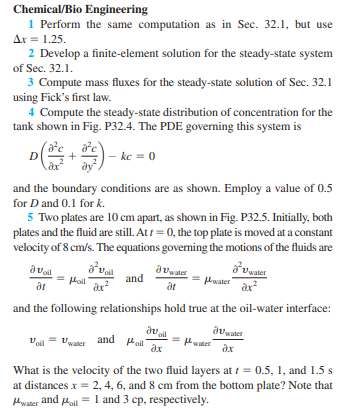
Chemical/Bio Engineering 1 Perform the same computation as in Sec. 32.1, but use Ax = 1.25. 2 Develop a finite-element solution for the steady-state system of Sec. 32.1. 3 Compute mass fluxes for the steady-state solution of Sec. 32.1 using Fick's first law. 4 Compute the steady-state distribution of concentration for the tank shown in Fig. P32.4. The PDE governing this system is D kc = 0 and the boundary conditions are as shown. Employ a value of 0.5 for D and 0.1 for k. 5 Two plates are 10 cm apart, as shown in Fig. P32.5. Initially, both plates and the fluid are still. At / = 0, the top plate is moved at a constant velocity of 8 cm/s. The equations governing the motions of the fluids are Vail a Vall d water = Hail and ar = water ar and the following relationships hold true at the oil-water interface: Dall = Vener and Poll ax ax What is the velocity of the two fluid layers at / = 0.5, 1, and 1.5 s at distances x = 2, 4, 6, and 8 cm from the bottom plate? Note that Awater and pan = 1 and 3 cp, respectively
Step by Step Solution
There are 3 Steps involved in it

Get step-by-step solutions from verified subject matter experts
 Study Help