







Question: Please draw the graphs the same format as in Figure 2(b). Thank you so much. An ATMD-based video rate adaptation system (discussed in class) can
Please draw the graphs the same format as in Figure 2(b). Thank you so much.
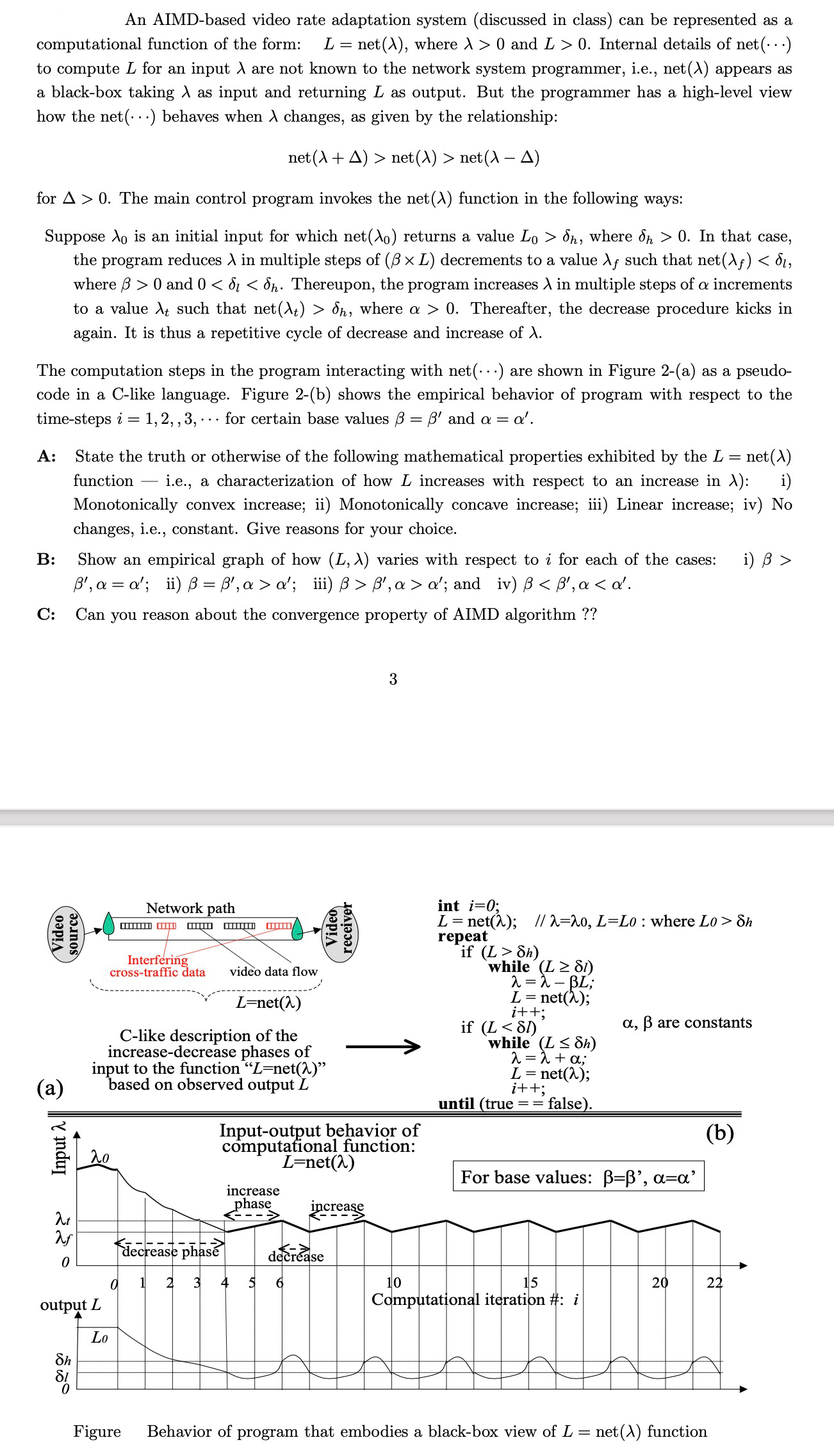
An ATMD-based video rate adaptation system (discussed in class) can be represented as a computational function of the form: L = net(A), where A > 0 and L > 0. Internal details of net(-- ) to compute L for an input A are not known to the network system programmer, i.e., net(\\) appears as a black-box taking A as input and returning L as output. But the programmer has a high-level view how the net(- - -) behaves when A changes, as given by the relationship: net(A + A) > net(A\\) > net(A A) for A > 0. The main control program invokes the net()\\) function in the following ways: Suppose Ag is an initial input for which net(A\\g) returns a value Ly > &, where 6, > 0. In that case, the program reduces A in multiple steps of (8 x L) decrements to a value As such that net(\\f) 0 and 0 &, where @ > 0. Thereafter, the decrease procedure kicks in again. It is thus a repetitive cycle of decrease and increase of A. The computation steps in the program interacting with net(- - -) are shown in Figure 2-(a) as a pseudo- code in a C-like language. Figure 2-(b) shows the empirical behavior of program with respect to the time-steps = 1,2,,3, - - - for certain base values 8 = 8' and o = &'. A: State the truth or otherwise of the following mathematical properties exhibited by the L = net()) function i.e., a characterization of how L increases with respect to an increase in A): i) Monotonically convex increase; ii) Monotonically concave increase; iii) Linear increase; iv) No changes, i.e., constant. Give reasons for your choice. B: Show an empirical graph of how (L, X) varies with respect to for each of the cases: i) 8 > Ba=o; i) f=F,a>a; iii) > f,a>a;and iv) B &k =5 - repeat 3 Inlcrtng - if (L>8n) cross-traffic data video data flow Whlle g{' = 51) """""""""" ey L+ et Y . o if (L -15 Figure Behavior of program that embodies a black-box view of L = net(\\) function
Step by Step Solution
There are 3 Steps involved in it

Get step-by-step solutions from verified subject matter experts
 Study Help