







Question: please explain a-f 1. Negative Externality Consider a competitive market with inverse demand: p(q) = 100 -q. Production creates a negative externality (pollution). Supply is
please explain a-f
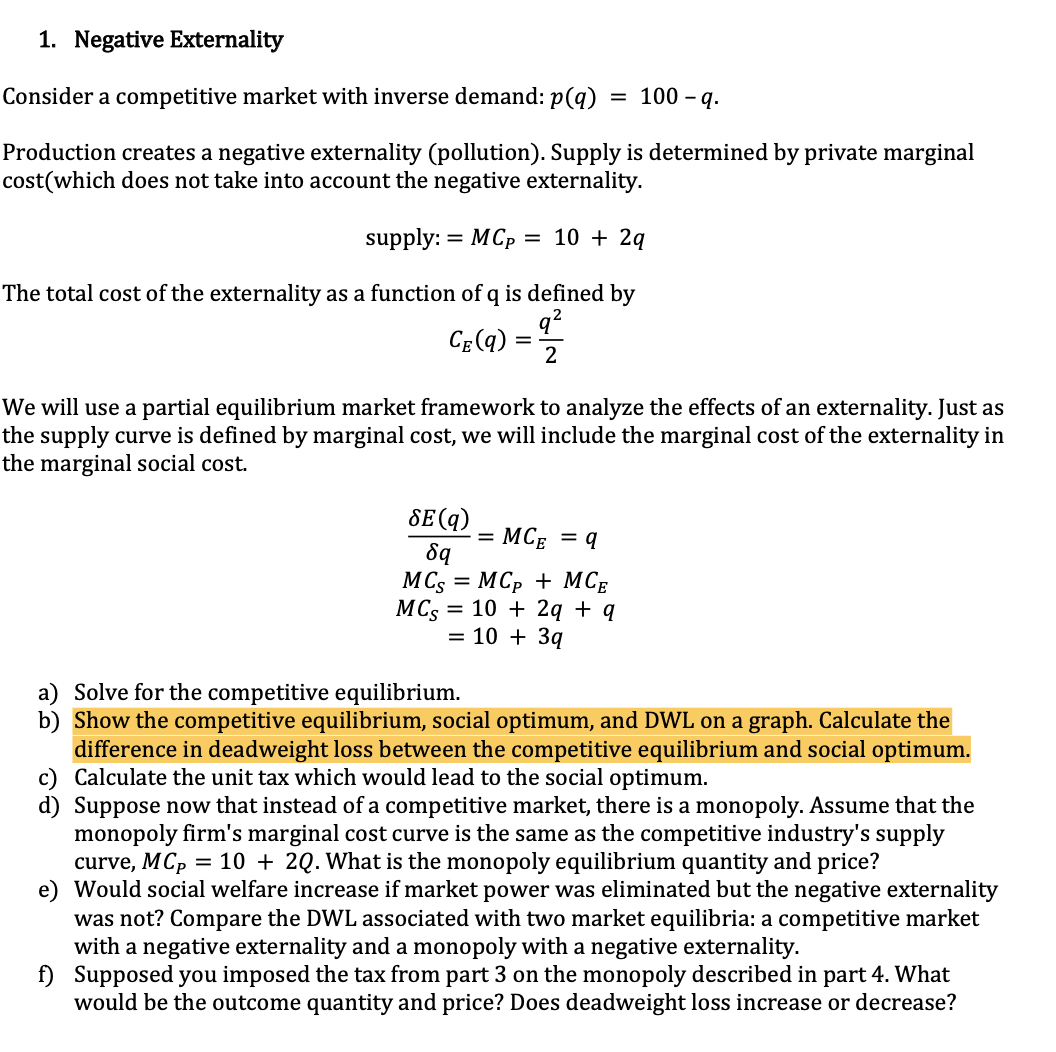
1. Negative Externality Consider a competitive market with inverse demand: p(q) = 100 -q. Production creates a negative externality (pollution). Supply is determined by private marginal cost(which does not take into account the negative externality. supply: = MCp = 10 + 2q The total cost of the externality as a function of q is defined by CE (q) = 2 We will use a partial equilibrium market framework to analyze the effects of an externality. Just as the supply curve is defined by marginal cost, we will include the marginal cost of the externality in the marginal social cost. SE(q) = MCE = q MCs = MCp + MCE MCs = 10 + 2q + q = 10 + 3q a) Solve for the competitive equilibrium. b ) Show the competitive equilibrium, social optimum, and DWL on a graph. Calculate the difference in deadweight loss between the competitive equilibrium and social optimum. c) Calculate the unit tax which would lead to the social optimum. d) Suppose now that instead of a competitive market, there is a monopoly. Assume that the monopoly firm's marginal cost curve is the same as the competitive industry's supply curve, MCp = 10 + 2Q. What is the monopoly equilibrium quantity and price? e) Would social welfare increase if market power was eliminated but the negative externality was not? Compare the DWL associated with two market equilibria: a competitive market with a negative externality and a monopoly with a negative externality f) Supposed you imposed the tax from part 3 on the monopoly described in part 4. What would be the outcome quantity and price? Does deadweight loss increase or decrease
Step by Step Solution
There are 3 Steps involved in it

Get step-by-step solutions from verified subject matter experts
 Study Help