





Question: Please explain and prove the problem 8, including part (a) and part(b). The details are below: 8. The Cantor set C is obtained by removing
Please explain and prove the problem 8, including part (a) and part(b). The details are below:
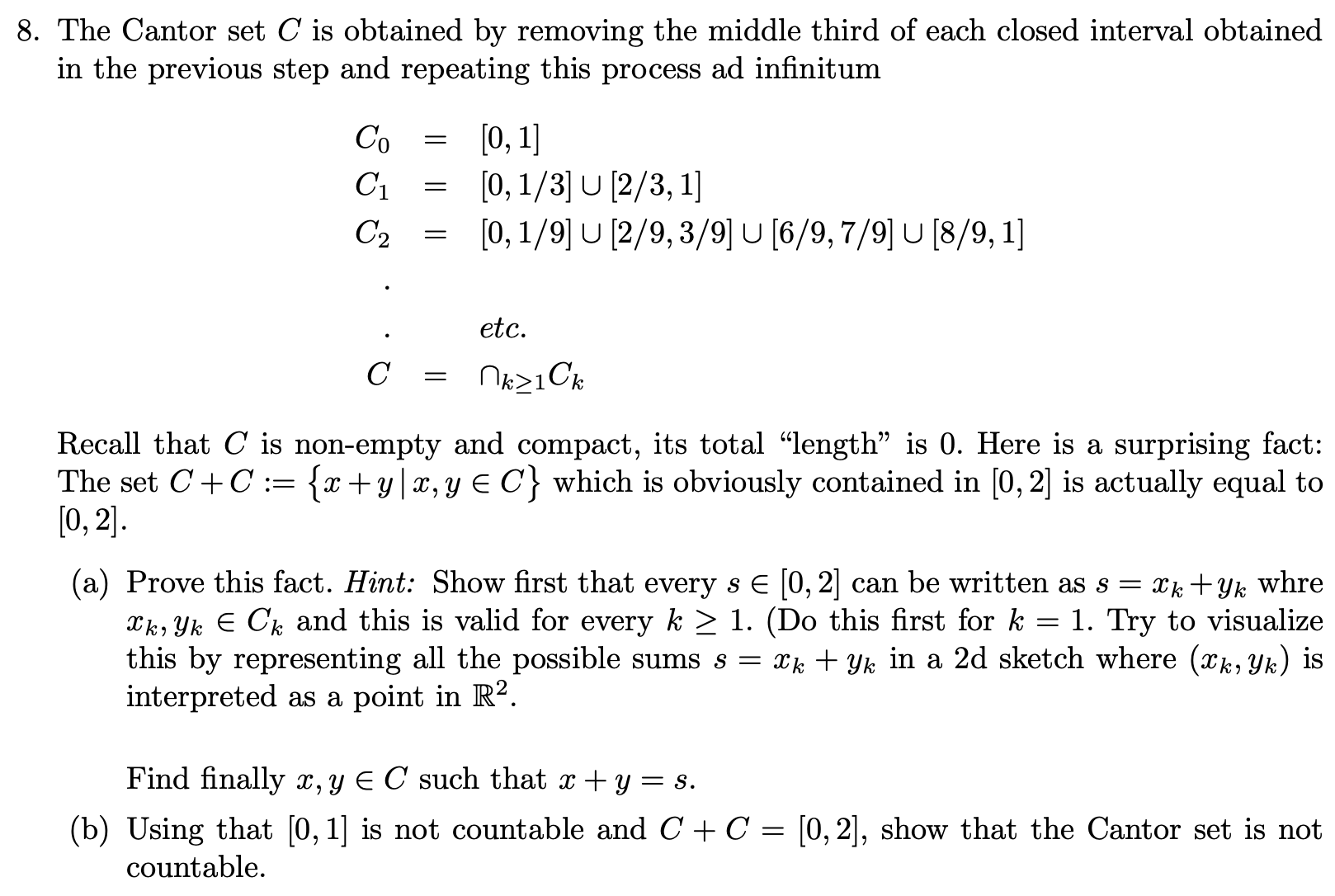
8. The Cantor set C is obtained by removing the middle third of each closed interval obtained in the previous step and repeating this process ad innitum CO [0,1] 01 [0,1/3] U [2/3,1] 02 = [0, 1/9] U [2/9,3/9] U [6/9, 7/9] U [8/9, 1] etc. 0 = kgick Recall that C is non-empty and compact, its total \"length\" is 0. Here is a surprising fact: The set C + C := {:17 + y | ac, y E C} which is obviously contained in [0,2] is actually equal to [0, 2]- (a) Prove this fact. Hint: Show rst that every .3 E [0, 2] can be written as s = :11], +97, whre ask, yk E 0;, and this is valid for every k 2 1. (Do this rst for k = 1. Try to visualize this by representing all the possible sums s = {1:1, + yk in a 2d sketch where (3%, yk) is interpreted as a point in R2. Find nally (1:, y E C such that a: + y = s. (b) Using that [0,1] is not countable and C + C = [0,2], show that the Cantor set is not countable
Step by Step Solution
There are 3 Steps involved in it
1 Expert Approved Answer
Step: 1 Unlock

Question Has Been Solved by an Expert!
Get step-by-step solutions from verified subject matter experts
Step: 2 Unlock
Step: 3 Unlock

Students Have Also Explored These Related Mathematics Questions!