







Question: Please explain and show your reasoning for (b) and (c). For (b), why do we use binomial distribution? For (c), what is the formula for
Please explain and show your reasoning for (b) and (c).
For (b), why do we use binomial distribution?
For (c), what is the formula for this question?
Please note that the solutions are already provided
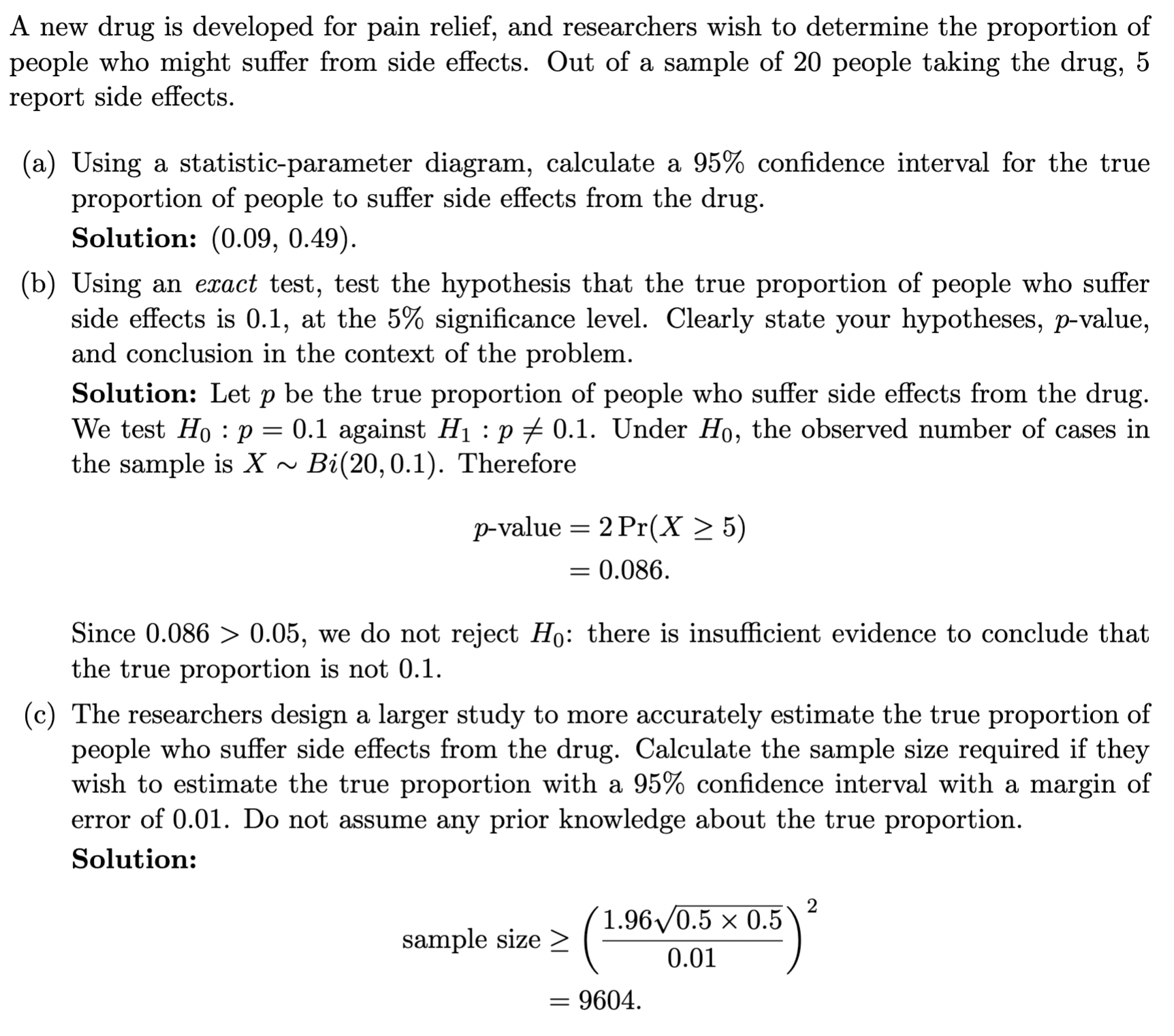
A new drug is developed for pain relief, and researchers wish to determine the proportion of people who might suffer from side effects. Out of a sample of 20 people taking the drug, 5 report side effects. (a) Using a statistic-parameter diagram, calculate a 95% confidence interval for the true proportion of people to suffer side effects from the drug. Solution: (0.09, 0.49). (b) Using an exact test, test the hypothesis that the true proportion of people who suffer side effects is 0.1, at the 5% significance level. Clearly state your hypotheses, p-value, and conclusion in the context of the problem. Solution: Let p be the true proportion of people who suffer side effects from the drug. We test Ho : p = 0.1 against H1 : p # 0.1. Under Ho, the observed number of cases in the sample is X ~ Bi(20, 0.1). Therefore p-value = 2 Pr(X 2 5) = 0.086. Since 0.086 > 0.05, we do not reject Ho: there is insufficient evidence to conclude that the true proportion is not 0.1. (c) The researchers design a larger study to more accurately estimate the true proportion of people who suffer side effects from the drug. Calculate the sample size required if they wish to estimate the true proportion with a 95% confidence interval with a margin of error of 0.01. Do not assume any prior knowledge about the true proportion. Solution: N 1.96 V0.5 x 0.5 sample size > 0.01 = 9604
Step by Step Solution
There are 3 Steps involved in it

Get step-by-step solutions from verified subject matter experts
 Study Help