







Question: Please explain each step. And please DON'T COPY AND PASTE THE SAME ANSWERS ON THE SITE, because they are wrong. Thank u Please explain each
Please explain each step. And please DON'T COPY AND PASTE THE SAME ANSWERS ON THE SITE, because they are wrong. Thank u
Please explain each step. And please DON'T COPY AND PASTE THE SAME ANSWERS ON THE SITE, because they are wrong. Thank u
Please explain each step. And please DON'T COPY AND PASTE THE SAME ANSWERS ON THE SITE, because they are wrong. Thank u
Please explain each step. And please DON'T COPY AND PASTE THE SAME ANSWERS ON THE SITE, because they are wrong. Thank u
Please explain each step. And please DON'T COPY AND PASTE THE SAME ANSWERS ON THE SITE, because they are wrong. Thank u
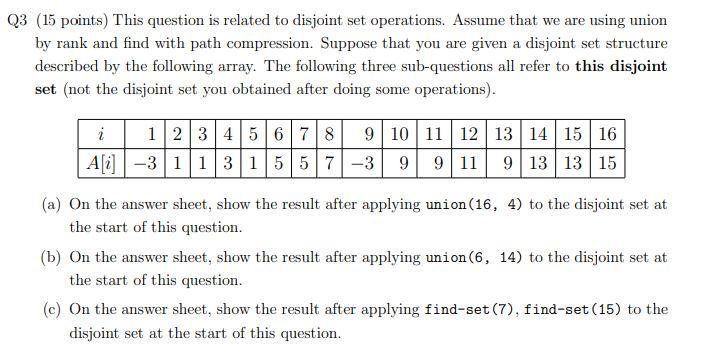
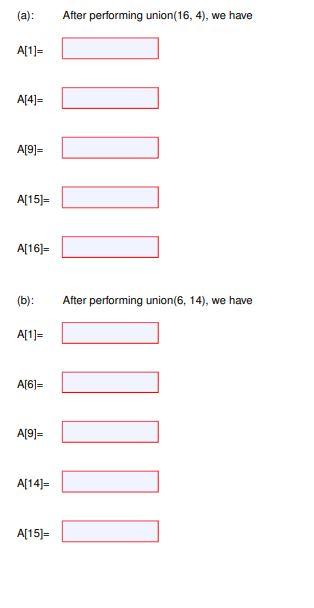
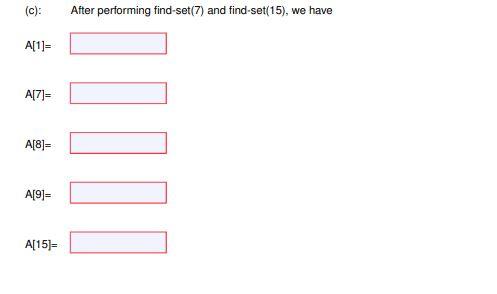
Q3 (15 points) This question is related to disjoint set operations. Assume that we are using union by rank and find with path compression. Suppose that you are given a disjoint set structure described by the following array. The following three sub-questions all refer to this disjoint set (not the disjoint set you obtained after doing some operations). (a) On the answer sheet, show the result after applying union (16,4) to the disjoint set at the start of this question. (b) On the answer sheet, show the result after applying union (6,14) to the disjoint set at the start of this question. (c) On the answer sheet, show the result after applying find-set(7), find-set (15) to the disjoint set at the start of this question. (a): After performing union (16,4), we have A[1]= A[4]= A[9]= A[15]= A[16]= (b): After performing union(6, 14), we have A[1]= A[6]= A[9]= A[14]= A[15]= (c): After performing find-set(7) and find-set(15), we have A[1]= A[7]= A[B]= A[9]= A[15]= Q3 (15 points) This question is related to disjoint set operations. Assume that we are using union by rank and find with path compression. Suppose that you are given a disjoint set structure described by the following array. The following three sub-questions all refer to this disjoint set (not the disjoint set you obtained after doing some operations). (a) On the answer sheet, show the result after applying union (16,4) to the disjoint set at the start of this question. (b) On the answer sheet, show the result after applying union (6,14) to the disjoint set at the start of this question. (c) On the answer sheet, show the result after applying find-set(7), find-set (15) to the disjoint set at the start of this question. (a): After performing union (16,4), we have A[1]= A[4]= A[9]= A[15]= A[16]= (b): After performing union(6, 14), we have A[1]= A[6]= A[9]= A[14]= A[15]= (c): After performing find-set(7) and find-set(15), we have A[1]= A[7]= A[B]= A[9]= A[15]=
Step by Step Solution
There are 3 Steps involved in it

Get step-by-step solutions from verified subject matter experts
 Study Help