







Question: Please explain each step you took to get to the answer 2. In the postfix (or reverse Polish) notation of expressions, the operator always follows
 Please explain each step you took to get to the answer
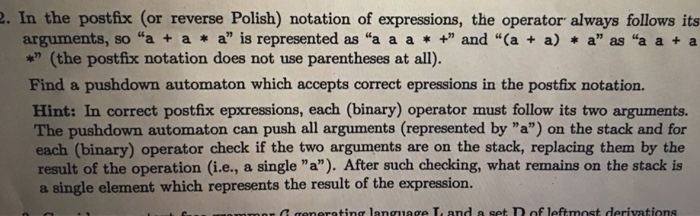
 2. In the postfix (or reverse Polish) notation of expressions, the operator always follows its arguments, so a + a * a" is represented as "a a a * +" and "(a + a) * a" as "a a + a * (the postfix notation does not use parentheses at all). Find a pushdown automaton which accepts correct epressions in the postfix notation. Hint: In correct postfix epxressions, each (binary) operator must follow its two arguments. The pushdown automaton can push all arguments (represented by "a") on the stack and for each (binary) operator check if the two arguments are on the stack, replacing them by the result of the operation (i.e., a single "a"). After such checking, what remains on the stack is a single element which represents the result of the expression
Step by Step Solution
There are 3 Steps involved in it

Get step-by-step solutions from verified subject matter experts
 Study Help