







Question: Please Explain! eBook Problem Walk-Through Beale Manufacturing Company has a beta of 1.8, and Foley Industries has a beta of 0.60. The required return on


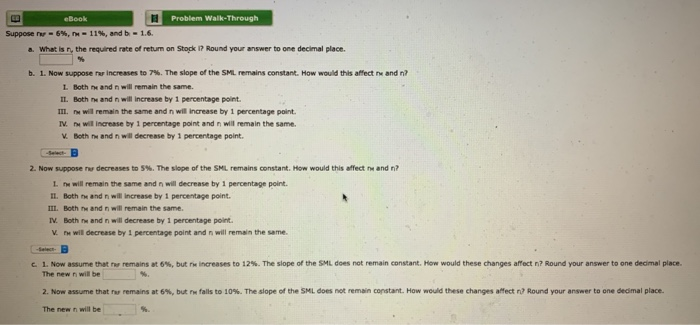
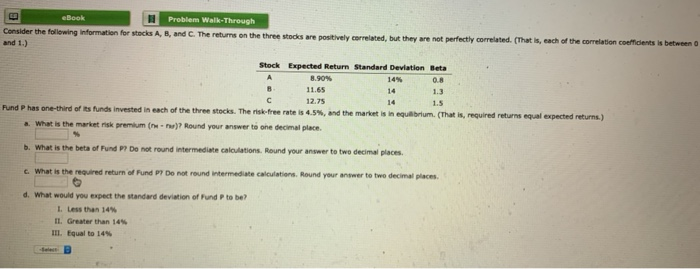
eBook Problem Walk-Through Beale Manufacturing Company has a beta of 1.8, and Foley Industries has a beta of 0.60. The required return on an index fund that holds the entire stock market is 9%. The risk-free rate of interest is 2.5%. By how much does Beale's required return exceed Foley's required return? Do not round intermediate calculations. Round your answer to two decimal places % eBook Problem Walk-Through Calculate the required rate of return for Mudd Enterprises assuming that investors expect a 4.0% rate of inflation in the future. The real risk-free rate is 1.5%, and the mark risk premium is 6.5%. Mudd has a beta of 1.6, and its realized rate of return has averaged 9.0% over the past 5 years. Round your answer to two decimal places. LE eBook Problem Walk-Through Suppose -6% -11%, and b = 1.6. a. What is n, the required rate of return on Stock I? Round your answer to one decimal place. b. 1. Now suppose to increases to 7%. The slope of the SML remains constant. How would this affect and n? 1 Both and n will remain the same. 11. Both and will increase by 1 percentage point. III. will remain the same and will increase by 1 percentage point. I will increase by 1 percentage point and will remain the same. V. Both and will decrease by 1 percentage point. 2. Now suppose to decreases to 5%. The slope of the SML remains constant. How would this affect and n? I will remain the same and will decrease by 1 percentage point. 11. Both and n will increase by 1 percentage point. III. Both and will remain the same. IV. Both and will decrease by 1 percentage point. V. will decrease by 1 percentage point and will remain the same. 1. Now assume that the remains at 6%, but increases to 12%. The slope of the SML does not remain constant. How would these changes affect n? Round your answer to one decimal place The new n will be 2. Now assume that remains at 6%, but fails to 10%. The slope of the SML does not remain constant. How would these changes affect n Round your answer to one decimal place. The new n will be eBook Problem Walk-Through Consider the following information for stocks A, B, and C. The returns on the three stocks are positively correlated, but they are not perfectly correlated. (That is, each of the correlation coefficients is between a and 1.) Stock Expected Return Standard Deviation Beta 8.90% 14% 0.8 11.65 14 1.3 12.75 14 1.5 Fund Phas one-third of its funds invested in each of the three stocks. The risk-free rate is 4.5%, and the market is in equilibrium. (That is required returns equal expected returns.) a. What is the market risk premium (ne)? Round your answer to the decimal place . What is the beta of Fund P? Do not round intermediate calculations. Round your answer to two decimal places c. What is the required return of Fund P7 Do not round intermediate calculations. Round your answer to two decimal places d. What would you expect the standard deviation of Fund P to be? 1. Less than 14% II. Greater than 14% III. Equal to 144
Step by Step Solution
There are 3 Steps involved in it

Get step-by-step solutions from verified subject matter experts
 Study Help