







Question: please explain every parts with clear explanation. Problem 1: A Circular matrix is an n xn matrix A which is defined by its first row,
please explain every parts with clear explanation.
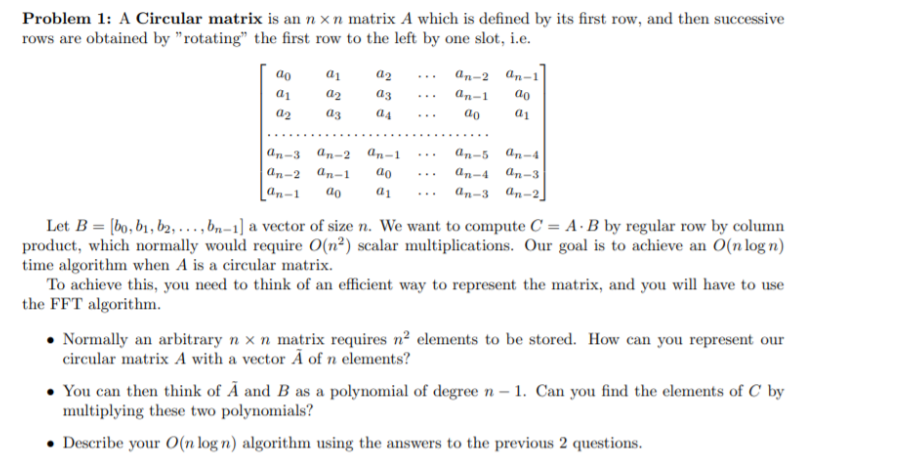
Problem 1: A Circular matrix is an n xn matrix A which is defined by its first row, and then successive rows are obtained by rotating the first row to the left by one slot, i.e. do 21 02 an-2an-1 di 02 d3 an-1 010 02 03 04 do 21 an-3 0-2 0-1 an-2a-1 do an-5 an-4 an-4 an-3 an-3 an-2] an-1 Go 01 Let B = [bo, b1,b2, ..., bn-1) a vector of size n. We want to compute C = A. B by regular row by column product, which normally would require O(na) scalar multiplications. Our goal is to achieve an O(n log n) time algorithm when A is a circular matrix. To achieve this, you need to think of an efficient way to represent the matrix, and you will have to use the FFT algorithm. Normally an arbitrary n x n matrix requires n? elements to be stored. How can you represent our circular matrix A with a vector of n elements? You can then think of A and B as a polynomial of degree n - 1. Can you find the elements of C by multiplying these two polynomials? Describe your O(n log n) algorithm using the answers to the previous 2 questions. Problem 1: A Circular matrix is an n xn matrix A which is defined by its first row, and then successive rows are obtained by rotating the first row to the left by one slot, i.e. do 21 02 an-2an-1 di 02 d3 an-1 010 02 03 04 do 21 an-3 0-2 0-1 an-2a-1 do an-5 an-4 an-4 an-3 an-3 an-2] an-1 Go 01 Let B = [bo, b1,b2, ..., bn-1) a vector of size n. We want to compute C = A. B by regular row by column product, which normally would require O(na) scalar multiplications. Our goal is to achieve an O(n log n) time algorithm when A is a circular matrix. To achieve this, you need to think of an efficient way to represent the matrix, and you will have to use the FFT algorithm. Normally an arbitrary n x n matrix requires n? elements to be stored. How can you represent our circular matrix A with a vector of n elements? You can then think of A and B as a polynomial of degree n - 1. Can you find the elements of C by multiplying these two polynomials? Describe your O(n log n) algorithm using the answers to the previous 2 questions
Step by Step Solution
There are 3 Steps involved in it

Get step-by-step solutions from verified subject matter experts
 Study Help