







Question: Please explain how is done not only the answer! Problem 5. (34 POINTS) Fill in the table below by providing the running time for every
Please explain how is done not only the answer!
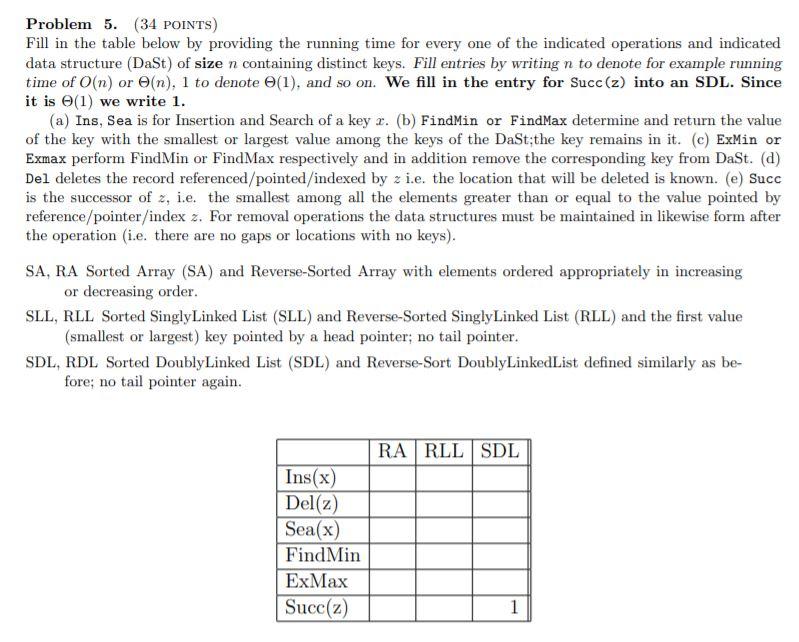
Problem 5. (34 POINTS) Fill in the table below by providing the running time for every one of the indicated operations and indicated data structure (DaSt) of size n containing distinct keys. Fill entries by writing n to denote for example running time of O(n) or O(n), 1 to denote (1), and so on. We fill in the entry for Succ(z) into an SDL. Since it is (1) we write 1. (a) Ins, Sea is for Insertion and Search of a key r. (b) FindMin or FindMax determine and return the value of the key with the smallest or largest value among the keys of the DaSt;the key remains in it. (c) ExMin or Exmax perform FindMin or FindMax respectively and in addition remove the corresponding key from DaSt. (d) Del deletes the record referenced/pointed/indexed by z i.e. the location that will be deleted is known. (e) Suce is the successor of z, i.e. the smallest among all the elements greater than or equal to the value pointed by reference/pointer/index z. For removal operations the data structures must be maintained in likewise form after the operation (i.e. there are no gaps or locations with no keys). SA, RA Sorted Array (SA) and Reverse-Sorted Array with elements ordered appropriately in increasing or decreasing order. SLL, RLL Sorted SinglyLinked List (SLL) and Reverse-Sorted SinglyLinked List (RLL) and the first value (smallest or largest) key pointed by a head pointer; no tail pointer. SDL, RDL Sorted Doubly Linked List (SDL) and Reverse-Sort DoublyLinkedList defined similarly as be- fore; no tail pointer again. RA RLL SDL Ins(x) Del(z) Sea(x) Find Min ExMax Succ(z) 1 Problem 5. (34 POINTS) Fill in the table below by providing the running time for every one of the indicated operations and indicated data structure (DaSt) of size n containing distinct keys. Fill entries by writing n to denote for example running time of O(n) or O(n), 1 to denote (1), and so on. We fill in the entry for Succ(z) into an SDL. Since it is (1) we write 1. (a) Ins, Sea is for Insertion and Search of a key r. (b) FindMin or FindMax determine and return the value of the key with the smallest or largest value among the keys of the DaSt;the key remains in it. (c) ExMin or Exmax perform FindMin or FindMax respectively and in addition remove the corresponding key from DaSt. (d) Del deletes the record referenced/pointed/indexed by z i.e. the location that will be deleted is known. (e) Suce is the successor of z, i.e. the smallest among all the elements greater than or equal to the value pointed by reference/pointer/index z. For removal operations the data structures must be maintained in likewise form after the operation (i.e. there are no gaps or locations with no keys). SA, RA Sorted Array (SA) and Reverse-Sorted Array with elements ordered appropriately in increasing or decreasing order. SLL, RLL Sorted SinglyLinked List (SLL) and Reverse-Sorted SinglyLinked List (RLL) and the first value (smallest or largest) key pointed by a head pointer; no tail pointer. SDL, RDL Sorted Doubly Linked List (SDL) and Reverse-Sort DoublyLinkedList defined similarly as be- fore; no tail pointer again. RA RLL SDL Ins(x) Del(z) Sea(x) Find Min ExMax Succ(z) 1
Step by Step Solution
There are 3 Steps involved in it

Get step-by-step solutions from verified subject matter experts
 Study Help