







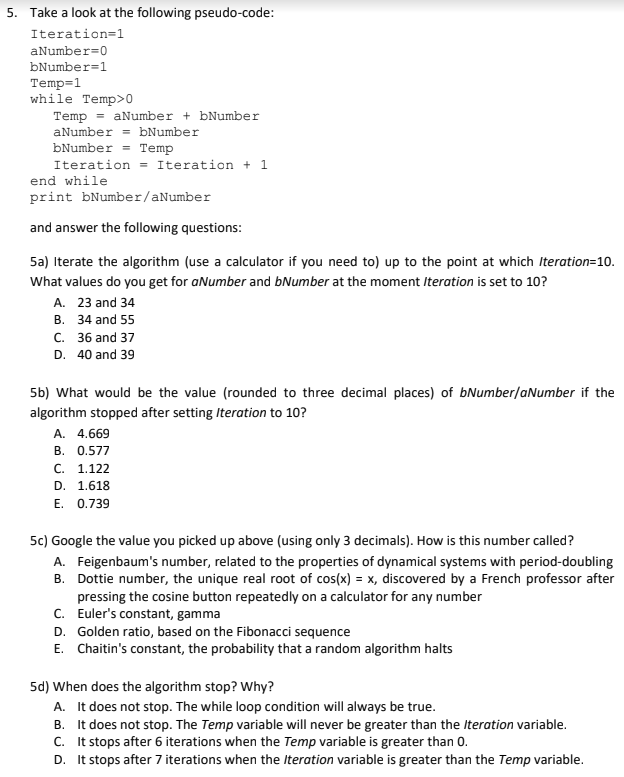
Question: PLEASE EXPLAIN HOW THIS WAS DONE 5. Take a look at the following pseudo-code Iteration-1 aNumber-0 bNumber-1 Temp-1 while Temp>0 Temp aNumberbNumber aNumberbNumber bNumberTemp Iteration
PLEASE EXPLAIN HOW THIS WAS DONE
5. Take a look at the following pseudo-code Iteration-1 aNumber-0 bNumber-1 Temp-1 while Temp>0 Temp aNumberbNumber aNumberbNumber bNumberTemp Iteration Iteration + 1 end while print bNumber/aNumber and answer the following questions 5a) terate the algorithm (use a calculator if you need to) up to the point at which Iteration 10 What values do you get for aNumber and bNumber at the moment Iteration is set to 10? A. 23 and 34 B. 34 and 55 C. 36 and 37 D. 40 and 39 5b) What would be the value (rounded to three decimal places) of bNumber/aNumber if the algorithm stopped after setting Iteration to 10? A. 4.669 B. 0.577 C. 1.122 D. 1.618 E. 0.739 5c) Google the value you picked up above (using only 3 decimals). How is this number called? A. Feigenbaum's number, related to the properties of dynamical systems with period-doubling B. Dottie number, the unique real root of cos(x) - x, discovered by a French professor after C. D. E. pressing the cosine button repeatedly on a calculator for any number Euler's constant, gamma Golden ratio, based on the Fibonacci sequence Chaitin's constant, the probability that a random algorithm halts 5d) When does the algorithm stop? Why? A. It does not stop. The while loop condition will always be true B. It does not stop. The Temp variable will never be greater than the Iteration variable C. It stops after 6 iterations when the Temp variable is greater than 0. D. t stops after 7 iterations when the Iteration variable is greater than the Temp variable
Step by Step Solution
There are 3 Steps involved in it

Get step-by-step solutions from verified subject matter experts
 Study Help