Question: Please explain how to solve part 2, part 3, and part 4 with an explanation thank you A firm is looking to hire a worker
Please explain how to solve part 2, part 3, and part 4 with an explanation
thank you
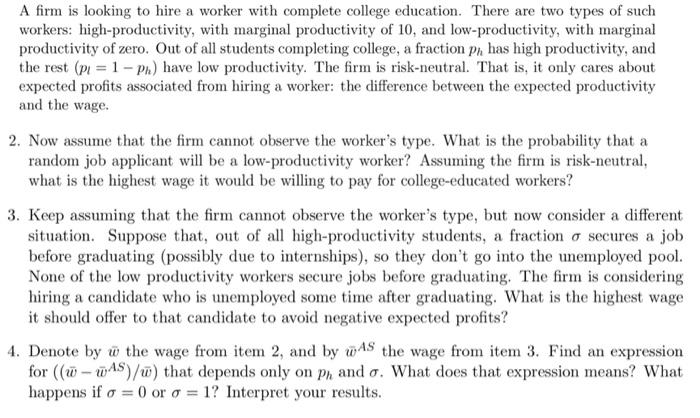
A firm is looking to hire a worker with complete college education. There are two types of such workers: high-productivity, with marginal productivity of 10, and low-productivity, with marginal productivity of zero. Out of all students completing college, a fraction ph has high productivity, and the rest (P1 = 1 - Pn) have low productivity. The firm is risk-neutral. That is, it only cares about expected profits associated from hiring a worker: the difference between the expected productivity and the wage. 2. Now assume that the firm cannot observe the worker's type. What is the probability that a random job applicant will be a low-productivity worker? Assuming the firm is risk-neutral, what is the highest wage it would be willing to pay for college-educated workers? 3. Keep assuming that the firm cannot observe the worker's type, but now consider a different situation. Suppose that, out of all high-productivity students, a fraction o secures a job before graduating (possibly due to internships), so they don't go into the unemployed pool. None of the low productivity workers secure jobs before graduating. The firm is considering hiring a candidate who is unemployed some time after graduating. What is the highest wage it should offer to that candidate to avoid negative expected profits? 4. Denote by w the wage from item 2, and by wAS the wage from item 3. Find an expression for ((w - WAS)/w) that depends only on ph and o. What does that expression means? What happens if o = 0 or a = 1? Interpret your results. A firm is looking to hire a worker with complete college education. There are two types of such workers: high-productivity, with marginal productivity of 10, and low-productivity, with marginal productivity of zero. Out of all students completing college, a fraction ph has high productivity, and the rest (P1 = 1 - Pn) have low productivity. The firm is risk-neutral. That is, it only cares about expected profits associated from hiring a worker: the difference between the expected productivity and the wage. 2. Now assume that the firm cannot observe the worker's type. What is the probability that a random job applicant will be a low-productivity worker? Assuming the firm is risk-neutral, what is the highest wage it would be willing to pay for college-educated workers? 3. Keep assuming that the firm cannot observe the worker's type, but now consider a different situation. Suppose that, out of all high-productivity students, a fraction o secures a job before graduating (possibly due to internships), so they don't go into the unemployed pool. None of the low productivity workers secure jobs before graduating. The firm is considering hiring a candidate who is unemployed some time after graduating. What is the highest wage it should offer to that candidate to avoid negative expected profits? 4. Denote by w the wage from item 2, and by wAS the wage from item 3. Find an expression for ((w - WAS)/w) that depends only on ph and o. What does that expression means? What happens if o = 0 or a = 1? Interpret your results









 Study Help