







Question: please explain how to solve part d, part e, part f and part g with an explanation thank you yariance and Qovariance. Let Y be
please explain how to solve part d, part e, part f and part g with an explanation thank you
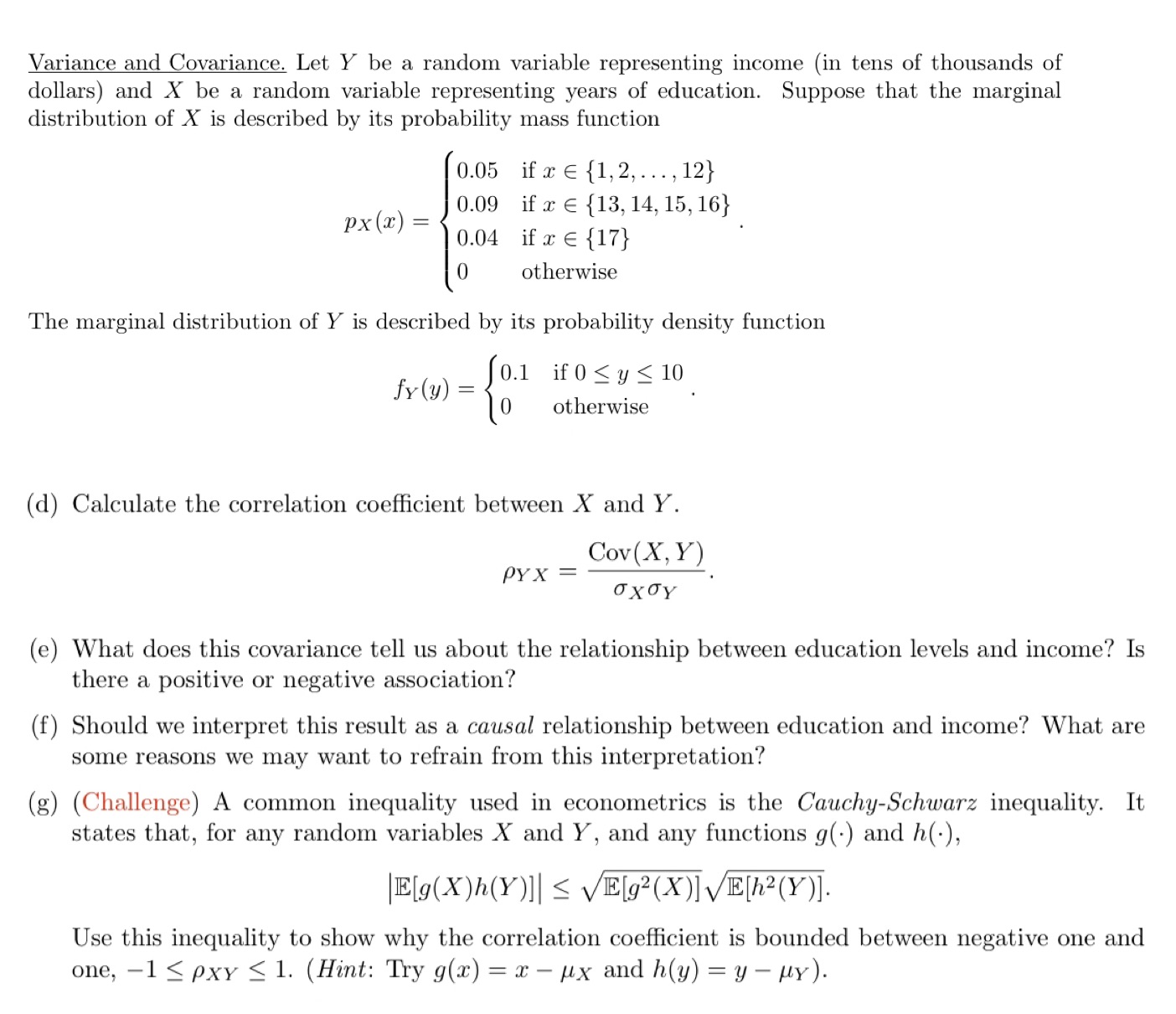
yariance and Qovariance. Let Y be a random variable representing income (in tens of thousands of dollars) and X be a random variable representing years of education. Suppose that the marginal distribution of X is described by its probability mass function 0.05 ime{1,2,...,12} 0.09 if a: E {13, 14, 15,16} 0.04 if a: e {17} ' 0 otherwise px(:c) = The marginal distribution of Y is described by its probability density function 0.1 if 0 5 y g 10 0 otherwise I fYCU) ={ ((1) Calculate the correlation coefcient between X and Y. (e) What does this covariance tell us about the relationship between education levels and income? Is there a positive or negative association? (f) Should we interpret this result as a causal relationship between education and income? What are some reasons we may want to refrain from this interpretation? (g) (Challenge) A common inequality used in econometrics is the Cauchy-Schwarz inequality. It states that, for any random variables X and Y, and any functions g(-) and h(-), IE[9(X)h(Y)]| S VE[92(X)]\\/1Elh2(Y)l- Use this inequality to show why the correlation coefcient is bounded between negative one and one. 1 S pm 5 1- (Hint: Try 9(3) = In - Jux and My) = y - w)
Step by Step Solution
There are 3 Steps involved in it

Get step-by-step solutions from verified subject matter experts
 Study Help