







Question: Please explain how to solve step by step and name any rules or theorems used. The following is from Chiang's fundamental mathematical economics. 1. Given
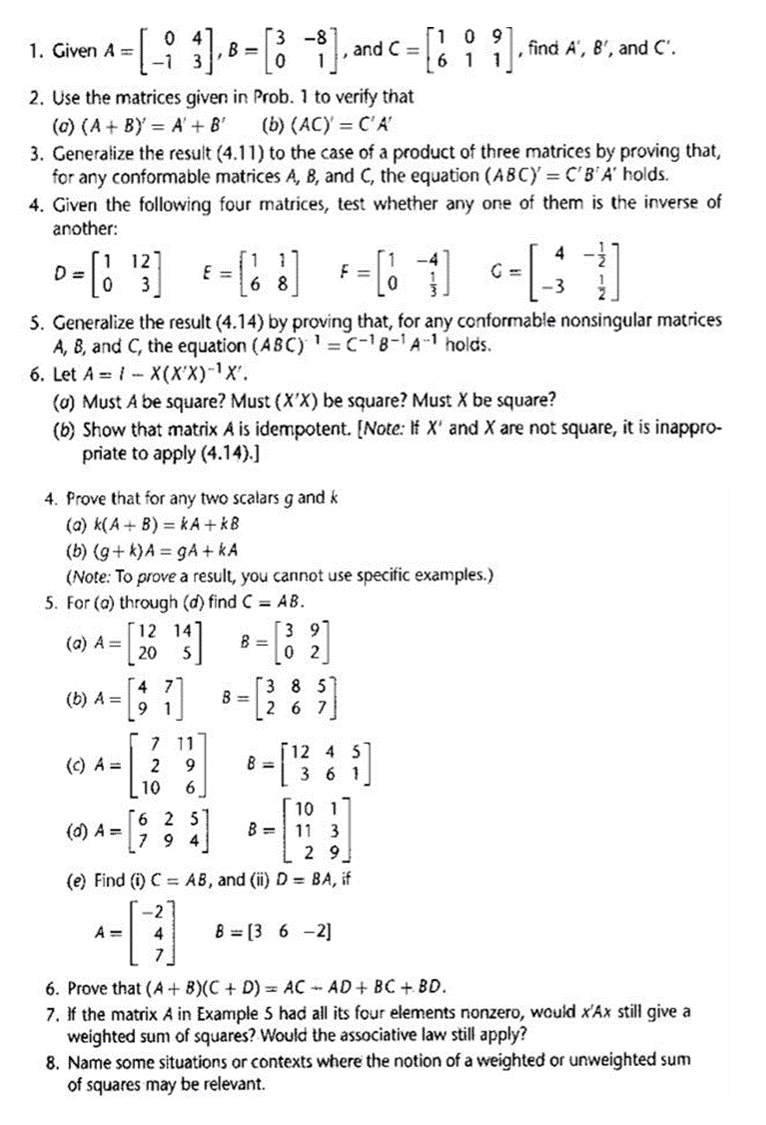
Please explain how to solve step by step and name any rules or theorems used.
The following is from Chiang's fundamental mathematical economics.
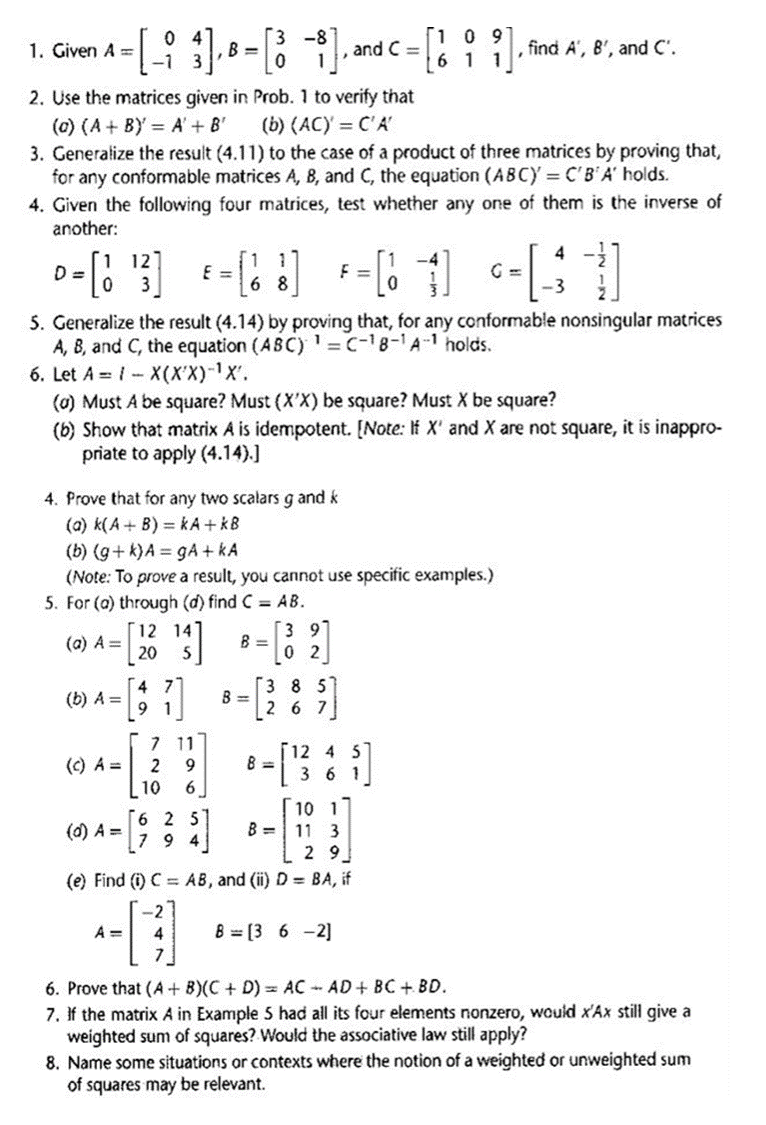
1. Given A = [_; ; ]. 8 - [8 -8]. andc =[! " ;]. find A:, 8', and C'. 2. Use the matrices given in Prob. 1 to verify that (0) (A + B)' = A' + B' (b) (AC)' = C'A' 3. Generalize the result (4.11) to the case of a product of three matrices by proving that, for any conformable matrices A, B, and C, the equation (ABC)' = C'B'A' holds. 4. Given the following four matrices, test whether any one of them is the inverse of another: D=[8 3] = = [6 8] #= [6 7] -[$ 1 ] 5. Generalize the result (4.14) by proving that, for any conformable nonsingular matrices A, B, and C, the equation (ABC) 1 = C-18-1A-1 holds. 6. Let A = 1 - X(X'X)-1X'. (0) Must A be square? Must (X'X) be square? Must X be square? (b) Show that matrix A is idempotent. [Note: If X' and X are not square, it is inappro- priate to apply (4.14).] 4. Prove that for any two scalars g and k (a) k(A + B) = KA +KB (b) (g + k)A = gA + KA (Note: To prove a result, you cannot use specific examples.) 5. For (a) through (d) find C = AB. (a ) A = 12 14 20 B = 0 2 ( b) A = B = 2 8 5 6 7 7 11 ( C) A = 2 9 8 = 12 3 4 6 10 6 10 (0) A = 2 5 9 B = 11 3 2 9 (e) Find (@) C = AB, and (ii) D = BA, if AN A = B = [3 6 -2] 6. Prove that (A + B)(C + D) = AC - AD + BC + BD. 7. If the matrix A in Example 5 had all its four elements nonzero, would x'Ax still give a weighted sum of squares? Would the associative law still apply? 8. Name some situations or contexts where the notion of a weighted or unweighted sum of squares may be relevant
Step by Step Solution
There are 3 Steps involved in it

Get step-by-step solutions from verified subject matter experts
 Study Help