







Question: please explain in detail Question 2: (20 marks) The seven-segment indicator (shown in the figure) can be used to display any of the decimal digits
please explain in detail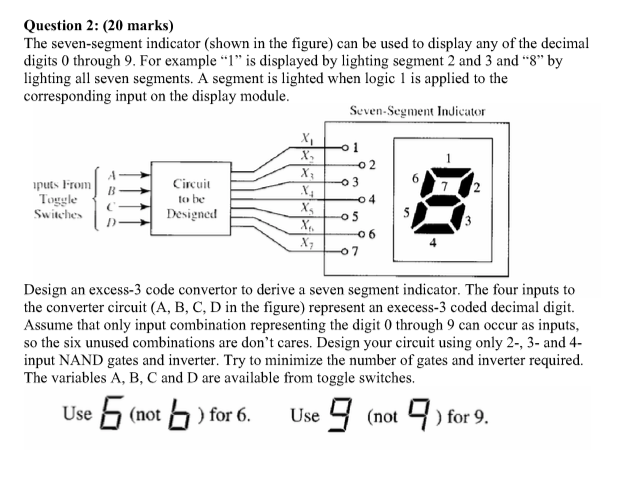
Question 2: (20 marks) The seven-segment indicator (shown in the figure) can be used to display any of the decimal digits 0 through 9. For example "1" is displayed by lighting segment 2 and 3 and "8" by lighting all seven segments. A segment is lighted when logic 1 is applied to the corresponding input on the display module Seven-Segment Indicator puts lrom Toggle SwitchesD ircu to be Designed Design an excess-3 code convertor to derive a seven segment indicator. The four inputs to the converter circuit (A, B, C, D in the figure) represent an execess-3 coded decimal digit. Assume that only input combination representing the digit 0 through 9 can occur as inputs, so the six unused combinations are don't cares. Design your circuit using only 2-, 3- and 4- input NAND gates and inverter. Try to minimize the number of gates and inverter required. The variables A, B, C and D are available from toggle switches. Use(notfor . Use(not for 9. Question 2: (20 marks) The seven-segment indicator (shown in the figure) can be used to display any of the decimal digits 0 through 9. For example "1" is displayed by lighting segment 2 and 3 and "8" by lighting all seven segments. A segment is lighted when logic 1 is applied to the corresponding input on the display module Seven-Segment Indicator puts lrom Toggle SwitchesD ircu to be Designed Design an excess-3 code convertor to derive a seven segment indicator. The four inputs to the converter circuit (A, B, C, D in the figure) represent an execess-3 coded decimal digit. Assume that only input combination representing the digit 0 through 9 can occur as inputs, so the six unused combinations are don't cares. Design your circuit using only 2-, 3- and 4- input NAND gates and inverter. Try to minimize the number of gates and inverter required. The variables A, B, C and D are available from toggle switches. Use(notfor . Use(not for 9
Step by Step Solution
There are 3 Steps involved in it

Get step-by-step solutions from verified subject matter experts
 Study Help