







Question: Please explain in detail. Thanks! Each problem presents an experiment with two random variables. For each problem: Decide whether the two random variables are independent
Please explain in detail. Thanks!
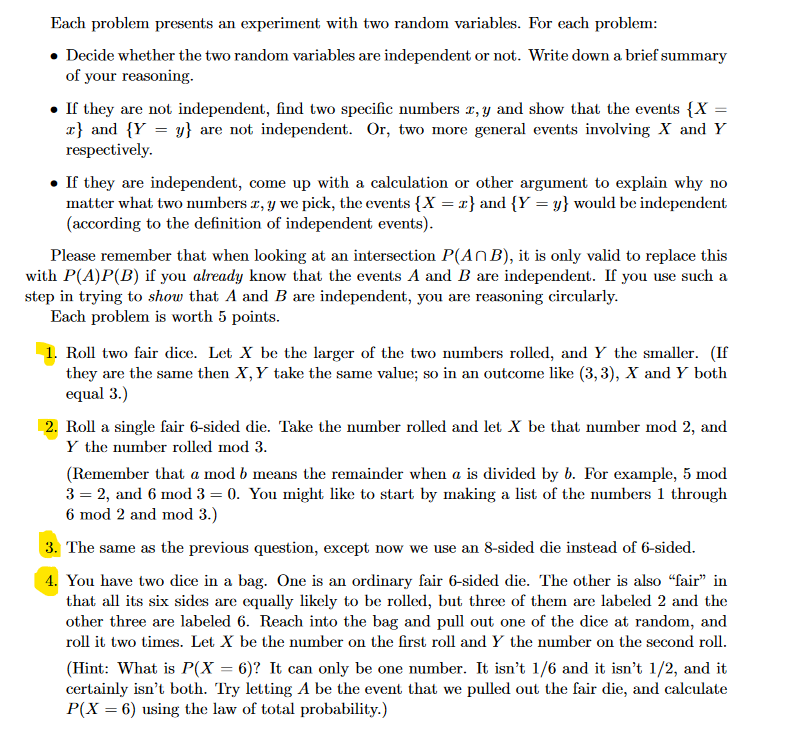
Each problem presents an experiment with two random variables. For each problem: Decide whether the two random variables are independent or not. Write down a brief summary of your reasoning If they are not independent, find two specific numbers 1, y and show that the events {X = r} and {Y = y} are not independent. Or, two more general events involving X and Y respectively. If they are independent, come up with a calculation or other argument to explain why no matter what two numbers I, y we pick, the events {X =} and {Y = y} would be independent (according to the definition of independent events). Please remember that when looking at an intersection P(ANB), it is only valid to replace this with P(A)P(B) if you already know that the events A and B are independent. If you use such a step in trying to show that A and B are independent, you are reasoning circularly. Each problem is worth 5 points. 1. Roll two fair dice. Let X be the larger of the two numbers rolled, and Y the smaller. (If they are the same then X,Y take the same value; so in an outcome like (3,3), X and Y both equal 3.) 2. Roll a single fair 6-sided die. Take the number rolled and let X be that number mod 2, and Y the number rolled mod 3. (Remember that a mod b means the remainder when a is divided by b. For example, 5 mod 3 = 2, and 6 mod 3 = 0. You might like to start by making a list of the numbers 1 through 6 mod 2 and mod 3.) 3. The same as the previous question, except now we use an 8-sided die instead of 6-sided. 4. You have two dice in a bag. One is an ordinary fair 6-sided die. The other is also fair in that all its six sides are equally likely to be rolled, but three of them are labeled 2 and the other three are labeled 6. Reach into the bag and pull out one of the dice at random, and roll it two times. Let X be the number on the first roll and Y the number on the second roll. (Hint: What is P(X = 6)? It can only be one number. It isn't 1/6 and it isn't 1/2, and it certainly isn't both. Try letting A be the event that we pulled out the fair die, and calculate P(X = 6) using the law of total probability.) a Each problem presents an experiment with two random variables. For each problem: Decide whether the two random variables are independent or not. Write down a brief summary of your reasoning If they are not independent, find two specific numbers 1, y and show that the events {X = r} and {Y = y} are not independent. Or, two more general events involving X and Y respectively. If they are independent, come up with a calculation or other argument to explain why no matter what two numbers I, y we pick, the events {X =} and {Y = y} would be independent (according to the definition of independent events). Please remember that when looking at an intersection P(ANB), it is only valid to replace this with P(A)P(B) if you already know that the events A and B are independent. If you use such a step in trying to show that A and B are independent, you are reasoning circularly. Each problem is worth 5 points. 1. Roll two fair dice. Let X be the larger of the two numbers rolled, and Y the smaller. (If they are the same then X,Y take the same value; so in an outcome like (3,3), X and Y both equal 3.) 2. Roll a single fair 6-sided die. Take the number rolled and let X be that number mod 2, and Y the number rolled mod 3. (Remember that a mod b means the remainder when a is divided by b. For example, 5 mod 3 = 2, and 6 mod 3 = 0. You might like to start by making a list of the numbers 1 through 6 mod 2 and mod 3.) 3. The same as the previous question, except now we use an 8-sided die instead of 6-sided. 4. You have two dice in a bag. One is an ordinary fair 6-sided die. The other is also fair in that all its six sides are equally likely to be rolled, but three of them are labeled 2 and the other three are labeled 6. Reach into the bag and pull out one of the dice at random, and roll it two times. Let X be the number on the first roll and Y the number on the second roll. (Hint: What is P(X = 6)? It can only be one number. It isn't 1/6 and it isn't 1/2, and it certainly isn't both. Try letting A be the event that we pulled out the fair die, and calculate P(X = 6) using the law of total probability.) a
Step by Step Solution
There are 3 Steps involved in it

Get step-by-step solutions from verified subject matter experts
 Study Help