







Question: please explain it give more details , thanks Problem 2 Your task is to estimate a demand equation for automobiles. The dependent variable is the
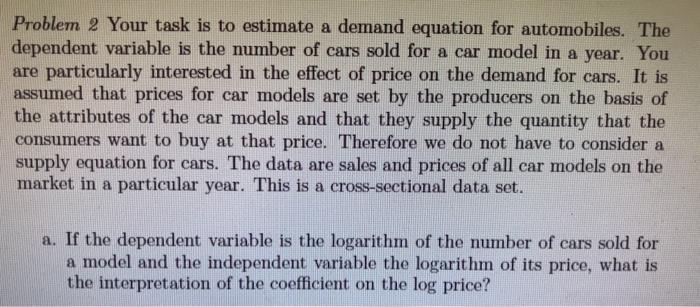
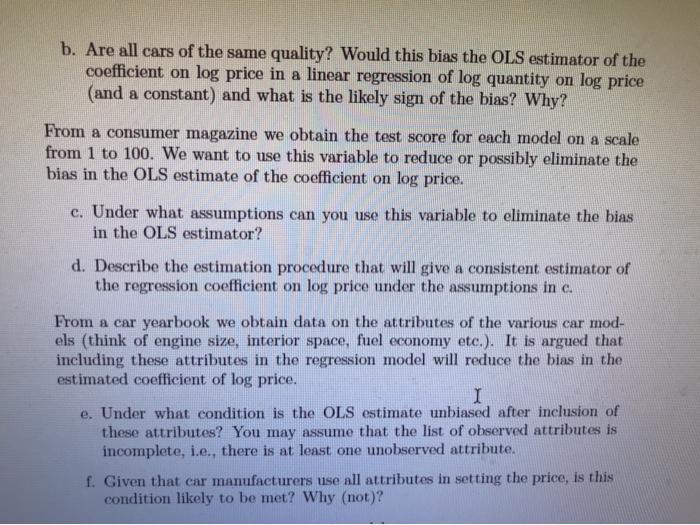
Problem 2 Your task is to estimate a demand equation for automobiles. The dependent variable is the number of cars sold for a car model in a year. You are particularly interested in the effect of price on the demand for cars. It is assumed that prices for car models are set by the producers on the basis of the attributes of the car models and that they supply the quantity that the consumers want to buy at that price. Therefore we do not have to consider a supply equation for cars. The data are sales and prices of all car models on the market in a particular year. This is a cross-sectional data set. a. If the dependent variable is the logarithm of the number of cars sold for a model and the independent variable the logarithm of its price, what is the interpretation of the coefficient on the log price? b. Are all cars of the same quality? Would this bias the OLS estimator of the coefficient on log price in a linear regression of log quantity on log price (and a constant) and what is the likely sign of the bias? Why? From a consumer magazine we obtain the test score for each model on a scale from 1 to 100. We want to use this variable to reduce or possibly eliminate the bias in the OLS estimate of the coefficient on log price. c. Under what assumptions can you use this variable to eliminate the bias in the OLS estimator? d. Describe the estimation procedure that will give a consistent estimator of the regression coefficient on log price under the assumptions in c. From a car yearbook we obtain data on the attributes of the various car mod- els (think of engine size, interior space, fuel economy etc.). It is argued that including these attributes in the regression model will reduce the bias in the estimated coefficient of log price. I e. Under what condition is the OLS estimate unbiased after inclusion of these attributes? You may assume that the list of observed attributes is incomplete, i.e., there is at least one unobserved attribute. f. Given that car manufacturers use all attributes in setting the price, is this condition likely to be met? Why (not)? Problem 2 Your task is to estimate a demand equation for automobiles. The dependent variable is the number of cars sold for a car model in a year. You are particularly interested in the effect of price on the demand for cars. It is assumed that prices for car models are set by the producers on the basis of the attributes of the car models and that they supply the quantity that the consumers want to buy at that price. Therefore we do not have to consider a supply equation for cars. The data are sales and prices of all car models on the market in a particular year. This is a cross-sectional data set. a. If the dependent variable is the logarithm of the number of cars sold for a model and the independent variable the logarithm of its price, what is the interpretation of the coefficient on the log price? b. Are all cars of the same quality? Would this bias the OLS estimator of the coefficient on log price in a linear regression of log quantity on log price (and a constant) and what is the likely sign of the bias? Why? From a consumer magazine we obtain the test score for each model on a scale from 1 to 100. We want to use this variable to reduce or possibly eliminate the bias in the OLS estimate of the coefficient on log price. c. Under what assumptions can you use this variable to eliminate the bias in the OLS estimator? d. Describe the estimation procedure that will give a consistent estimator of the regression coefficient on log price under the assumptions in c. From a car yearbook we obtain data on the attributes of the various car mod- els (think of engine size, interior space, fuel economy etc.). It is argued that including these attributes in the regression model will reduce the bias in the estimated coefficient of log price. I e. Under what condition is the OLS estimate unbiased after inclusion of these attributes? You may assume that the list of observed attributes is incomplete, i.e., there is at least one unobserved attribute. f. Given that car manufacturers use all attributes in setting the price, is this condition likely to be met? Why (not)
Step by Step Solution
There are 3 Steps involved in it

Get step-by-step solutions from verified subject matter experts
 Study Help