







Question: please explain. Let us consider the bounded-buffer problem in which the buffer pool consists of 2 buffers. Initially all buffers are empty. There are 3
please explain.
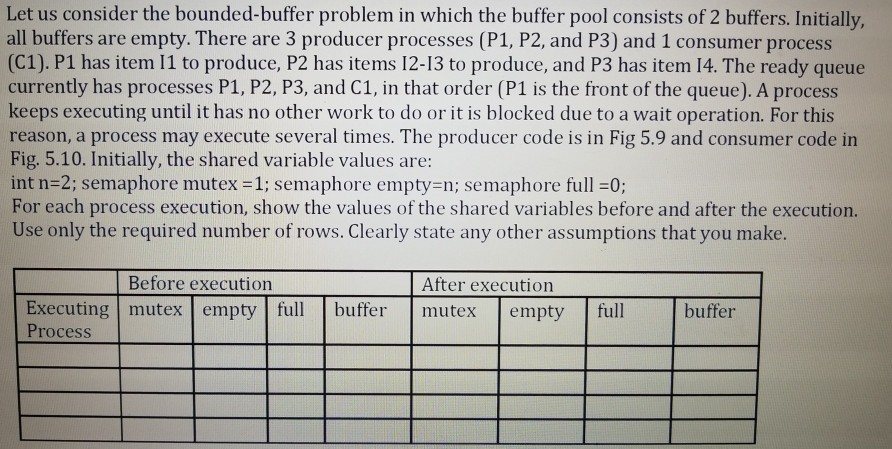
Let us consider the bounded-buffer problem in which the buffer pool consists of 2 buffers. Initially all buffers are empty. There are 3 producer processes (P1, P2, and P3) and 1 consumer process (C1). P1 has item I1 to produce, P2 has items 12-13 to produce, and P3 has item 14. The ready queue currently has processes P1, P2, P3, and C1, in that order (P1 is the front of the queue). A process keeps executing until it has no other work to do or it is blocked due to a wait operation. For this reason, a process may execute several times. The producer code is in Fig 5.9 and consumer code in Fig. 5.10. Initially, the shared variable values are: int n-2; semaphore mutex-1; semaphore empty-n; semaphore full-0; For each process execution, show the values of the shared variables before and after the execution. Use only the required number of rows. Clearly state any other assumptions that you make. Before execution After execution Executing mutex empty full buffer mutex empty full Process buffer
Step by Step Solution
There are 3 Steps involved in it

Get step-by-step solutions from verified subject matter experts
 Study Help