







Question: Please explain only 2part(c,d,e,f). Explain all steps in details Sampling and Dynamic Bayes Nets Many people would prefer to eat ice cream on a sunny
Please explain only 2part(c,d,e,f). Explain all steps in details
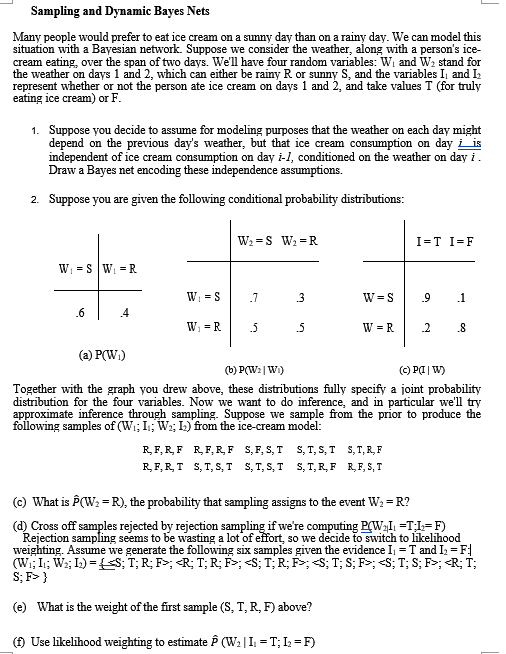
Sampling and Dynamic Bayes Nets Many people would prefer to eat ice cream on a sunny day than on a rainy day. We can model this situation with a Bayesian network. Suppose we consider the weather, along with a person's ice- cream eating, over the span of two days. We'll have four random variables: W. and W2 stand for the weather on days 1 and 2, which can either be rainy R or sunny S, and the variables I and I represent whether or not the person ate ice cream on days 1 and 2, and take values T (for truly eating ice cream) or F. 1. Suppose you decide to assume for modeling purposes that the weather on each day might depend on the previous day's weather, but that ice cream consumption on day iis independent of ice cream consumption on day i-l, conditioned on the weather on day i . Draw a Bayes net encoding these independence assumptions. 2. Suppose you are given the following conditional probability distributions: W2=S W2=R I=T I= F WES WER W = S 7 3 W=S 9 .1 .6 4 WER 5 5 WER 2 .8 (a) P(WI) (6) P(W2W) () PIW) Together with the graph you drew above, these distributions fully specify a joint probability distribution for the four variables. Now we want to do inference, and in particular we'll try approximate inference through sampling. Suppose we sample from the prior to produce the following samples of (W;1; W.; Ik) from the ice-cream model: RF, RF RF,R,F S, F, S, T S,T, S,T S,T,R,F RF, RTS,T, S.T S,T, S,T S,T,R,FR,F,S, T = c) What is (W2 =R), the probability that sampling assigns to the event W2=R? (d) Cross off samples rejected by rejection sampling if we're computing PW I =T:I:= F) Rejection sampling seems to be wasting a lot of effort, so we decide to switch to likelihood weighting. Assume we generate the following six samples given the evidence I = T and I2 =F: (W;I; W2; 1x) =S;T;R;F>; ; S;T;S;F>; ;
Step by Step Solution
There are 3 Steps involved in it

Get step-by-step solutions from verified subject matter experts
 Study Help