







Question: Please Explain Problem 5d (break it down). 5. For the following questions, assume we are playing the card game WAR. The deck of cards we
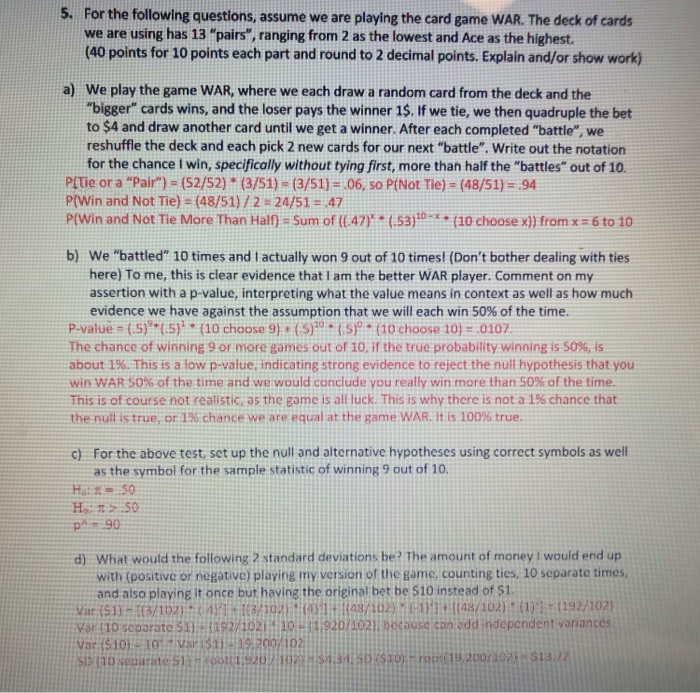
5. For the following questions, assume we are playing the card game WAR. The deck of cards we are using has 13 "pairs", ranging from 2 as the lowest and Ace as the highest (40 points for 10 points each part and round to 2 decimal points. Explain and/or show work) a) We play the game WAR, where we each draw a random card from the deck and the "bigger" cards wins, and the loser pays the winner 15. If we tie, we then quadruple the bet to $4 and draw another card until we get a winner. After each completed "battle", we reshuffle the deck and each pick 2 new cards for our next "battle". Write out the notation for the chance I win, specifically without tying first, more than half the "battles" out of 10. P(Tie or a "Pair") (S2/52) (3/51)-(3/51)-06, so P(Not Tie) (48/51) 94 P(Win and Not Tie)-(48/51/ 2 #24/51-47 PiWin and Not Tie More Than Half) Sum of (47) (531 (10 choose x)) from x 6 to 10 b) We "battled" 10 times and I actually won 9 out of 10 times! (Don't bother dealing with ties here) To me, this is clear evidence that I am the better WAR player. Comment on my assertion with a p-value, interpreting what the value means in context as well as how much evidence we have against the assumption that we will each win 50% of the time. P-value = (5(5)1(10 choose 91+ (S)10 * (SP . (10 choose 10) :0107 The chance of winning 9 or more games out of 10, if the true probability winning is 50%, is about 1%. This is a low p-value, indicating strong evidence to reject the null hypothesis that win wAR 50% of the time and we would conclude you really win more than 50% of the time. This is of course not realistic, as the game is all luck. This is why there is not a 1% chance that the nuit is true, or 1% chance we are equal at the game wAR. It is 100% true For the above test, set up the null and alternative hypotheses using correct symbols as well as the symbol for the sample statistic of winning 9 out of 10. c) d) What would the following 2 standard deviations be? The amount of money I would end up with (positive or negative) playing my version of the game, counting ties, 10 separate times, and also playing it once but having the original bet be $10 instead of $1 var (10 soparate $4)+1492/402401920/4021 885 n oddindependent voriances Var($10 1OVrSH9-2012 5. For the following questions, assume we are playing the card game WAR. The deck of cards we are using has 13 "pairs", ranging from 2 as the lowest and Ace as the highest (40 points for 10 points each part and round to 2 decimal points. Explain and/or show work) a) We play the game WAR, where we each draw a random card from the deck and the "bigger" cards wins, and the loser pays the winner 15. If we tie, we then quadruple the bet to $4 and draw another card until we get a winner. After each completed "battle", we reshuffle the deck and each pick 2 new cards for our next "battle". Write out the notation for the chance I win, specifically without tying first, more than half the "battles" out of 10. P(Tie or a "Pair") (S2/52) (3/51)-(3/51)-06, so P(Not Tie) (48/51) 94 P(Win and Not Tie)-(48/51/ 2 #24/51-47 PiWin and Not Tie More Than Half) Sum of (47) (531 (10 choose x)) from x 6 to 10 b) We "battled" 10 times and I actually won 9 out of 10 times! (Don't bother dealing with ties here) To me, this is clear evidence that I am the better WAR player. Comment on my assertion with a p-value, interpreting what the value means in context as well as how much evidence we have against the assumption that we will each win 50% of the time. P-value = (5(5)1(10 choose 91+ (S)10 * (SP . (10 choose 10) :0107 The chance of winning 9 or more games out of 10, if the true probability winning is 50%, is about 1%. This is a low p-value, indicating strong evidence to reject the null hypothesis that win wAR 50% of the time and we would conclude you really win more than 50% of the time. This is of course not realistic, as the game is all luck. This is why there is not a 1% chance that the nuit is true, or 1% chance we are equal at the game wAR. It is 100% true For the above test, set up the null and alternative hypotheses using correct symbols as well as the symbol for the sample statistic of winning 9 out of 10. c) d) What would the following 2 standard deviations be? The amount of money I would end up with (positive or negative) playing my version of the game, counting ties, 10 separate times, and also playing it once but having the original bet be $10 instead of $1 var (10 soparate $4)+1492/402401920/4021 885 n oddindependent voriances Var($10 1OVrSH9-2012
Step by Step Solution
There are 3 Steps involved in it

Get step-by-step solutions from verified subject matter experts
 Study Help