







Question: Please explain the answer step by step in details and make sure cover all the reasoning and the theory so I can understand, dont simply
Please explain the answer step by step in details and make sure cover all the reasoning and the theory so I can understand, dont simply copy the answer I provided, thanks
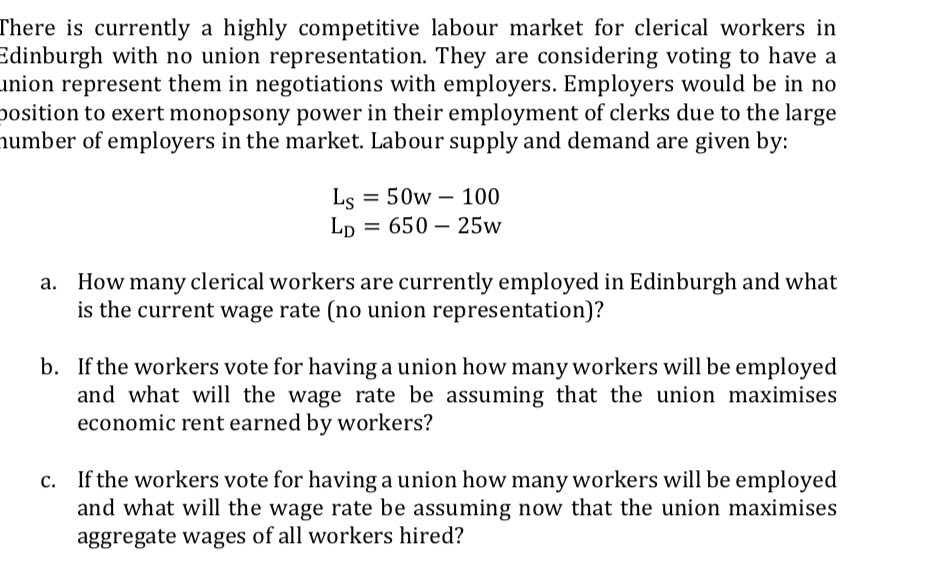
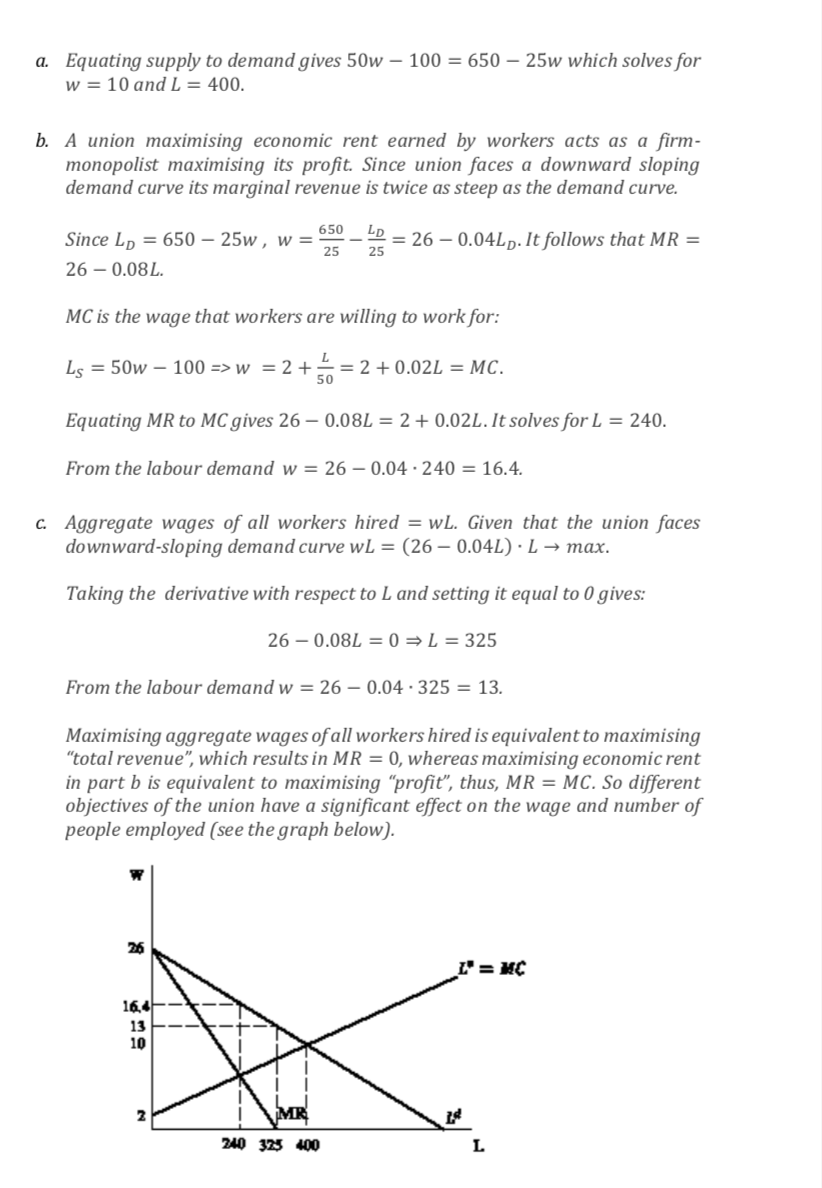
l'here is currently a highly competitive labour market for clerical workers in Edinburgh with no union representation. They are considering voting to have a .lI'liOIl represent them in negotiations with employers. Employers would be in no Josition to exert monopsony power in their employment of clerks due to the large number of employers in the market. Labour supply and demand are given by: L8 = 50w 100 Ln = 650 - 25w a. How many clerical workers are currently employed in Edinburgh and what is the current wage rate [no union representation]? b. If the workers vote for having a union how many workers will be employed and what will the wage rate be assuming that the union maximises economic rent earned by workers? c. If the workers vote for having a union how many workers will be employed and what will the wage rate be assuming now that the union maximises aggregate wages of all workers hired? a. Equating supply to demand gives 50w - 100 = 650 - 25w which solves for w = 10 and L = 400. b. A union maximising economic rent earned by workers acts as a firm- monopolist maximising its profit. Since union faces a downward sloping demand curve its marginal revenue is twice as steep as the demand curve. Since LD = 650 - 25w , w =- 650 25 25 LD = 26 - 0.04LD. It follows that MR = 26 - 0.08L. MC is the wage that workers are willing to work for: Ls = 50w - 100 => w = 2 += = 2 + 0.02L = MC. Equating MR to MC gives 26 - 0.08L = 2 + 0.02L. It solves for L = 240. From the labour demand w = 26 - 0.04 . 240 = 16.4. c. Aggregate wages of all workers hired = wL. Given that the union faces downward-sloping demand curve wl = (26 - 0.04L) . L - max. Taking the derivative with respect to L and setting it equal to 0 gives: 26 -0.08L = 0 = L = 325 From the labour demand w = 26 - 0.04 . 325 = 13. Maximising aggregate wages of all workers hired is equivalent to maximising "total revenue", which results in MR = 0, whereas maximising economic rent in part b is equivalent to maximising "profit", thus, MR = MC. So different objectives of the union have a significant effect on the wage and number of people employed (see the graph below). 26 L' = HC 16.4 13 10 2 MR 240 325 400
Step by Step Solution
There are 3 Steps involved in it

Get step-by-step solutions from verified subject matter experts
 Study Help