



Question: Please explain the formula, and how did the figures such as 50 percent coke from? thanks where K* and L* again denote the minimum-cost values
Please explain the formula, and how did the figures such as 50 percent coke from? thanks
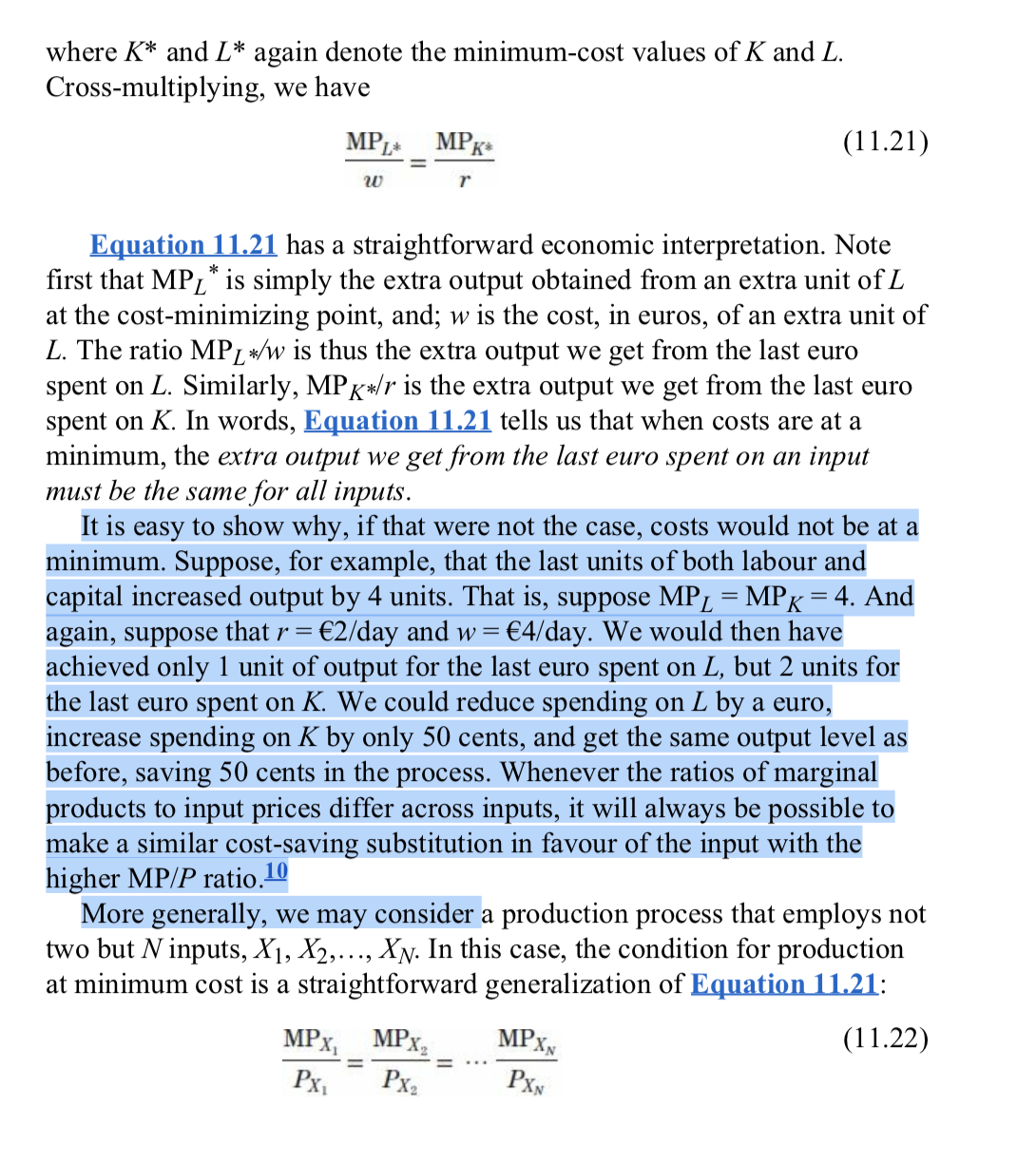
where K* and L* again denote the minimum-cost values of K and L. Cross-multiplying, we have MPLA MPK* (11.21) Equation 11.21 has a straightforward economic interpretation. Note first that MP_" is simply the extra output obtained from an extra unit of L at the cost-minimizing point, and; w is the cost, in euros, of an extra unit of L. The ratio MPL*/w is thus the extra output we get from the last euro spent on L. Similarly, MPx*/r is the extra output we get from the last euro spent on K. In words, Equation 11.21 tells us that when costs are at a minimum, the extra output we get from the last euro spent on an input must be the same for all inputs. It is easy to show why, if that were not the case, costs would not be at a minimum. Suppose, for example, that the last units of both labour and capital increased output by 4 units. That is, suppose MPL = MPK = 4. And again, suppose that r = E2/day and w = E4/day. We would then have achieved only 1 unit of output for the last euro spent on L, but 2 units for the last euro spent on K. We could reduce spending on L by a euro, increase spending on K by only 50 cents, and get the same output level as before, saving 50 cents in the process. Whenever the ratios of marginal products to input prices differ across inputs, it will always be possible to make a similar cost-saving substitution in favour of the input with the higher MP/P ratio. 10 More generally, we may consider a production process that employs not two but N inputs, X1, X2,..., XN. In this case, the condition for production at minimum cost is a straightforward generalization of Equation 11.21: MP X MPX, MP XN (1 1.22) . . . PX1 PX2 PX
Step by Step Solution
There are 3 Steps involved in it

Get step-by-step solutions from verified subject matter experts