







Question: Please explain What you have learned about your decision making based on your MBTI report and SF type. It's been a little while,
Please explain "What you have learned about your decision making" based on your MBTI report and SF type.
It's been a little while, so here are the 4 parts of the experiential learning cycle:
- The Experience - consider what did you do OR read OR watch OR listen to etc. Describe the learning experience related to decision making- what happened?
- Analyse & Reflect - remember the experience and take note of it (reflect) what does your reflection mean? In this phase consider things like ...how did you feel? OR What went well? OR What didn't go as expected? Then once you've captured this, what does it mean for you? Analyse it based upon information you had before, and new information from the course. - again, remember that this is to be about a learning experience regarding decision making.
- Context and Change - Here you draw conclusions and make judgments about what you knew before vs what you have now analysed from the experience. You draw conclusions and put meaning to them. Why is this new thing that you understand important? What should you do about it? That is, what will you change as a result of learning this new thing? - so what have you concluded your new insights about your decision making now that you've had this experience.
- Action & Try Again - what are the specific practical steps you will take to make sure that you make the change you intend in step 3? For example, if you feel you need to take more time to consider information before making a decision, what will you actually do to make this happen? Ask yourself some extra questions? Talk to someone else to check assumptions? What is the actionable, practical plan?
Be sure to answer each of the four parts above AND include application of course concepts, experiences, or content into the response. If you do not relate your answer to course work, you don't earn marks for this question. Don't forget to cite your work.
You can choose anything from this lesson. It can be an individual idea or experience, or something related to your team work or team experiences and decision making.
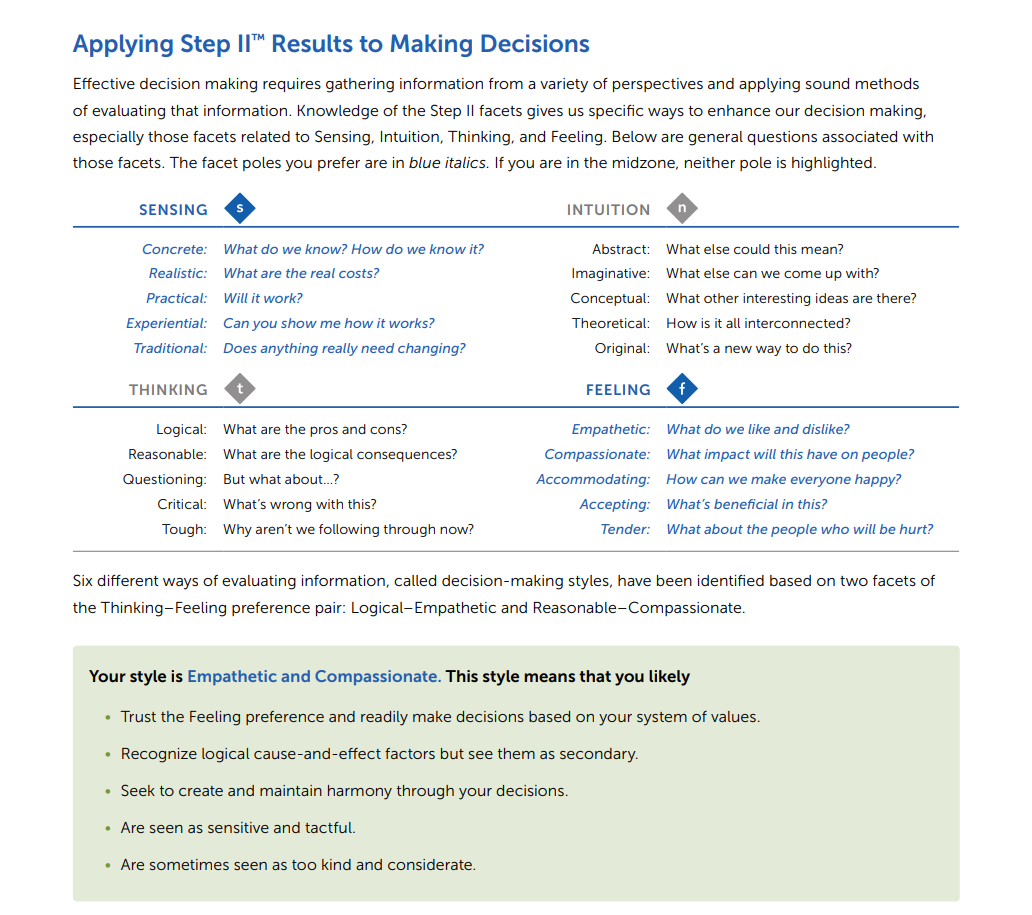
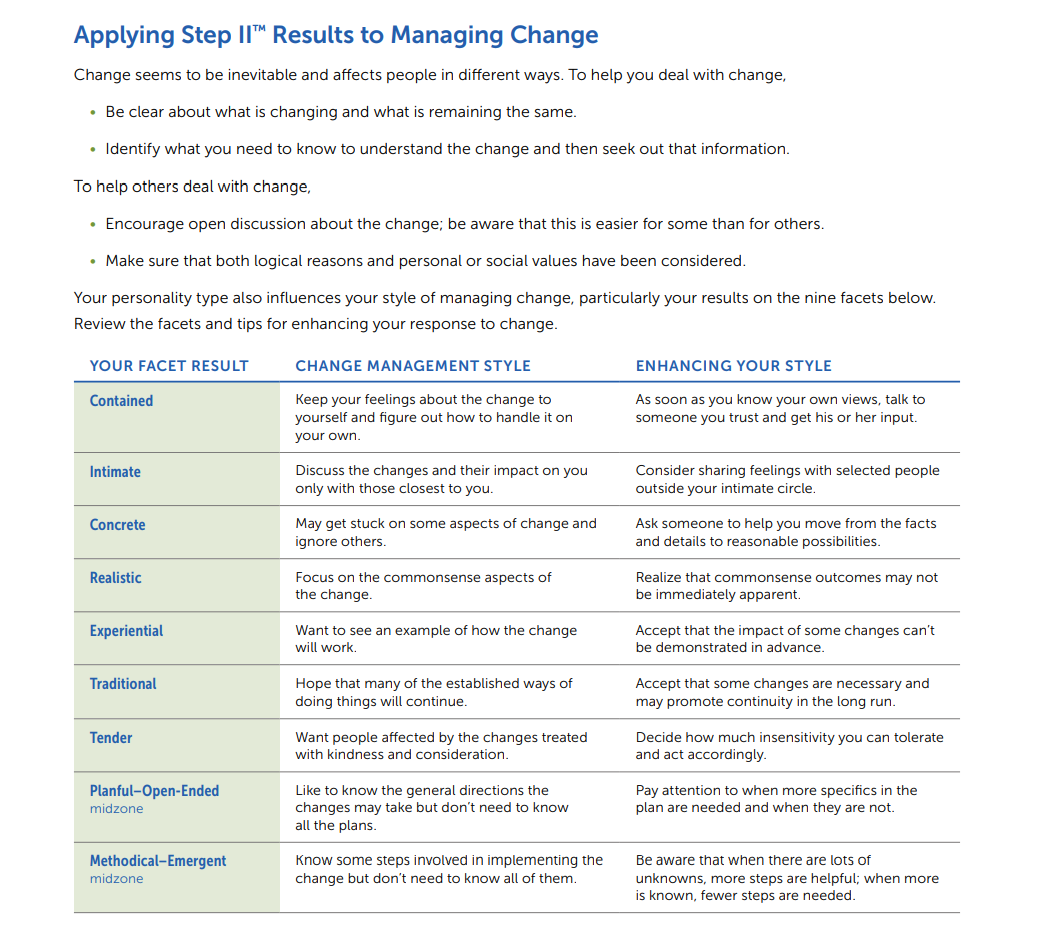
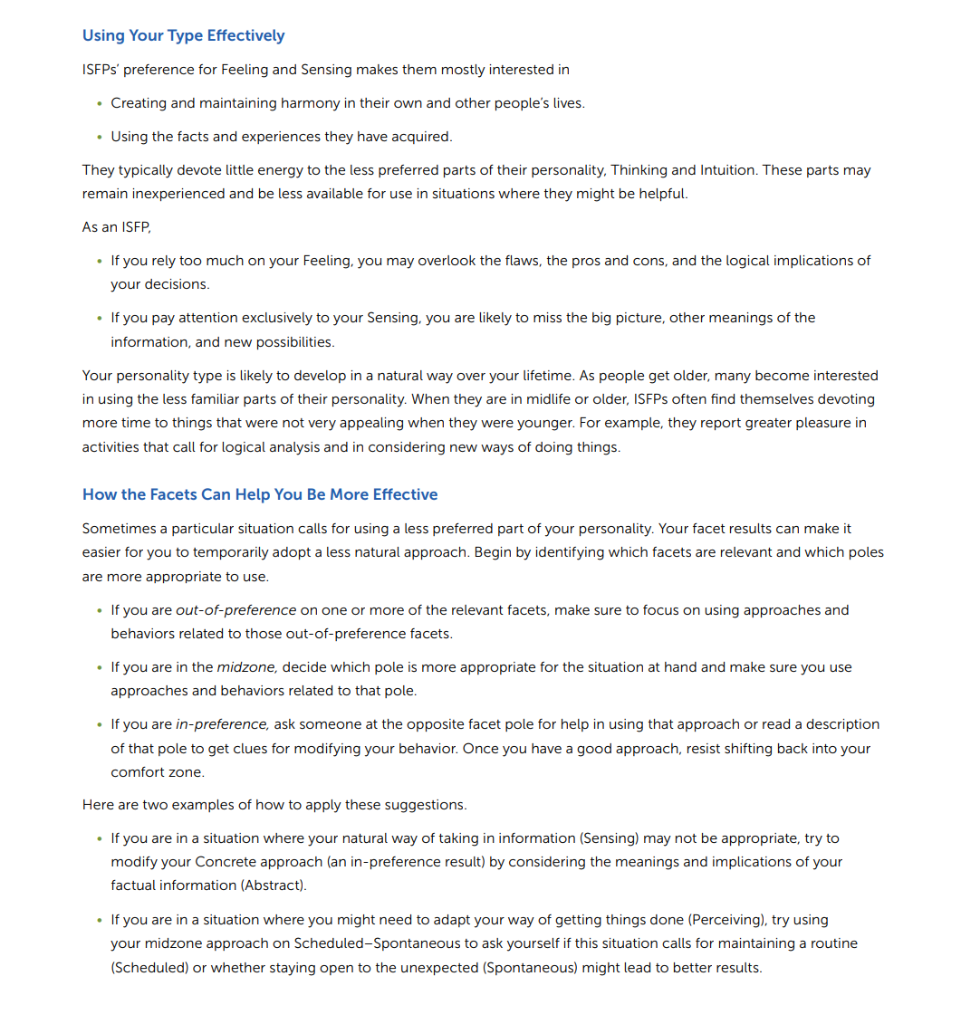
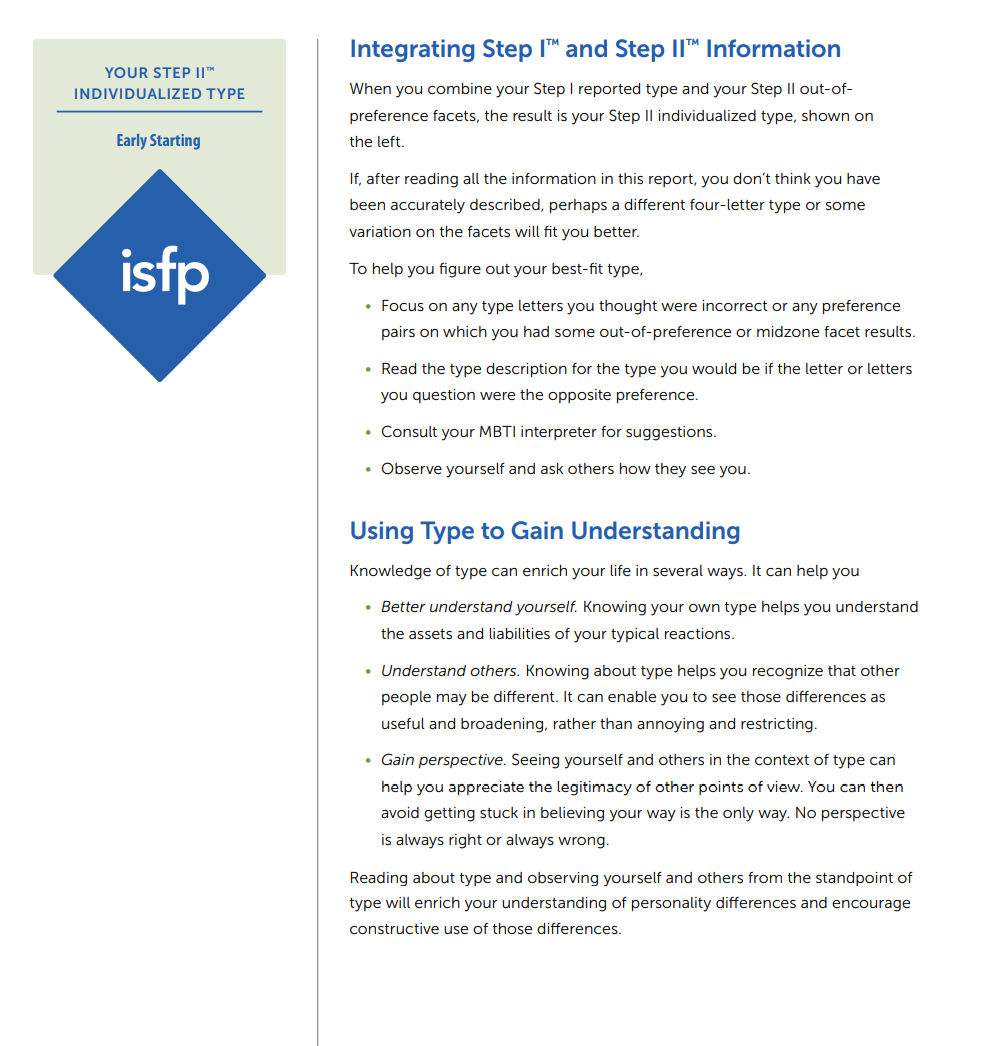
Applying Step II Results to Making Decisions Effective decision making requires gathering information from a variety of perspectives and applying sound methods of evaluating that information. Knowledge of the Step Il facets gives us specific ways to enhance our decision making, especially those facets related to Sensing, Intuition, Thinking, and Feeling. Below are general questions associated with those facets. The facet poles you prefer are in blue italics. If you are in the midzone, neither pole is highlighted. SENSING INTUITION Concrete: What do we know? How do we know it? Realistic: What are the real costs? Practical: Will it work? Experiential: Can you show me how it works? Traditional: Does anything really need changing? Abstract: What else could this mean? Imaginative: What else can we come up with? Conceptual: What other interesting ideas are there? Theoretical: How is it all interconnected? Original: What's a new way to do this? THINKING FEELING Logical: What are the pros and cons? Reasonable: What are the logical consequences? Questioning: But what about...? Critical: What's wrong with this? Tough: Why aren't we following through now? Empathetic: What do we like and dislike? Compassionate: What impact will this have on people? Accommodating: How can we make everyone happy? Accepting: What's beneficial in this? Tender: What about the people who will be hurt? Six different ways of evaluating information, called decision-making styles, have been identified based on two facets of the Thinking-Feeling preference pair: Logical-Empathetic and Reasonable-Compassionate. Your style is Empathetic and Compassionate. This style means that you likely Trust the Feeling preference and readily make decisions based on your system of values. Recognize logical cause-and-effect factors but see them as secondary. Seek to create and maintain harmony through your decisions. Are seen as sensitive and tactful. Are sometimes seen as too kind and considerate. Applying Step II" Results to Managing Change Change seems to be inevitable and affects people in different ways. To help you deal with change, Be clear about what is changing and what is remaining the same. Identify what you need to know to understand the change and then seek out that information. To help others deal with change, Encourage open discussion about the change; be aware that this is easier for some than for others. Make sure that both logical reasons and personal or social values have been considered. Your personality type also influences your style of managing change, particularly your results on the nine facets below. Review the facets and tips for enhancing your response to change. YOUR FACET RESULT CHANGE MANAGEMENT STYLE ENHANCING YOUR STYLE Contained Keep your feelings about the change to yourself and figure out how to handle it on your own As soon as you know your own views, talk to someone you trust and get his or her input. Intimate Discuss the changes and their impact on you only with those closest to you. Consider sharing feelings with selected people outside your intimate circle, Concrete May get stuck on some aspects of change and ignore others. Ask someone to help you move from the facts and details to reasonable possibilities. Realistic Focus on the commonsense aspects of the change. Realize that commonsense outcomes may not be immediately apparent. Experiential Want to see an example of how the change will work. Accept that the impact of some changes can't be demonstrated in advance. Traditional Hope that many of the established ways of doing things will continue. Accept that some changes are necessary and may promote continuity in the long run. Tender Want people affected by the changes treated with kindness and consideration. Decide how much insensitivity you can tolerate and act accordingly. Planful-Open-Ended midzone Like to know the general directions the changes may take but don't need to know all the plans. Pay attention to when more specifics in the plan are needed and when they are not. Methodical-Emergent midzone Know some steps involved in implementing the change but don't need to know all of them. Be aware that when there are lots of unknowns, more steps are helpful; when more is known, fewer steps are needed. Using Your Type Effectively ISFPs' preference for Feeling and Sensing makes them mostly interested in Creating and maintaining harmony in their own and other people's lives. Using the facts and experiences they have acquired. They typically devote little energy to the less preferred parts of their personality, Thinking and Intuition. These parts may remain inexperienced and be less available for use in situations where they might be helpful. As an ISFP, If you rely too much on your Feeling, you may overlook the flaws, the pros and cons, and the logical implications of your decisions. If you pay attention exclusively to your Sensing, you are likely to miss the big picture, other meanings of the information, and new possibilities. Your personality type is likely to develop in a natural way over your lifetime. As people get older, many become interested in using the less familiar parts of their personality. When they are in midlife or older, ISFPs often find themselves devoting more time to things that were not very appealing when they were younger. For example, they report greater pleasure in activities that call for logical analysis and in considering new ways of doing things. How the Facets Can Help You Be More Effective Sometimes a particular situation calls for using a less preferred part of your personality. Your facet results can make it easier for you to temporarily adopt a less natural approach. Begin by identifying which facets are relevant and which poles are more appropriate to use. If you are out-of-preference on one or more of the relevant facets, make sure to focus on using approaches and behaviors related to those out-of-preference facets. If you are in the midzone, decide which pole is more appropriate for the situation at hand and make sure you use approaches and behaviors related to that pole. If you are in-preference, ask someone at the opposite facet pole for help in using that approach or read a description of that pole to get clues for modifying your behavior. Once you have a good approach, resist shifting back into your comfort zone. Here are two examples of how to apply these suggestions. If you are in a situation where your natural way of taking in information (Sensing) may not be appropriate, try to modify your Concrete approach (an in-preference result) by considering the meanings and implications of your factual information (Abstract). If you are in a situation where you might need to adapt your way of getting things done (Perceiving), try using your midzone approach on Scheduled-Spontaneous to ask yourself if this situation calls for maintaining a routine (Scheduled) or whether staying open to the unexpected (Spontaneous) might lead to better results. Integrating Step IT and Step II Information YOUR STEP 11 INDIVIDUALIZED TYPE When you combine your Step I reported type and your Step II out-of- preference facets, the result is your Step Il individualized type, shown on the left. Early Starting If, after reading all the information in this report, you don't think you have been accurately described, perhaps a different four-letter type or some variation on the facets will fit you better. isfp To help you figure out your best-fit type, Focus on any type letters you thought were incorrect or any preference pairs on which you had some out-of-preference or midzone facet results. Read the type description for the type you would be if the letter or letters you question were the opposite preference. Consult your MBTI interpreter for suggestions. Observe yourself and ask others how they see you. Using Type to Gain Understanding Knowledge of type can enrich your life in several ways. It can help you Better understand yourself. Knowing your own type helps you understand the assets and liabilities of your typical reactions. Understand others. Knowing about type helps you recognize that other people may be different. It can enable you to see those differences as useful and broadening, rather than annoying and restricting. Gain perspective. Seeing yourself and others in the context of type can help you appreciate the legitimacy of other points of view. You can then avoid getting stuck in believing your way is the only way. No perspective is always right or always wrong. Reading about type and observing yourself and others from the standpoint of type will enrich your understanding of personality differences and encourage constructive use of those differences. Applying Step II Results to Making Decisions Effective decision making requires gathering information from a variety of perspectives and applying sound methods of evaluating that information. Knowledge of the Step Il facets gives us specific ways to enhance our decision making, especially those facets related to Sensing, Intuition, Thinking, and Feeling. Below are general questions associated with those facets. The facet poles you prefer are in blue italics. If you are in the midzone, neither pole is highlighted. SENSING INTUITION Concrete: What do we know? How do we know it? Realistic: What are the real costs? Practical: Will it work? Experiential: Can you show me how it works? Traditional: Does anything really need changing? Abstract: What else could this mean? Imaginative: What else can we come up with? Conceptual: What other interesting ideas are there? Theoretical: How is it all interconnected? Original: What's a new way to do this? THINKING FEELING Logical: What are the pros and cons? Reasonable: What are the logical consequences? Questioning: But what about...? Critical: What's wrong with this? Tough: Why aren't we following through now? Empathetic: What do we like and dislike? Compassionate: What impact will this have on people? Accommodating: How can we make everyone happy? Accepting: What's beneficial in this? Tender: What about the people who will be hurt? Six different ways of evaluating information, called decision-making styles, have been identified based on two facets of the Thinking-Feeling preference pair: Logical-Empathetic and Reasonable-Compassionate. Your style is Empathetic and Compassionate. This style means that you likely Trust the Feeling preference and readily make decisions based on your system of values. Recognize logical cause-and-effect factors but see them as secondary. Seek to create and maintain harmony through your decisions. Are seen as sensitive and tactful. Are sometimes seen as too kind and considerate. Applying Step II" Results to Managing Change Change seems to be inevitable and affects people in different ways. To help you deal with change, Be clear about what is changing and what is remaining the same. Identify what you need to know to understand the change and then seek out that information. To help others deal with change, Encourage open discussion about the change; be aware that this is easier for some than for others. Make sure that both logical reasons and personal or social values have been considered. Your personality type also influences your style of managing change, particularly your results on the nine facets below. Review the facets and tips for enhancing your response to change. YOUR FACET RESULT CHANGE MANAGEMENT STYLE ENHANCING YOUR STYLE Contained Keep your feelings about the change to yourself and figure out how to handle it on your own As soon as you know your own views, talk to someone you trust and get his or her input. Intimate Discuss the changes and their impact on you only with those closest to you. Consider sharing feelings with selected people outside your intimate circle, Concrete May get stuck on some aspects of change and ignore others. Ask someone to help you move from the facts and details to reasonable possibilities. Realistic Focus on the commonsense aspects of the change. Realize that commonsense outcomes may not be immediately apparent. Experiential Want to see an example of how the change will work. Accept that the impact of some changes can't be demonstrated in advance. Traditional Hope that many of the established ways of doing things will continue. Accept that some changes are necessary and may promote continuity in the long run. Tender Want people affected by the changes treated with kindness and consideration. Decide how much insensitivity you can tolerate and act accordingly. Planful-Open-Ended midzone Like to know the general directions the changes may take but don't need to know all the plans. Pay attention to when more specifics in the plan are needed and when they are not. Methodical-Emergent midzone Know some steps involved in implementing the change but don't need to know all of them. Be aware that when there are lots of unknowns, more steps are helpful; when more is known, fewer steps are needed. Using Your Type Effectively ISFPs' preference for Feeling and Sensing makes them mostly interested in Creating and maintaining harmony in their own and other people's lives. Using the facts and experiences they have acquired. They typically devote little energy to the less preferred parts of their personality, Thinking and Intuition. These parts may remain inexperienced and be less available for use in situations where they might be helpful. As an ISFP, If you rely too much on your Feeling, you may overlook the flaws, the pros and cons, and the logical implications of your decisions. If you pay attention exclusively to your Sensing, you are likely to miss the big picture, other meanings of the information, and new possibilities. Your personality type is likely to develop in a natural way over your lifetime. As people get older, many become interested in using the less familiar parts of their personality. When they are in midlife or older, ISFPs often find themselves devoting more time to things that were not very appealing when they were younger. For example, they report greater pleasure in activities that call for logical analysis and in considering new ways of doing things. How the Facets Can Help You Be More Effective Sometimes a particular situation calls for using a less preferred part of your personality. Your facet results can make it easier for you to temporarily adopt a less natural approach. Begin by identifying which facets are relevant and which poles are more appropriate to use. If you are out-of-preference on one or more of the relevant facets, make sure to focus on using approaches and behaviors related to those out-of-preference facets. If you are in the midzone, decide which pole is more appropriate for the situation at hand and make sure you use approaches and behaviors related to that pole. If you are in-preference, ask someone at the opposite facet pole for help in using that approach or read a description of that pole to get clues for modifying your behavior. Once you have a good approach, resist shifting back into your comfort zone. Here are two examples of how to apply these suggestions. If you are in a situation where your natural way of taking in information (Sensing) may not be appropriate, try to modify your Concrete approach (an in-preference result) by considering the meanings and implications of your factual information (Abstract). If you are in a situation where you might need to adapt your way of getting things done (Perceiving), try using your midzone approach on Scheduled-Spontaneous to ask yourself if this situation calls for maintaining a routine (Scheduled) or whether staying open to the unexpected (Spontaneous) might lead to better results. Integrating Step IT and Step II Information YOUR STEP 11 INDIVIDUALIZED TYPE When you combine your Step I reported type and your Step II out-of- preference facets, the result is your Step Il individualized type, shown on the left. Early Starting If, after reading all the information in this report, you don't think you have been accurately described, perhaps a different four-letter type or some variation on the facets will fit you better. isfp To help you figure out your best-fit type, Focus on any type letters you thought were incorrect or any preference pairs on which you had some out-of-preference or midzone facet results. Read the type description for the type you would be if the letter or letters you question were the opposite preference. Consult your MBTI interpreter for suggestions. Observe yourself and ask others how they see you. Using Type to Gain Understanding Knowledge of type can enrich your life in several ways. It can help you Better understand yourself. Knowing your own type helps you understand the assets and liabilities of your typical reactions. Understand others. Knowing about type helps you recognize that other people may be different. It can enable you to see those differences as useful and broadening, rather than annoying and restricting. Gain perspective. Seeing yourself and others in the context of type can help you appreciate the legitimacy of other points of view. You can then avoid getting stuck in believing your way is the only way. No perspective is always right or always wrong. Reading about type and observing yourself and others from the standpoint of type will enrich your understanding of personality differences and encourage constructive use of those differences
Step by Step Solution
There are 3 Steps involved in it

Get step-by-step solutions from verified subject matter experts
 Study Help