







Question: Please explain why E is the correct answer ? Patient_Visit (DoctoriD, PatiendD, Date, Diagnosis, PatientName, Procedure, Charge, Billing_code) and the set of functional dependencies (F.D.s)
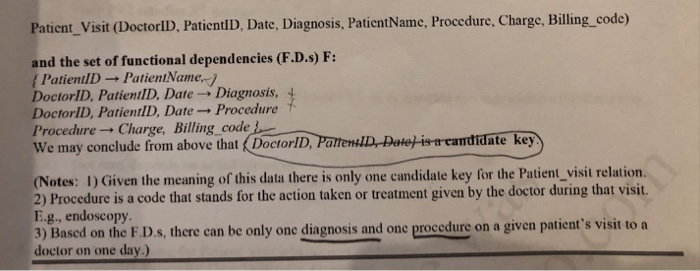

Patient_Visit (DoctoriD, PatiendD, Date, Diagnosis, PatientName, Procedure, Charge, Billing_code) and the set of functional dependencies (F.D.s) F: PatientlD-PatientName. DoctorID, PatientlD, Date Diagnosis DoctoriD, PatientlD, Date Procedure Procedure- Charge, Billing code We may conclude from above that KDoctoriD, PattenlD-DeteHis-arcandidate key (Notes: I) Given the meaning of this data there is only one candidate key for the Patient_visit relation. 2) Procedure is a code that stands for the action taken or treatment given by the doctor during that visit. TE.g., endoscopy 3) Based on the F.D.s, there can be only one diagnosis and one procedure on a given patient's visit to a doctor on one day.) Patient_Visit (DoctoriD, PatiendD, Date, Diagnosis, PatientName, Procedure, Charge, Billing_code) and the set of functional dependencies (F.D.s) F: PatientlD-PatientName. DoctorID, PatientlD, Date Diagnosis DoctoriD, PatientlD, Date Procedure Procedure- Charge, Billing code We may conclude from above that KDoctoriD, PattenlD-DeteHis-arcandidate key (Notes: I) Given the meaning of this data there is only one candidate key for the Patient_visit relation. 2) Procedure is a code that stands for the action taken or treatment given by the doctor during that visit. TE.g., endoscopy 3) Based on the F.D.s, there can be only one diagnosis and one procedure on a given patient's visit to a doctor on one day.)
Step by Step Solution
There are 3 Steps involved in it

Get step-by-step solutions from verified subject matter experts
 Study Help