







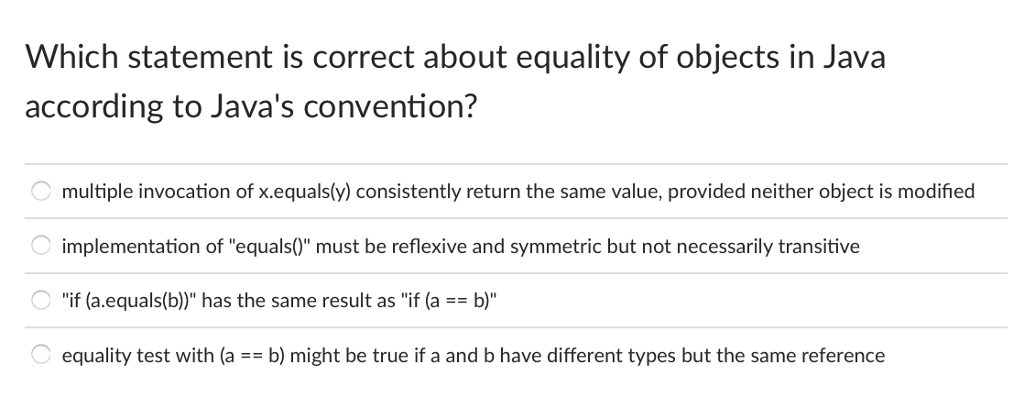
Question: Please explain why each alternative is right/wrong :-) Which statement is correct about equality of objects in Java according to Java's convention? multiple invocation of
Please explain why each alternative is right/wrong :-)
Which statement is correct about equality of objects in Java according to Java's convention? multiple invocation of x.equals(y) consistently return the same value, provided neither object is modified implementation of "equals()" must be reflexive and symmetric but not necessarily transitive "if (a.equals(b))" has the same result as "if (a == b)" equality test with (a == b) might be true if a and b have different types but the same reference
Step by Step Solution
There are 3 Steps involved in it
1 Expert Approved Answer
Step: 1 Unlock

Question Has Been Solved by an Expert!
Get step-by-step solutions from verified subject matter experts
Step: 2 Unlock
Step: 3 Unlock
 Study Help