







Question: Please explain why Suppose an operating system attempts to approximate SRTF with a priority scheduler based on observing how existing threads and assuming that future
 Please explain why
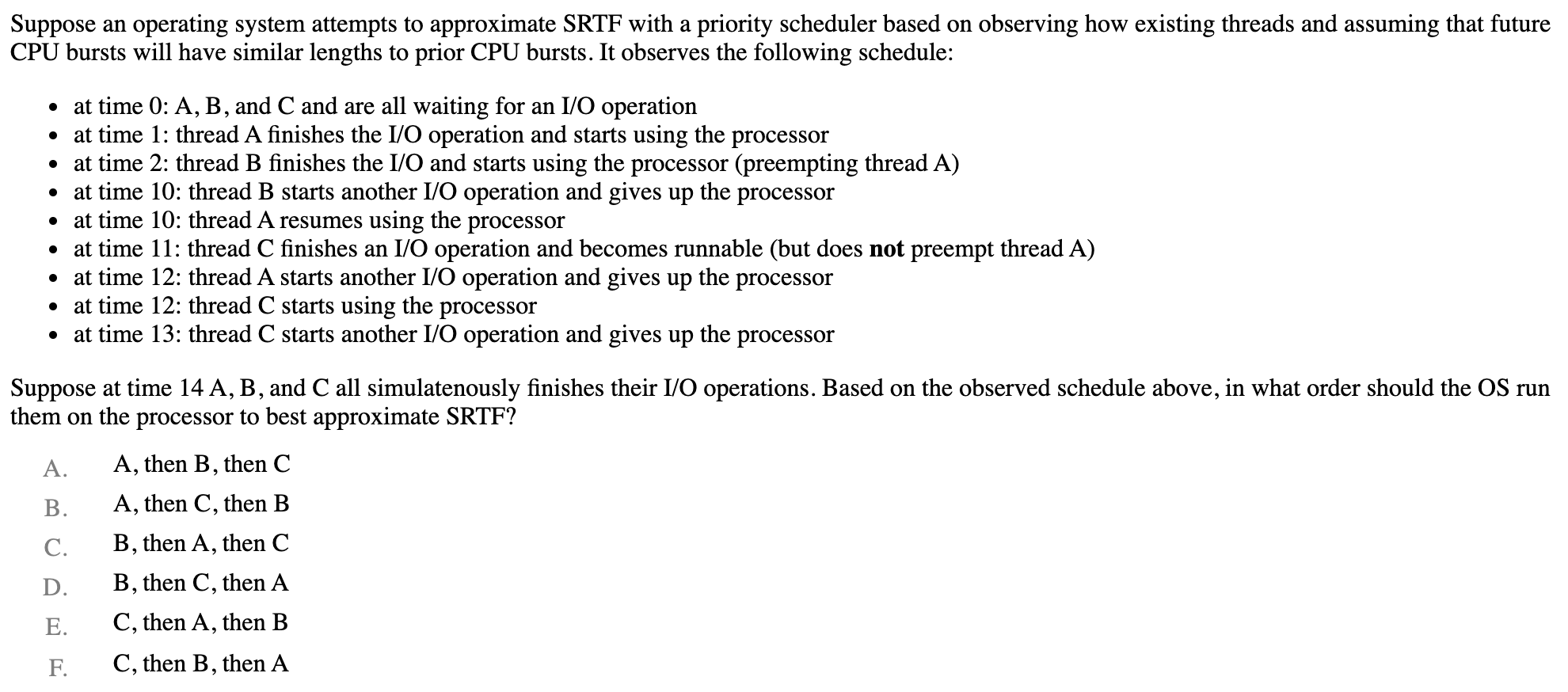
Suppose an operating system attempts to approximate SRTF with a priority scheduler based on observing how existing threads and assuming that future CPU bursts will have similar lengths to prior CPU bursts. It observes the following schedule: at time 0: A, B, and C and are all waiting for an I/O operation at time 1: thread A finishes the I/O operation and starts using the processor at time 2: thread B finishes the I/O and starts using the processor (preempting thread A) at time 10: thread B starts another I/O operation and gives up the processor at time 10: thread A resumes using the processor at time 11: thread C finishes an I/O operation and becomes runnable (but does not preempt thread A) at time 12: thread A starts another I/O operation and gives up the processor at time 12: thread C starts using the processor at time 13: thread C starts another I/O operation and gives up the processor Suppose at time 14 A, B, and C all simulatenously finishes their I/O operations. Based on the observed schedule above, in what order should the OS run them on the processor to best approximate SRTF? A. B. C. A, then B, then C A, then C, then B B, then A, then C B, then C, then A C, then A, then B C, then B, then A D. E. F
Step by Step Solution
There are 3 Steps involved in it

Get step-by-step solutions from verified subject matter experts
 Study Help