







Question: Please fill in the table with the answer to the part (a) and part (b). In our Python, we likely stored the entire solution history
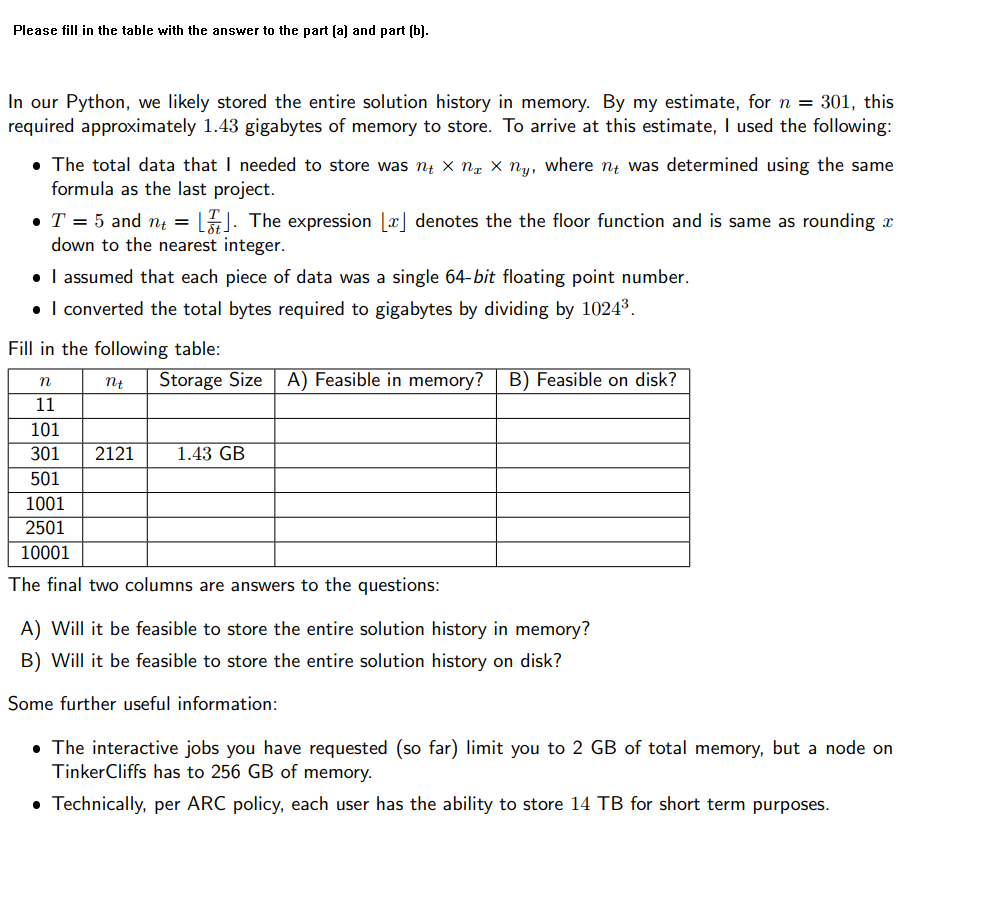
Please fill in the table with the answer to the part (a) and part (b). In our Python, we likely stored the entire solution history in memory. By my estimate, for n = 301, this required approximately 1.43 gigabytes of memory to store. To arrive at this estimate, I used the following: The total data that I needed to store was nt x nz X ny, where nt was determined using the same formula as the last project. T = 5 and nt = L&E. The expression [2] denotes the the floor function and is same as rounding 2 down to the nearest integer. I assumed that each piece of data was a single 64-bit floating point number. I converted the total bytes required to gigabytes by dividing by 10243. B) Feasible on disk? Fill in the following table: n nt Storage Size A Feasible in memory? 11 101 301 2121 1.43 GB 501 1001 2501 10001 The final two columns are answers to the questions: A) Will it be feasible to store the entire solution history in memory? B) Will it be feasible to store the entire solution history on disk? Some further useful information: The interactive jobs you have requested (so far) limit you to 2 GB of total memory, but a node on TinkerCliffs has to 256 GB of memory. Technically, per ARC policy, each user has the ability to store 14 TB for short term purposes
Step by Step Solution
There are 3 Steps involved in it

Get step-by-step solutions from verified subject matter experts
 Study Help