







Question: Please fill out this Risk Response and Contingency Plan Table: Take 2 risk threats from the risk register below. Decide which risk you will use
- Please fill out this Risk Response and Contingency Plan Table: Take 2 risk threats from the risk register below. Decide which risk you will use for the contingency plan and use the other risk for identifying a secondary risk or residual risk. If you need to increase or decrease the probability or add or reduce costs, include the reasoning in the risk response reason area.
**DO NOT MODIFY THIS TEMPLATE
Big Island Hotel:Insert your project scenario here.Risk IDRisk StatementProbabilityImpactRisk RatingRisk TypeEMV CostEMV DurRisk Category1 Trigger Risk response & reason Contingency plan reasoning 2 Trigger Risk response & reason Identify secondary or residual Risk & description.
2. Use the below table as a guide:
Big Island Hotel:Insert your project scenario here.Risk ID
Risk Statement
Probability
Impact
Risk RatingRisk TypeEMV
Cost
EMV
Dur
Risk Category
1
From the Risk Register below TriggerClearly (specific and quantifiable) identify a trigger for this risk.Risk Response & Reason
- Enter the most appropriate risk response (this is one-word like Accept)
- Include the reason why you believe this is the best risk response.
- If applicable, explain the changes made to the original risk
Overview of the
Contingency Plan
- Describe the reason(s) it makes sense to have a contingency plan for this risk
2
From the Risk Register below TriggerClearly (specific and quantifiable) identify a trigger for this risk.Risk Response & Reason
- Enter the most appropriate risk response (this is one word likeAccept)
- Include the reason (s) why you believe this is the best response.
- If applicable, explain the changes made to the original risk
Secondary or Residual Risk
- Identify and clearly label if there would be a residual or secondary risk based on the response selected (if this risk occurs). Using a statement like the risk response will create a secondary risk, or there will be a residual risk .
- Describe the secondary risk or residual risk
3. Case & Project Information: Big Island Hotel The management team at Big Island Hotel in Hawaii is responsible for transitioning from a hotel model to an all-inclusive concept. The Board of Directors wants to shift from marketing the resort as a hotel-only destination to an all-inclusive, which is rare in Hawaii. These concepts are far more popular in destinations such as Mexico, Dominican Republic, or Jamaica. The Hotel President has approved the project: A Fitness Center.
The Fitness Centre project meets the growing need for health and wellness services, improves the guest experience, and gives the hospitality business a competitive edge. The Fitness Centre at Big Island Hotel is a state-of-the-art facility designed to cater to the health and wellness needs of guests. It features a wide range of modern exercise equipment, offers group fitness classes led by certified instructors, provides personalized training with professional trainers, and may include spa and relaxation facilities. The Fitness Centre aims to enhance the guest experience and give the hotel a competitive edge in transitioning to an all-inclusive concept.
4. Risk Register:
ABCDEFGHI1Risk IDRisk DescriptionRisk categoryProbabilityImpactRisk RatingEMV costEMV Duration2R1Construction delays due to increment weatherScheduleHighHigh16$2400010 Days3R2Shortage of skilled laborResourcesModerateHigh12$180006 Weeks
5. Big Island Hotel Cost Table:
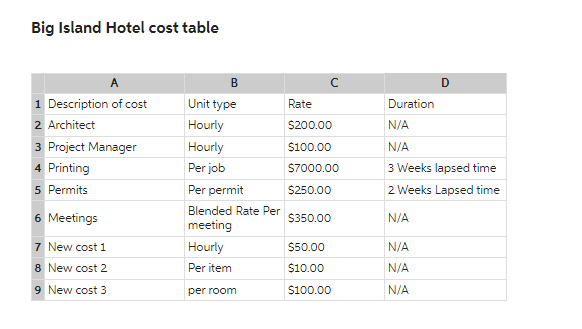
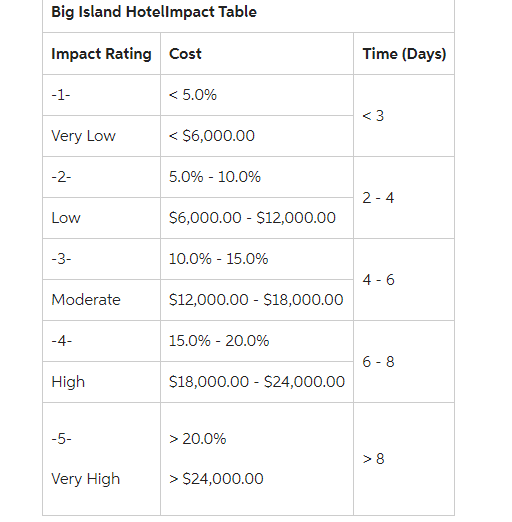
6. Impact Table:
7. Heat Map:
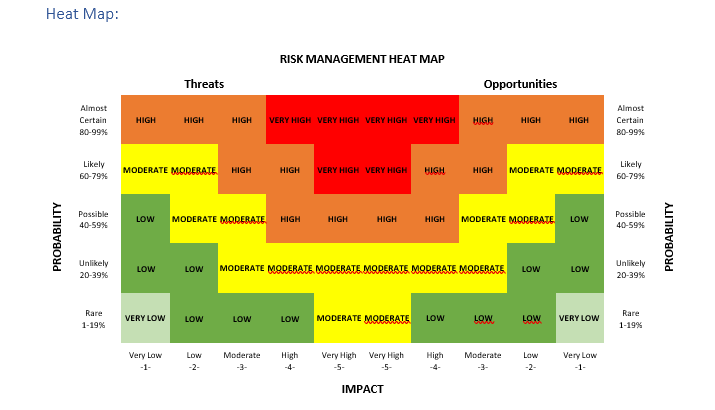
Big Island Hotel cost table Heat Map: RISK MANAGEMENT HEAT MAP Threats Big Island Hotellmpact Table \begin{tabular}{|l|l|l|} \hline Impact Rating & Cost & Time (Days) \\ \hline1 & 20.0% & \\ \hline5 & >$24,000.00 & \\ \hline Very High & & \\ \hline \end{tabular}
Step by Step Solution
There are 3 Steps involved in it

Get step-by-step solutions from verified subject matter experts
 Study Help