Question: Please find a published article (published year between 2010-2021) in the area of transport economics, supply chain management, logistics or other relevent to the subject.
Please find a published article (published year between 2010-2021) in the area of transport economics, supply chain management, logistics or other relevent to the subject.
1. Findings/results of the research
2. Implications/contribution of the research
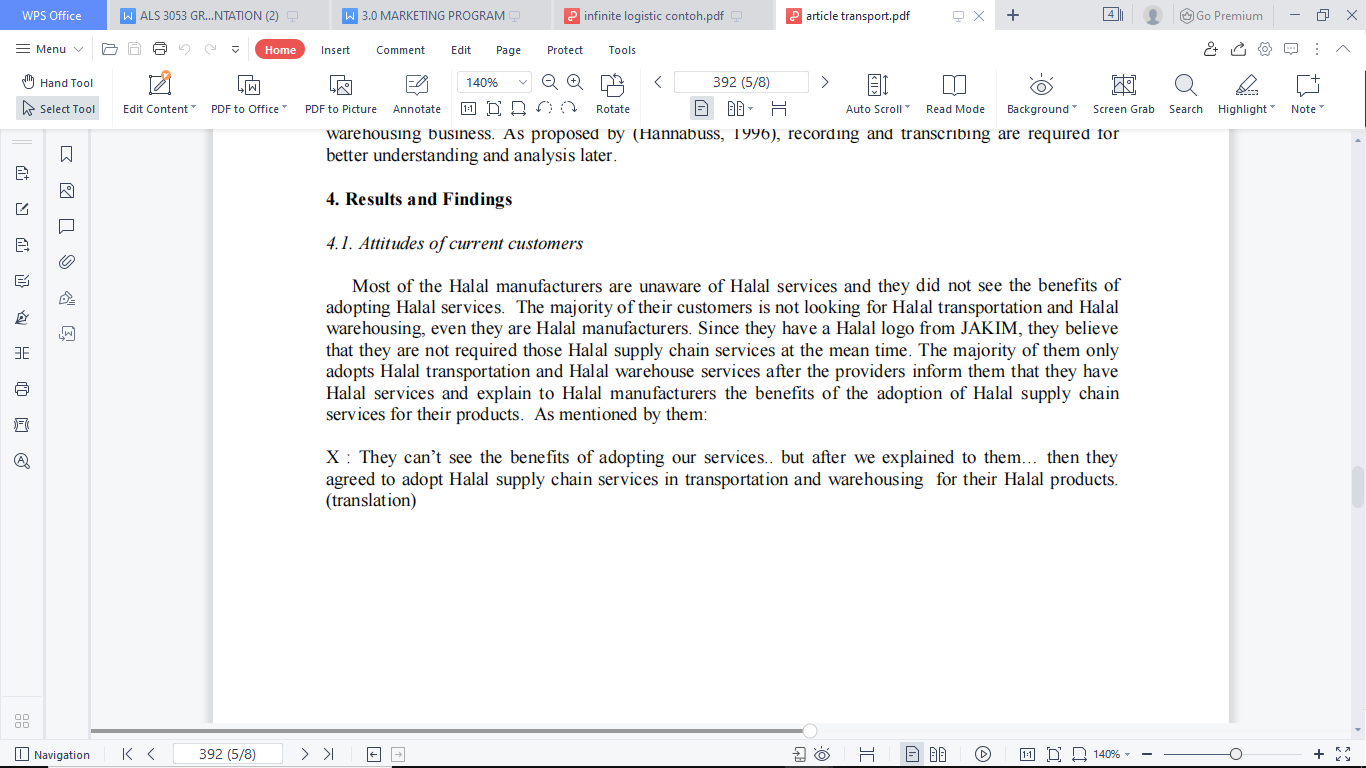
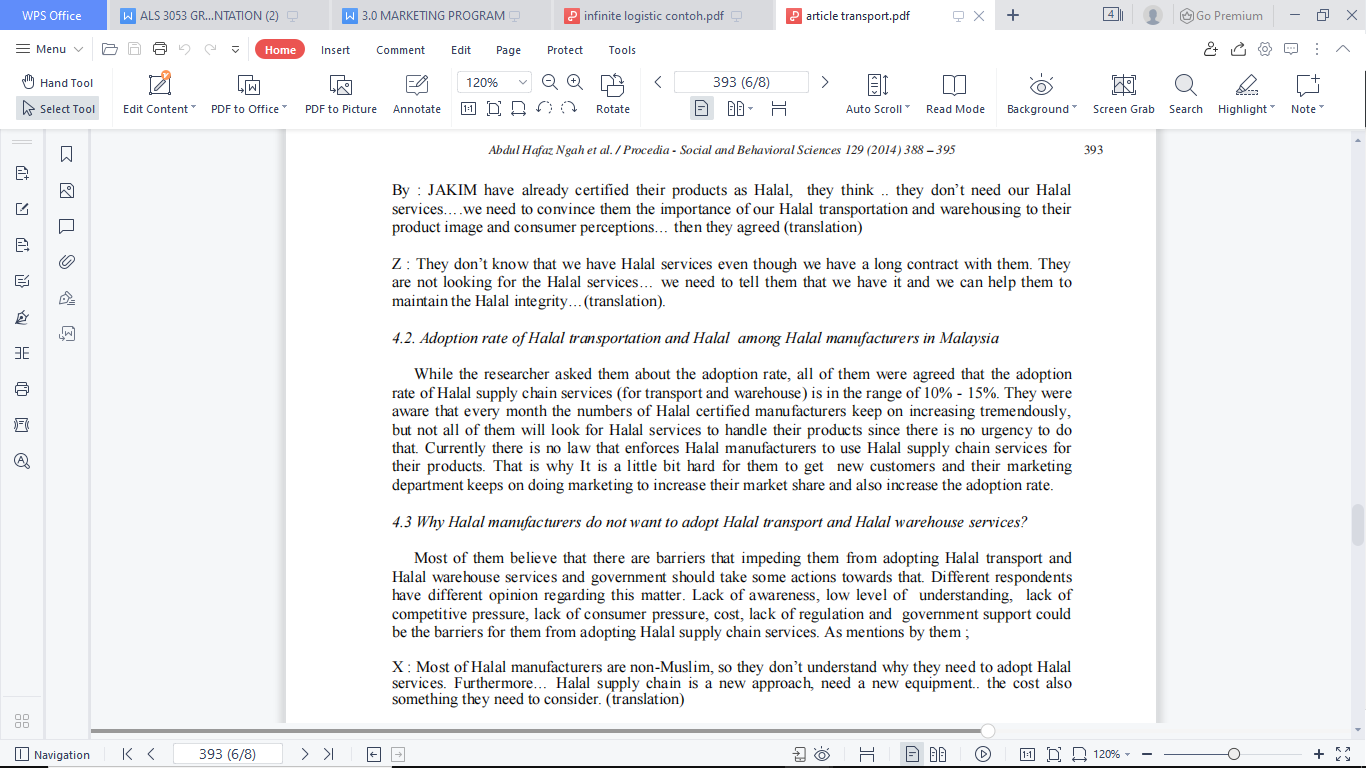
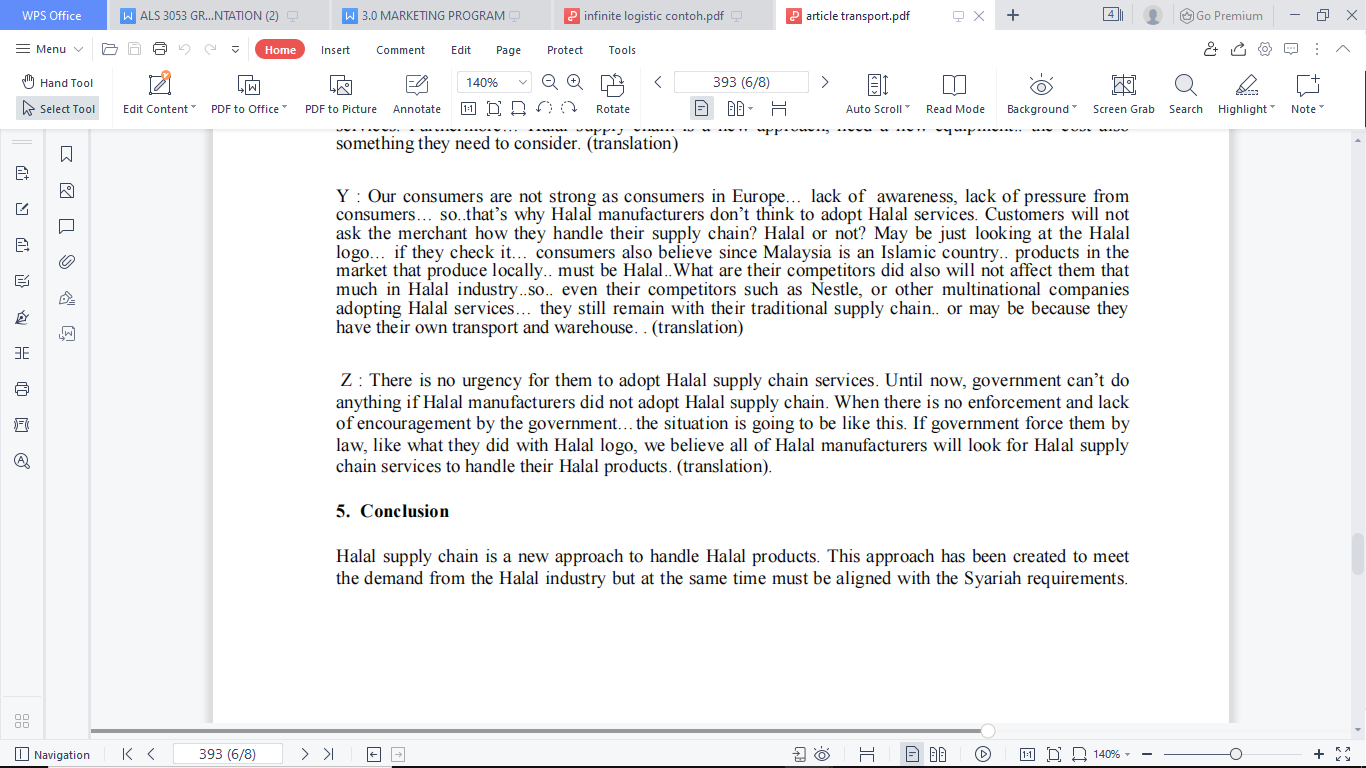
WPS Office W ALS 3053 GR...NTATION (2) Q W 3.0 MARKETING PROGRAM 2 infinite logistic contoh.pdf ?article transport.pdf QX + Go Premium Menu Home Insert Comment Edit Page Protect Tools 2 Hand Tool LW Ws Select Tool Edit Content PDF to Office Search Highlight Note LR -2 140% m PDF to Picture Annotate 11 OD Rotate 5 BD-H Auto Scroll Read Mode BackgroundScreen Grab warehousing business. As proposed by (Hannabuss, 1996), recording and transcribing are required for better understanding and analysis later. 4. Results and Findings 4.1. Attitudes of current customers B B Eue & JE Most of the Halal manufacturers are unaware of Halal services and they did not see the benefits of adopting Halal services. The majority of their customers is not looking for Halal transportation and Halal warehousing, even they are Halal manufacturers. Since they have a Halal logo from JAKIM, they believe that they are not required those Halal supply chain services at the mean time. The majority of them only adopts Halal transportation and Halal warehouse services after the providers inform them that they have Halal services and explain to Halal manufacturers the benefits of the adoption of Halal supply chain services for their products. As mentioned by them: A X: They can't see the benefits of adopting our services.. but after we explained to them... then they agreed to adopt Halal supply chain services in transportation and warehousing for their Halal products. (translation) 08 Navigation K m 393 (6/8) Ws Select Tool Edit Content PDF to Office PDF to Picture Annotate 11 DD Rotate Auto Scroll Read Mode Background" Screen Grab Search Highlight Note a Abdul Hafaz Ngah et al./Procedia - Social and Behavioral Sciences 129 (2014) 388-395 393 By : JAKIM have already certified their products as Halal, they think .. they don't need our Halal services....we need to convince them the importance of our Halal transportation and warehousing to their product image and consumer perceptions... then they agreed (translation) Z: They don't know that we have Halal services even though we have a long contract with them. They are not looking for the Halal services... we need to tell them that we have it and we can help them to maintain the Halal integrity... (translation). 2 Eue @ W 4.2. Adoption rate of Halal transportation and Halal among Halal manufacturers in Malaysia JE While the researcher asked them about the adoption rate, all of them were agreed that the adoption rate of Halal supply chain services (for transport and warehouse) is in the range of 10% - 15%. They were aware that every month the numbers of Halal certified manufacturers keep on increasing tremendously, but not all of them will look for Halal services to handle their products since there is no urgency to do that. Currently there is no law that enforces Halal manufacturers to use Halal supply chain services for their products. That is why It is a little bit hard for them to get new customers and their marketing department keeps on doing marketing to increase their market share and also increase the adoption rate. 4.3 Why Halal manufacturers do not want to adopt Halal transport and Halal warehouse services Most of them believe that there are barriers that impeding them from adopting Halal transport and Halal warehouse services and government should take some actions towards that. Different respondents have different opinion regarding this matter. Lack of awareness, low level of understanding, lack of competitive pressure, lack of consumer pressure, cost, lack of regulation and government support could be the barriers for them from adopting Halal supply chain services. As mentions by them; X: Most of Halal manufacturers are non-Muslim, so they don't understand why they need to adopt Halal services. Furthermore, Halal supply chain is a new approach, need a new equipment. the cost also something they need to consider. (translation) 08 Navigation K 393 (6/8) Ws Select Tool Edit Content PDF to Office PDF to Picture Annotate 11 On Rotate Auto Scroll Read Mode Background" Screen Grab Search Highlight Note something they need to consider. (translation) Eue & B B Y: Our consumers are not strong as consumers in Europe... lack of awareness, lack of pressure from consumers... so..that's why Halal manufacturers don't think to adopt Halal services. Customers will not ask the merchant how they handle their supply chain? Halal or not? May be just looking at the Halal logo... if they check it... consumers also believe since Malaysia is an Islamic country.. products in the market that produce locally.. must be Halal.. What are their competitors did also will not affect them that much in Halal industry..so.. even their competitors such as Nestle, or other multinational companies adopting Halal services... they still remain with their traditional supply chain.. or may be because they have their own transport and warehouse. . (translation) JE Z : There is no urgency for them to adopt Halal supply chain services. Until now, government can't do anything if Halal manufacturers did not adopt Halal supply chain. When there is no enforcement and lack of encouragement by the government... the situation is going to be like this. If government force them by law, like what they did with Halal logo, we believe all of Halal manufacturers will look for Halal supply chain services to handle their Halal products. (translation). A 5. Conclusion Halal supply chain is a new approach to handle Halal products. This approach has been created to meet the demand from the Halal industry but at the same time must be aligned with the Syariah requirements. 08 Navigation K









 Study Help