



Question: Please find attached for the question. Thank you. Question 3: Edgeworth box with Cobb-Douglas utility functions Suppose that Jane and Denise live near each other
Please find attached for the question. Thank you.
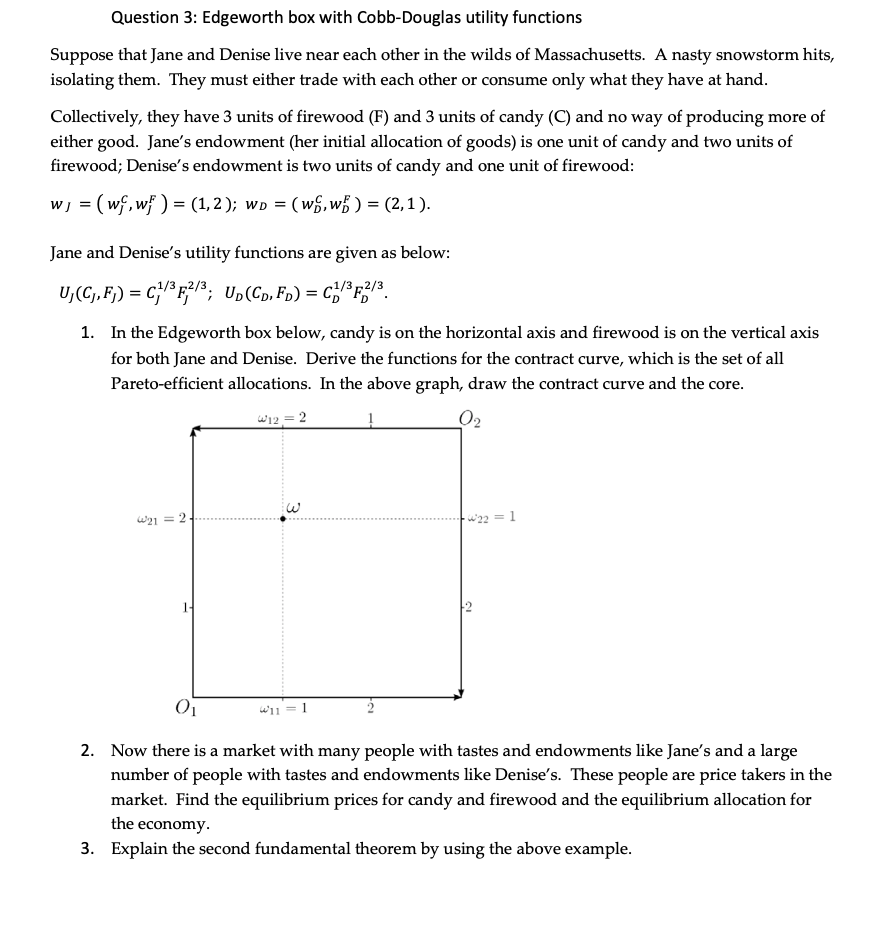
Question 3: Edgeworth box with Cobb-Douglas utility functions Suppose that Jane and Denise live near each other in the wilds of Massachusetts. A nasty snowstorm hits, isolating them. They must either trade with each other or consume only what they have at hand Collectively, they have 3 units of firewood (F) and 3 units of candy (C) and no way of producing more of either good. Jane's endowment (her initial allocation of goods) is one unit of candy and two units of firewood; Denise's endowment is two units of candy and one unit of firewood: WJ = (wf, wf ) = (1,2); WD = (w;, w; ) = (2,1). Jane and Denise's utility functions are given as below: U,(CJ, F,) = 61/3 F,2/3; UD(CD, FD) = C/3 F3/3 1. In the Edgeworth box below, candy is on the horizontal axis and firewood is on the vertical axis for both Jane and Denise. Derive the functions for the contract curve, which is the set of all Pareto-efficient allocations. In the above graph, draw the contract curve and the core. 12 = 2 O2 421 = 2. -W22 = 1 2 O1 #11 = 1 2. Now there is a market with many people with tastes and endowments like Jane's and a large number of people with tastes and endowments like Denise's. These people are price takers in the market. Find the equilibrium prices for candy and firewood and the equilibrium allocation for the economy. 3. Explain the second fundamental theorem by using the above example
Step by Step Solution
There are 3 Steps involved in it

Get step-by-step solutions from verified subject matter experts