







Question: Please find attachment below. Topic: The Koch Antisnowflake The Koch antisnowflake can be constructed by starting with an equilateral triangle with sides length one, then
Please find attachment below. Topic: The Koch Antisnowflake
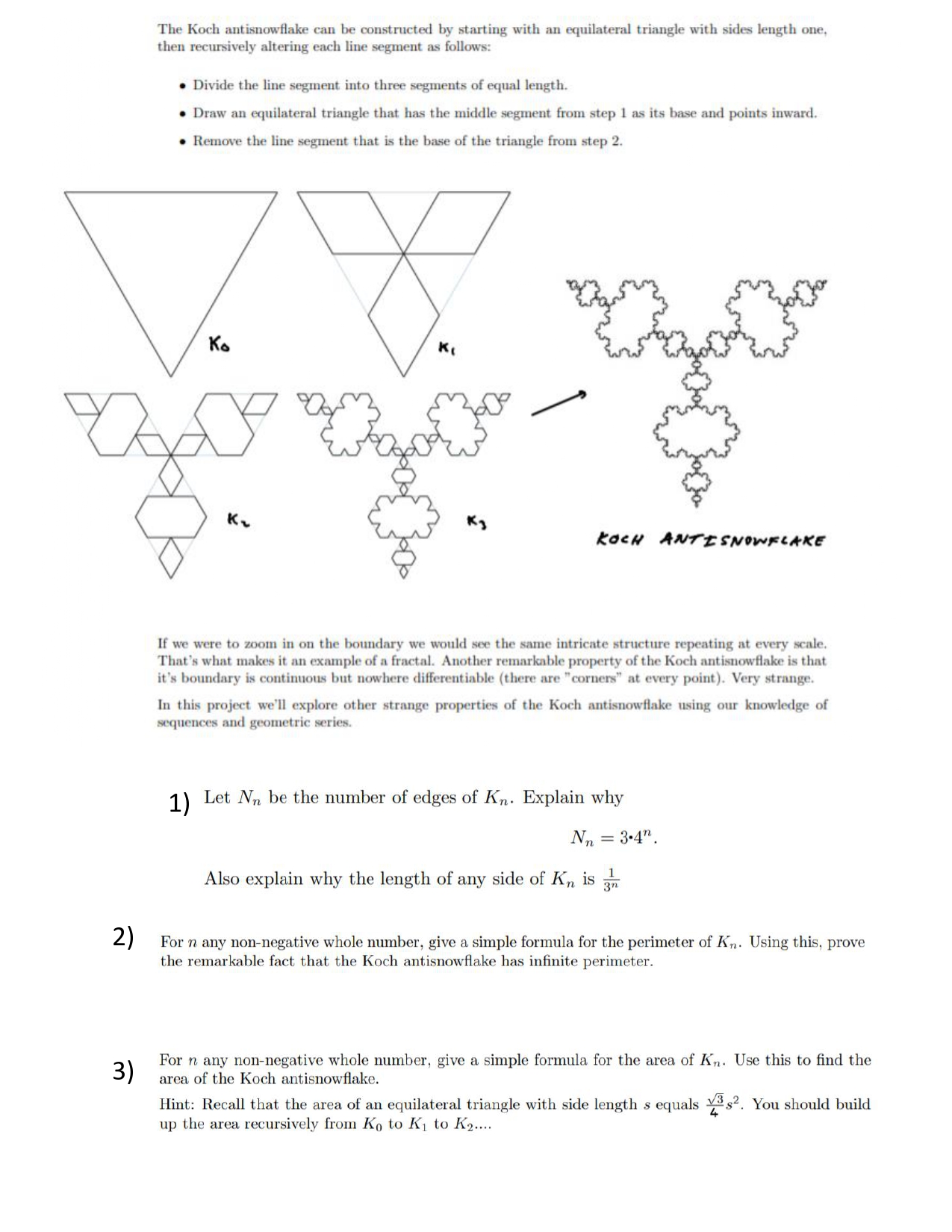
The Koch antisnowflake can be constructed by starting with an equilateral triangle with sides length one, then recursively altering each line segment as follows: . Divide the line segment into three segments of equal length. . Draw an equilateral triangle that has the middle segment from step 1 as its base and points inward. . Remove the line segment that is the base of the triangle from step 2. Ko K KOCH ANTISNOWFLAKE If we were to zoom in on the boundary we would see the same intricate structure repeating at every scale. That's what makes it an example of a fractal. Another remarkable property of the Koch antisnowflake is that it's boundary is continuous but nowhere differentiable (there are "corners" at every point). Very strange. In this project we'll explore other strange properties of the Koch antisnowflake using our knowledge of sequences and geometric series. 1) Let An be the number of edges of Kn. Explain why Nn = 3-4". Also explain why the length of any side of Kn is 37 2) For n any non-negative whole number, give a simple formula for the perimeter of Kn. Using this, prove the remarkable fact that the Koch antisnowflake has infinite perimeter. 3) For n any non-negative whole number, give a simple formula for the area of K'n. Use this to find the area of the Koch antisnowflake. Hint: Recall that the area of an equilateral triangle with side length s equals 132. You should build up the area recursively from Ko to K1 to K2
Step by Step Solution
There are 3 Steps involved in it

Get step-by-step solutions from verified subject matter experts
 Study Help