







Question: Please find the info and question below: 2. Consider the heat equation on the positive real axis with a fixed temperature level at the origin:
Please find the info and question below:
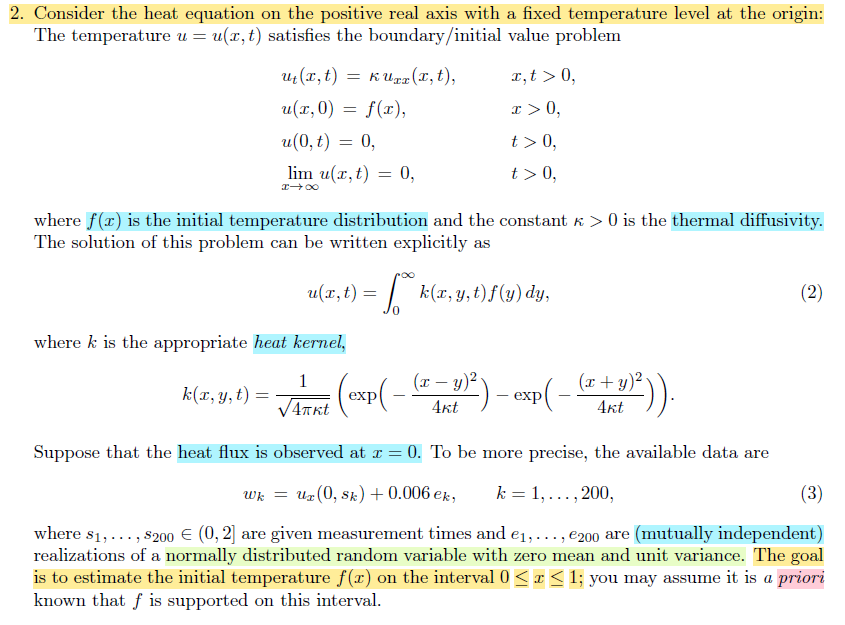

2. Consider the heat equation on the positive real axis with a fixed temperature level at the origin: The temperature u = u(r, t) satisfies the boundary /initial value problem at(x, t) = kurr(I, t), r, t>0, u(x, 0) = f(x), r >0, u(0, t) = 0, 1>0, lim u(r, t) = 0, r-+00 where f(r) is the initial temperature distribution and the constant 0 is the thermal diffusivity. The solution of this problem can be written explicitly as u(x, t) = k(x, y, t) f (y) dy, (2) where k is the appropriate heat kernel, (r - y)' (arty)2 k(x, y, t) = VARKI exp - exp 4kit Art Suppose that the heat flux is observed at r = 0. To be more precise, the available data are Wk = ux (0, Sk) + 0.006 ek, k = 1, . .., 200, (3) where $1, . . .; $200 E (0, 2] are given measurement times and e1, . . .; e200 are (mutually independent) realizations of a normally distributed random variable with zero mean and unit variance. The goal is to estimate the initial temperature f(x) on the interval 0
Step by Step Solution
There are 3 Steps involved in it

Get step-by-step solutions from verified subject matter experts
 Study Help