







Question: Please find two documents attached. The first one is the assignment and the second one is the overview of the case. Please address the business
Please find two documents attached. The first one is the assignment and the second one is the overview of the case. Please address the business issues raised by this case from the perspectives of different stakeholders affected by the problem.Also can you tell me if the company should be acquired.
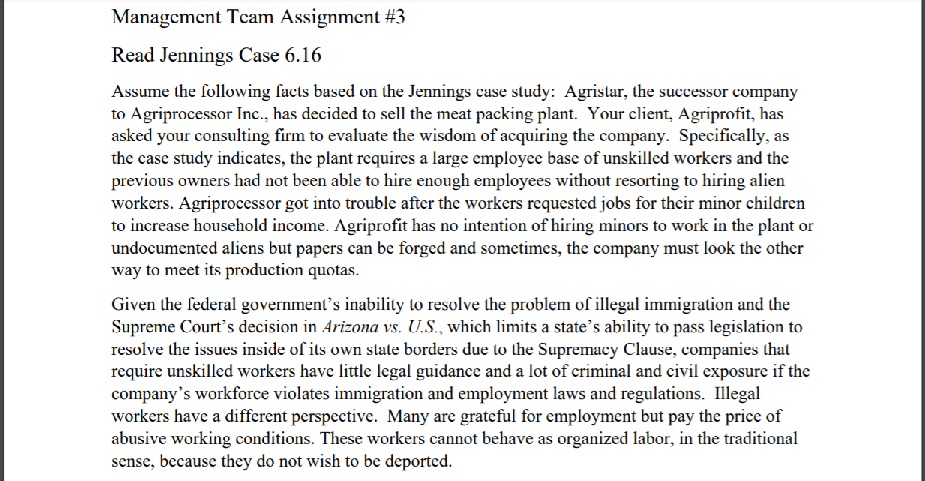
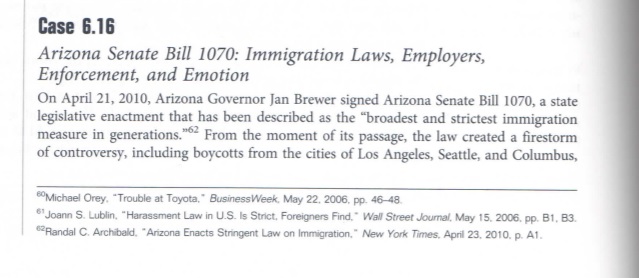
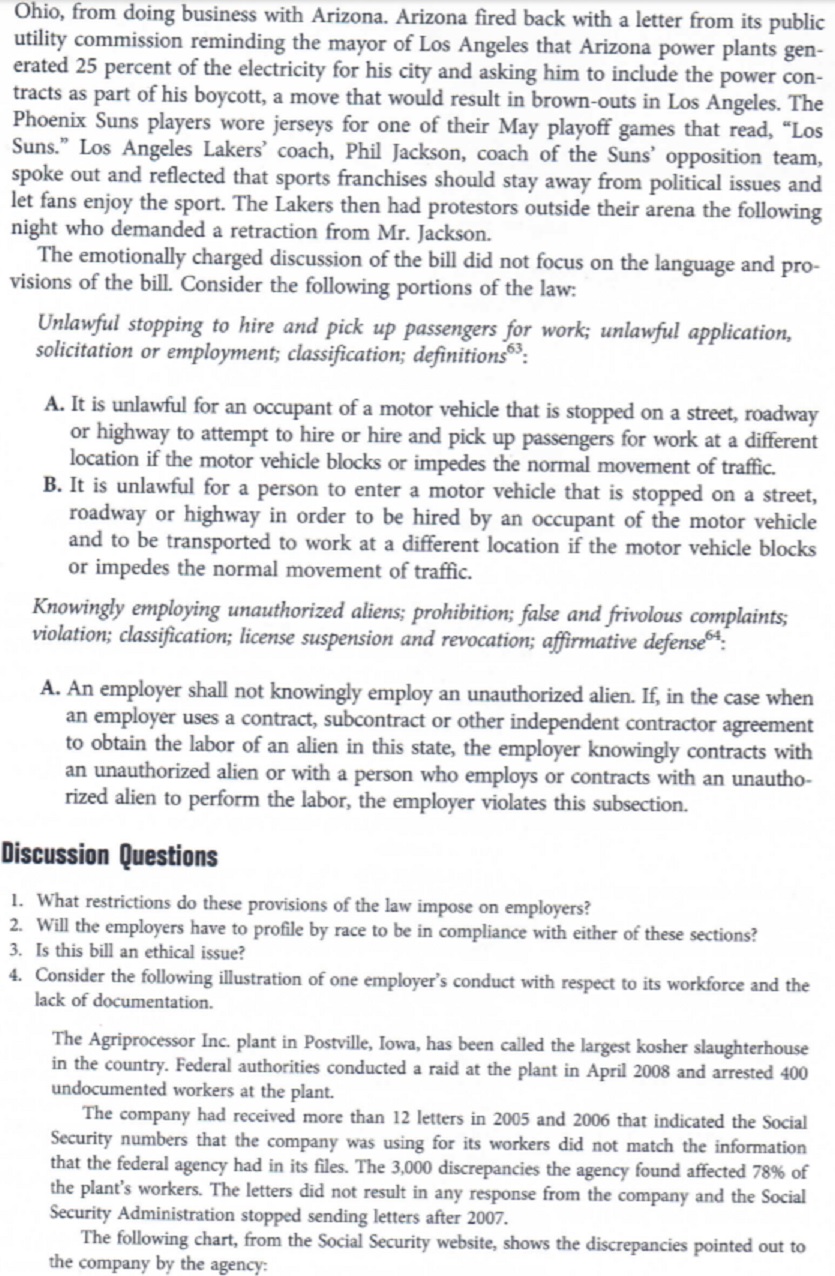
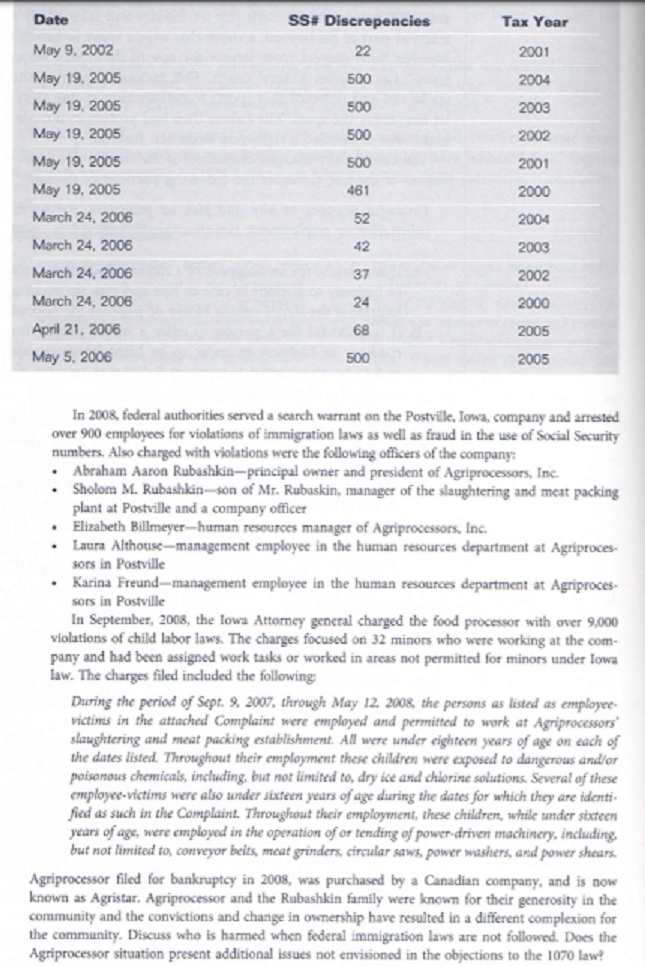
Management Team Assignment #3 Read Jennings Case 6.16 Assume the following fuels based on Lhe Jennings ease study: Agrislar, [he successor company to A griproeessor [no.1 has decided to sell the meat packing plant. Your client, Agriprnt, has asked your consulting rm to evaluate the wisdom of acquiring the company. Specically, as the case study indicates, the plant requires a large employee base of mislrjlled workers and the previous owners had not been able to hire enough employees without resenting to hiring alien workers. Agriproccssor got into trouble after the workers requested jobs for their minor children to increase household income. Agriprot has no intention of hiring minors to work in the plant or undocumented aliens but papers can be forged and sometimes, the company must look the other way to meet its production quotas. Given the federal government's inability to resolve the problem of illegal inmiigration and the Supreme Court's decision in Arizona vs. U..S'., which limits a state's ability to pass legislation to resolve the issues inside of its own state borders due to [he Supremacy Clause, companies Lhal require unskilled workers have little legal guidance and a lot of criminal and civil exposure ifthe company's workforce violates immigration and employment laws and regulations. Illegal workers have a different perspective. Many are grateful for employment but pay the price of abusive working conditions. These workers cannot behave as organized labor, in the traditional sense, because they do not wish to be deported. Case 6.16 Arizona Senate Bill 1070: Immigration Laws, Employers, Enforcement, and Emotion On April 21, 2010, Arizona Governor Jan Brewer signed Arizona Senate Bill 1070, a state legislative enactment that has been described as the "broadest and strictest immigration measure in generations."From the moment of its passage, the law created a firestorm of controversy, including boycotts from the cities of Los Angeles, Seattle, and Columbus, Michael Orey. "Trouble at Toyota," BusinessWeek, May 22. 2006, pp. 46-48. "Joann S. Lublin. "Harassment Law in U.S. Is Strict, Foreigners Find, " Wall Street Journal, May 15. 2006. pp. B1, 83. "Randal C. Archibald. "Arizona Enacts Stringent Law on Immigration, " New York Times, April 23. 2010. p. Al.Ohio, from doing business with Arizona. Arizona fired back with a letter from its public utility commission reminding the mayor of Los Angeles that Arizona power plants gen- erated 25 percent of the electricity for his city and asking him to include the power con- tracts as part of his boycott, a move that would result in brown-outs in Los Angeles. The Phoenix Suns players wore jerseys for one of their May playoff games that read, "Los Suns." Los Angeles Lakers' coach, Phil Jackson, coach of the Suns' opposition team, spoke out and reflected that sports franchises should stay away from political issues and let fans enjoy the sport. The Lakers then had protestors outside their arena the following night who demanded a retraction from Mr. Jackson. The emotionally charged discussion of the bill did not focus on the language and pro- visions of the bill. Consider the following portions of the law: Unlawful stopping to hire and pick up passengers for work; unlawful application, solicitation or employment; classification; definitions: A. It is unlawful for an occupant of a motor vehicle that is stopped on a street, roadway or highway to attempt to hire or hire and pick up passengers for work at a different location if the motor vehicle blocks or impedes the normal movement of traffic. B. It is unlawful for a person to enter a motor vehicle that is stopped on a street, roadway or highway in order to be hired by an occupant of the motor vehicle and to be transported to work at a different location if the motor vehicle blocks or impedes the normal movement of traffic. Knowingly employing unauthorized aliens; prohibition; false and frivolous complaints; violation; classification; license suspension and revocation; affirmative defense: A. An employer shall not knowingly employ an unauthorized alien. If, in the case when an employer uses a contract, subcontract or other independent contractor agreement to obtain the labor of an alien in this state, the employer knowingly contracts with an unauthorized alien or with a person who employs or contracts with an unautho rized alien to perform the labor, the employer violates this subsection. Discussion Questions 1. What restrictions do these provisions of the law impose on employers? 2. Will the employers have to profile by race to be in compliance with either of these sections? 3. Is this bill an ethical issue? 4. Consider the following illustration of one employer's conduct with respect to its workforce and the lack of documentation. The Agriprocessor Inc. plant in Postville, Iowa, has been called the largest kosher slaughterhouse in the country. Federal authorities conducted a raid at the plant in April 2008 and arrested 400 undocumented workers at the plant. The company had received more than 12 letters in 2005 and 2006 that indicated the Social Security numbers that the company was using for its workers did not match the information that the federal agency had in its files. The 3,000 discrepancies the agency found affected 78% of the plant's workers. The letters did not result in any response from the company and the Social Security Administration stopped sending letters after 2007. The following chart, from the Social Security website, shows the discrepancies pointed out to the company by the agency:Date SS# Discrepancies Tax Year May 9. 2002 22 2001 May 19. 2005 500 2004 May 19. 2005 500 2003 May 19, 2005 500 2002 May 19. 2005 500 2001 May 19, 2005 461 2000 March 24, 2006 52 2004 March 24, 2006 42 2003 March 24, 2006 37 2002 March 24, 2006 24 2000 April 21. 2006 68 2005 May 5. 2006 500 2005 In 2008, federal authorities served a search warrant on the Postville, Iowa, company and arrested over 900 employees for violations of immigration laws as well as fraud in the use of Social Security numbers, Also charged with violations were the following officers of the company: . Abraham Aaron Rubashkin-principal owner and president of Agriprocessors, Inc. . Sholom M. Rubashkin-son of Mr. Rubaskin, manager of the slaughtering and meat packing plant at Postville and a company officer Elizabeth Billmeyer-human resources manager of Agriprocessors, Inc. Laura Althouse-management employee in the human resources department at Agriproces- sors in Postville Karina Freund-management employee in the human resources department at Agriproces- sors in Postville In September, 2008, the lowa Attorney general charged the food processor with over 9,000 violations of child labor laws. The charges focused on 32 minors who were working at the com- pany and had been assigned work tasks or worked in areas not permitted for minors under lowa law. The charges filed included the following During the period of Sept. 9, 2007. through May 12. 2008, the persons as listed as employee- victims in the attached Complaint were employed and permitted to work at Agriprocessors' slaughtering and meat packing establishment. All were under eighteen years of age on each of the dates listed. Throughout their employment these children were exposed to dangerous and/or poisonous chemicals, including, but not limited to, dry ice and chlorine solutions. Several of these employee-victims were also under sixteen years of age during the dates for which they are identi- fied as such in the Complaint. Throughout their employment, these children, while under sixteen years of age, were employed in the operation of or tending of power-driven machinery, including. but not limited to, conveyor belts, meat grinders, circular saws, power washers, and power shears. Agriprocessor filed for bankruptcy in 2008, was purchased by a Canadian company, and is now known as Agristar. Agriprocessor and the Rubashkin family were known for their generosity in the community and the convictions and change in ownership have resulted in a different complexion for the community. Discuss who is harmed when federal immigration laws are not followed. Does the Agriprocessor situation present additional issues not envisioned in the objections to the 1070 law
Step by Step Solution
There are 3 Steps involved in it

Get step-by-step solutions from verified subject matter experts
 Study Help