







Question: Please fix the error for value of n Newton's Method 6 solutions submitted (max 10) View my solutions Implement Newton's method as a function function
![function function [P,n] = myNewton(f,fprime, xe,tol) We seek a root of the](https://dsd5zvtm8ll6.cloudfront.net/si.experts.images/questions/2024/09/66f51e54366c4_11566f51e53ac6fb.jpg)
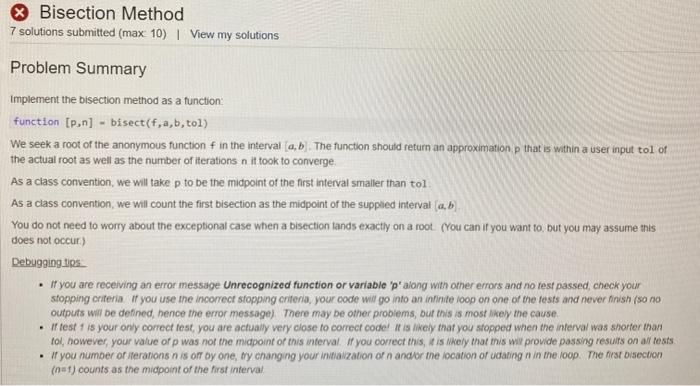
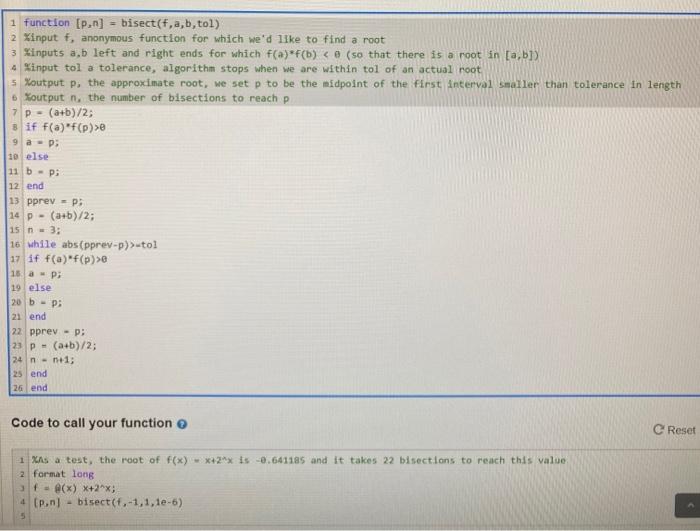
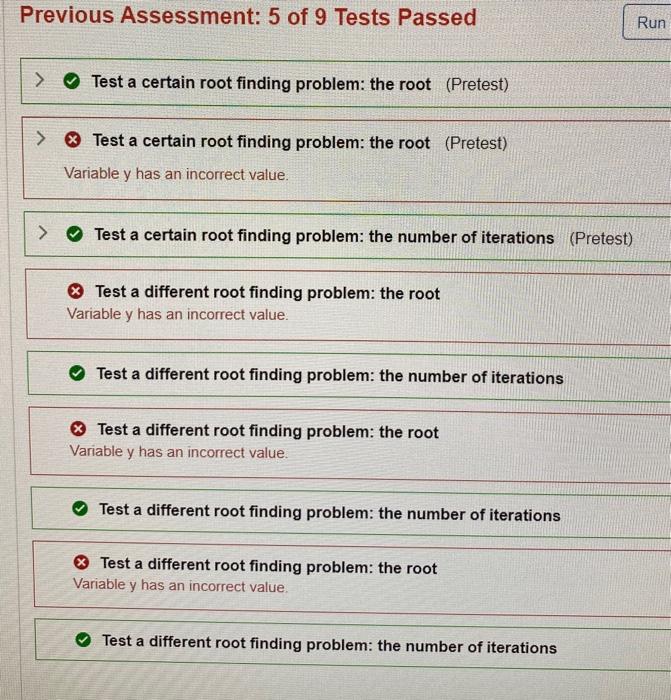
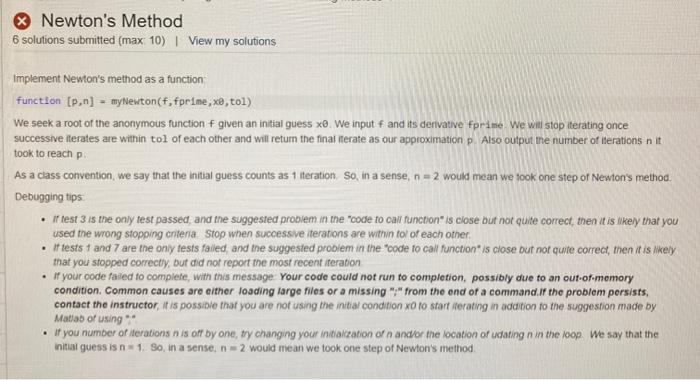
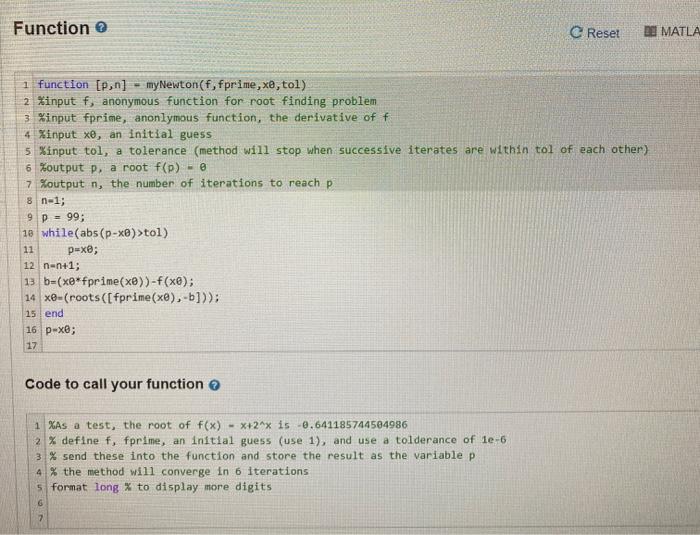
Newton's Method 6 solutions submitted (max 10) View my solutions Implement Newton's method as a function function [P,n] = myNewton(f,fprime, xe,tol) We seek a root of the anonymous function f given an initial guess xo. We input f and its derivative fprime We will stop iterating once successive interates are within tol of each other and will return the final ferate as our approximation p Also output the number of iterations nit took to reach p As a class convention, we say that the initial guess counts as 1 iteration So, in a sense, n = 2 would mean we took one step of Newton's method. Debugging tips . Il test 3 is the only test passed, and the suggested problem in the code to call function is close but not quite correct, then it is Nkely that you used the wrong stopping criteria Stop when successive iterations are within to of each other If tests 1 and 7 are the only tests failed, and the suggested problem in the code to call function is close but not quite correct, then it is likely that you stopped correctly, but did not report the most recent iteration If your code failed to complete with this message. Your code could not run to completion, possibly due to an out of memory condition. Common causes are e/ther loading large files or a missing ";" from the end of a command. If the problem persists, contact the instructor, it is possible that you are not using the initial condition xo to start storating an addition to the suggestion made by Matlab of using ** If you number of iterations n is off by one, try changing your inittakzation or n and or the location of dating n in the loop we say that the I guess is n =1. So, in a sense, n = 2 would mean we took one step of Newton's method initiat Function Reset 20 MATLA 1 function [P,n] = myNewton(f,fprime ,xa ,tol) 2. Xinput f, anonymous function for root finding problem 3. Linput fprime, anonlymous function, the derivative of f 4 Xinput xe, an initial guess 5 Xinput tol, a tolerance (method will stop when successive iterates are within tol of each other) 6 Zoutput p, a root f(p) 7 Koutput n, the number of iterations to reach p 8 -1; 9 D = 99; 10 while(abs(p-x)>tol) 11 p=x0; 12 n-n+1; 13 b=(xe* fprime(xe)) -f(x); 14 xe (roots([fprime(x), b])); 15 end 16 P=x0; 17 Code to call your function 1 %As a test, the root of f(x) - X+2^x is 0.641185744504986 2 % define f, fprime, an initial guess (use 1), and use a tolderance of le-6 3% send these into the function and store the result as the variable p 4 % the method will converge in 6 iterations 5 format long x to display more digits > Test certain root finding problem: the root (Pretest) > Test a certain root finding problem: the number of iterations (Pretest) Test a different root finding problem: the root (Pretest) Test a different root finding problem: the number of iterations (Pretest) Test certain root finding problem : the root * Test a certain root finding problem: the number of iterations Variable n has an incorrect value. Test certain root finding problem: the root Test certain root finding problem: the number of iterations * Bisection Method 7 solutions submitted (max 10) | View my solutions Problem Summary Implement the bisection method as a function function (p.n] - bisect(f, a,b,tol) We seek a root of the anonymous function in the interval (a,b). The function should return an approximation that is within a user input tol of the actual root as well as the number of iterations n it took to converge As a class convention, we will take p to be the midpoint of the first interval smaller than tol As a class convention, we will count the first bisection as the midpoint of the supplied interval (a,b) You do not need to worry about the exceptional case when a bisection lands exactly on a root. (You can if you want to, but you may assume this does not occur) Debugging tips If you are receiving an error message Unrecognized function or variable 'o' along with other errors and no rest passed, check your stopping criteria. If you use the incorrect stopping criteria, your code will go into an infinite loop on one of the tests and never finish (sono outputs will be defined nence the error message). There may be other problems, but this is most like the cause If test 1 is your only correct test, you are actually very close to correct code is likely that you stopped when the interval was shorter than tol, however, your value of p was not the midpoint of this interval. If you correct this, it is kely that this will provide passing results on all tests. If you number of Aerations n is off by one, ny changing your initization of n and or the location of dating nin me loop. The art bisection (nut) counts as the midpoint of the first interval 1 function (p.n] = bisect(f, a,b,tol) 2 Xinput t, anonymous function for which we'd like to find a root 3 Xinputs a,b left and right ends for which f(a) f(b) 9 - D: 10 else 11 b - P: 12 end 13 pprev=P 14 p - (a+b)/2; 15 n = 3; 16 while abs(pprev-p)>tol 17 if f(a) f(p) 15a - P: 19 else 20 b - P: 21 end 22 pprev - P: 23 P = (a+b)/2; 24 - 1+1; 25 end 26 end Code to call your function e Reset 12x is 0.641185 and it takes 22 bisections to reach this value 1 xAs a test, the root of f(x) 2 format long 3= @(x) X+2; 4 (pin) - bisect(1,-1,1,1e-6) Previous Assessment: 5 of 9 Tests Passed Run > Test a certain root finding problem: the root (Pretest) > Test a certain root finding problem: the root (Pretest) Variable y has an incorrect value. > Test a certain root finding problem: the number of iterations (Pretest) % Test a different root finding problem: the root Variable y has an incorrect value. Test a different root finding problem: the number of iterations ** Test a different root finding problem: the root Variable y has an incorrect value. Test a different root finding problem: the number of iterations * Test a different root finding problem: the root Variable y has an incorrect value. Test a different root finding problem: the number of iterations Newton's Method 6 solutions submitted (max 10) View my solutions Implement Newton's method as a function function [P,n] = myNewton(f,fprime, xe,tol) We seek a root of the anonymous function f given an initial guess xo. We input f and its derivative fprime We will stop iterating once successive interates are within tol of each other and will return the final ferate as our approximation p Also output the number of iterations nit took to reach p As a class convention, we say that the initial guess counts as 1 iteration So, in a sense, n = 2 would mean we took one step of Newton's method. Debugging tips . Il test 3 is the only test passed, and the suggested problem in the code to call function is close but not quite correct, then it is Nkely that you used the wrong stopping criteria Stop when successive iterations are within to of each other If tests 1 and 7 are the only tests failed, and the suggested problem in the code to call function is close but not quite correct, then it is likely that you stopped correctly, but did not report the most recent iteration If your code failed to complete with this message. Your code could not run to completion, possibly due to an out of memory condition. Common causes are e/ther loading large files or a missing ";" from the end of a command. If the problem persists, contact the instructor, it is possible that you are not using the initial condition xo to start storating an addition to the suggestion made by Matlab of using ** If you number of iterations n is off by one, try changing your inittakzation or n and or the location of dating n in the loop we say that the I guess is n =1. So, in a sense, n = 2 would mean we took one step of Newton's method initiat Function Reset 20 MATLA 1 function [P,n] = myNewton(f,fprime ,xa ,tol) 2. Xinput f, anonymous function for root finding problem 3. Linput fprime, anonlymous function, the derivative of f 4 Xinput xe, an initial guess 5 Xinput tol, a tolerance (method will stop when successive iterates are within tol of each other) 6 Zoutput p, a root f(p) 7 Koutput n, the number of iterations to reach p 8 -1; 9 D = 99; 10 while(abs(p-x)>tol) 11 p=x0; 12 n-n+1; 13 b=(xe* fprime(xe)) -f(x); 14 xe (roots([fprime(x), b])); 15 end 16 P=x0; 17 Code to call your function 1 %As a test, the root of f(x) - X+2^x is 0.641185744504986 2 % define f, fprime, an initial guess (use 1), and use a tolderance of le-6 3% send these into the function and store the result as the variable p 4 % the method will converge in 6 iterations 5 format long x to display more digits > Test certain root finding problem: the root (Pretest) > Test a certain root finding problem: the number of iterations (Pretest) Test a different root finding problem: the root (Pretest) Test a different root finding problem: the number of iterations (Pretest) Test certain root finding problem : the root * Test a certain root finding problem: the number of iterations Variable n has an incorrect value. Test certain root finding problem: the root Test certain root finding problem: the number of iterations * Bisection Method 7 solutions submitted (max 10) | View my solutions Problem Summary Implement the bisection method as a function function (p.n] - bisect(f, a,b,tol) We seek a root of the anonymous function in the interval (a,b). The function should return an approximation that is within a user input tol of the actual root as well as the number of iterations n it took to converge As a class convention, we will take p to be the midpoint of the first interval smaller than tol As a class convention, we will count the first bisection as the midpoint of the supplied interval (a,b) You do not need to worry about the exceptional case when a bisection lands exactly on a root. (You can if you want to, but you may assume this does not occur) Debugging tips If you are receiving an error message Unrecognized function or variable 'o' along with other errors and no rest passed, check your stopping criteria. If you use the incorrect stopping criteria, your code will go into an infinite loop on one of the tests and never finish (sono outputs will be defined nence the error message). There may be other problems, but this is most like the cause If test 1 is your only correct test, you are actually very close to correct code is likely that you stopped when the interval was shorter than tol, however, your value of p was not the midpoint of this interval. If you correct this, it is kely that this will provide passing results on all tests. If you number of Aerations n is off by one, ny changing your initization of n and or the location of dating nin me loop. The art bisection (nut) counts as the midpoint of the first interval 1 function (p.n] = bisect(f, a,b,tol) 2 Xinput t, anonymous function for which we'd like to find a root 3 Xinputs a,b left and right ends for which f(a) f(b) 9 - D: 10 else 11 b - P: 12 end 13 pprev=P 14 p - (a+b)/2; 15 n = 3; 16 while abs(pprev-p)>tol 17 if f(a) f(p) 15a - P: 19 else 20 b - P: 21 end 22 pprev - P: 23 P = (a+b)/2; 24 - 1+1; 25 end 26 end Code to call your function e Reset 12x is 0.641185 and it takes 22 bisections to reach this value 1 xAs a test, the root of f(x) 2 format long 3= @(x) X+2; 4 (pin) - bisect(1,-1,1,1e-6) Previous Assessment: 5 of 9 Tests Passed Run > Test a certain root finding problem: the root (Pretest) > Test a certain root finding problem: the root (Pretest) Variable y has an incorrect value. > Test a certain root finding problem: the number of iterations (Pretest) % Test a different root finding problem: the root Variable y has an incorrect value. Test a different root finding problem: the number of iterations ** Test a different root finding problem: the root Variable y has an incorrect value. Test a different root finding problem: the number of iterations * Test a different root finding problem: the root Variable y has an incorrect value. Test a different root finding problem: the number of iterations
Step by Step Solution
There are 3 Steps involved in it

Get step-by-step solutions from verified subject matter experts
 Study Help