







Question: Please fully answer the questions 1-5 using this case study Woodyard, Insurance Commissioner v. Arkansas Diversified Insurance Co. 268 Ark. 94, 594 S.W.2d 13 (1980)
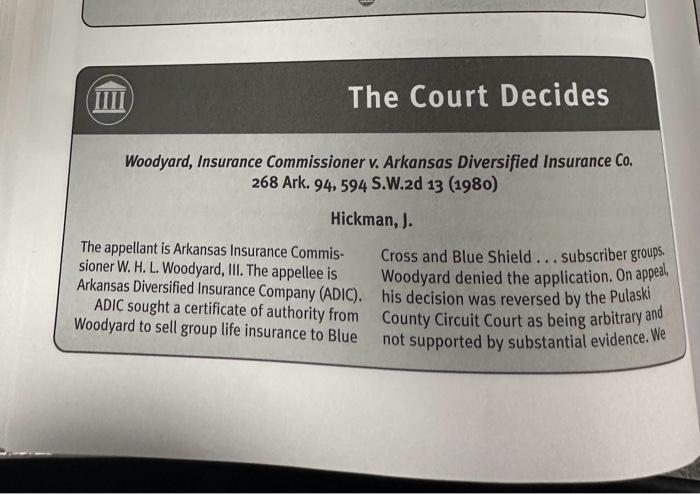
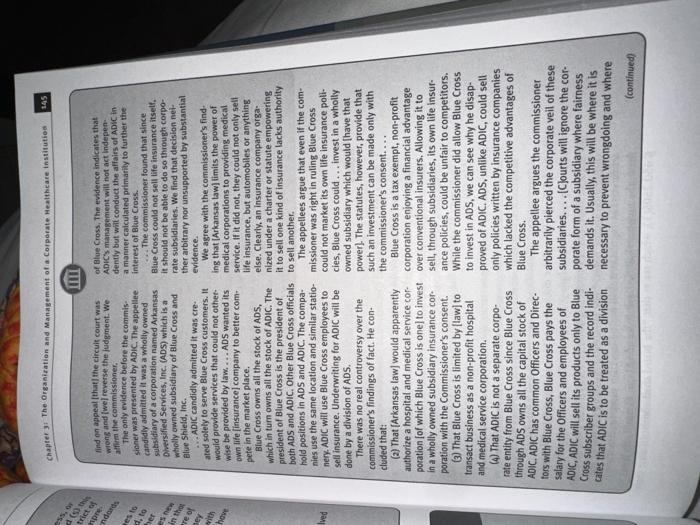
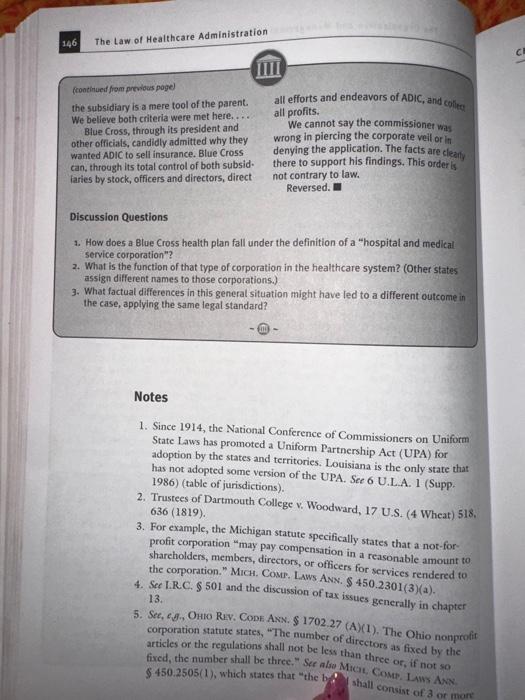
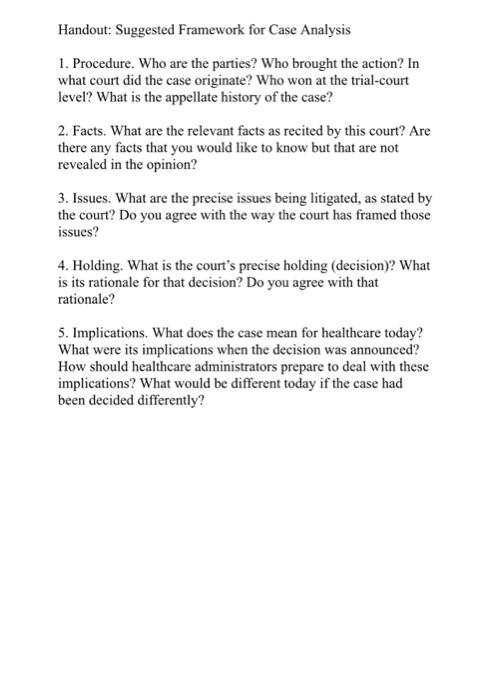
Woodyard, Insurance Commissioner v. Arkansas Diversified Insurance Co. 268 Ark. 94, 594 S.W.2d 13 (1980) Chaptef 3 : The Organization and Management of a Corperate Healtheare institutied 195 Iind on appeal [that i the circuit court was wiong and fwel reverse the judgment. We aflina the commissioner. The only evidence before the commis: sioner was presented by ADic. The appellee candidly admitted it was a mholly owned subsidiary of a corporation named Arkansas D.versified Services, Inc. (ADS) which is a mholly owned subsidiary of Btue Cross and Blise Shieid, Inc. ADIC candidly admitted it was cre. ated solely to serve Blue Cross customers. It would provide services that could not othetwise be provided by law. .... ADS wanted its own life linsurance] company to better com. pete in the market place. Blue Cross owns all the stock of ADS, which in turn owns all the stock of ADIC. The president of Blue Cross is the president of both ADS and ADIC. Other Blue Cross officials. hold positions in ADS and ADIC. The companies use the same location and similar stationery. ADIC will use Blue Cross employees to seli insurance. Underwriting for ADIC will be done by a division of ADS. There was no real controversy over the commissioner's findings of fact. He concluded that: (a) That [Arkansas law] would apparently authorize a hospital and medical service corporation lof which Blue Cross is one] to invest in a wholly owned subsidiary insurance cor* poration with the Commissioner's consent. (3) That Blue Cross is limited by [law] to transact business as a non-profit hospital and medical service corporation. (4) That ADIC is not a separate corporate entify from Blue Cross since Blue Cross through ADS owns all the capital stock of ADIC. ADIC has common Officers and Directors with Blue Cross, Blue Cross pays the salary for the Officers and employees of ADIC, ADIC will sell its products only to Blue Cross subscriber groups and the record indiates that ADIC is to be treated as a division of Blue Cross, The evidence indicates that ADICs management will not act indepen. dently but witi conduct the affairs of ADiC in a manner calculated primarily to further the interest of Blue Cross. The commissioner found that since Blue Cross could not sell life insurance itself. it should not be able to do so through corporate subsidiaries, We find that decision neither arbitrary nor unsupported by substantial evidence. We agree with the commissioner's find. ing that [Arkansas law] limits the power of medical corporations to providing medical service. If it did not, they could not only seli ife iasurance, but automobiles or anything else. Clearly, an insurance company organized under a charter or statute empowering it to sell one kind of insurance lacks authority to sell another. The appellees argue that even if the commissioner was right in ruling Blue Cross could not market its own life insurance policies, Blue Cross could.... invest in a wholly owned subsidiary which would lhave that power]. The statutes, however, provide that such an investment can be made only with the commissioner's consent.... Blue Cross is a tax exempt, non-profit corporation enjoying a financial advantage over conventional insurers, Allowing it to sell, through subsidiaries, its own life insurance policies, could be unfair to competitors. While the commissioner did allow Blue Cross to invest in ADS, we can see why he disapproved of ADIC. ADS, unlike ADIC, could sell only policies written by insurance companies which lacked the competitive advantages of Blue Cross. The appellee argues the commissioner arbitrarily pierced the corporate veil of these subsidiaries.... [C]ourts will ignore the corporate form of a subsidiary where fairness demands it. Usually, this will be where it is necessary to prevent wrongdoing and where Handout: Suggested Framework for Case Analysis 1. Procedure. Who are the parties? Who brought the action? In what court did the case originate? Who won at the trial-court level? What is the appellate history of the case? 2. Facts. What are the relevant facts as recited by this court? Are there any facts that you would like to know but that are not revealed in the opinion? 3. Issues. What are the precise issues being litigated, as stated by the court? Do you agree with the way the court has framed those issues? 4. Holding. What is the court's precise holding (decision)? What is its rationale for that decision? Do you agree with that rationale? 5. Implications. What does the case mean for healthcare today? What were its implications when the decision was announced? How should healthcare administrators prepare to deal with these implications? What would be different today if the case had been decided differently? (continued fom previous poge) the subsidiary is a mere tool of the parent. We believe both criteria were met here.... Blue Cross, through its president and other officials, candidly admitted why they wanted ADIC to sell insurance. Blue Cross can, through its total control of both subsid. iaries by stock, officers and directors, direct all efforts and endeavors of ADIC, and collto all profits. We cannot say the commissioner was wrong in piercing the corporate veil or it denying the application. The facts are cleatly there to support his findings. This order is not contrary to law. Reversed. Discussion Questions 1. How does a Blue Cross health plan fall under the definition of a "hospital and medical service corporation"? 2. What is the function of that type of corporation in the healthcare system? (Other states assign different names to those corporations.) 3. What factual differences in this general situation might have led to a different outcome in the case, applying the same legal standard? Notes 1. Since 1914, the National Conference of Commissioners on Uniform State Laws has promoted a Uniform Partnership Act (UPA) for adoption by the states and territories. Louisiana is the only state that has not adopted some version of the UPA. See 6 U.L.A. 1 (Supp. 1986) (table of jurisdictions). 2. Trustees of Dartmouth College v. Woodward, 17 U.S. (4 Wheat) 518 , 636(1819). 3. For example, the Michigan statute specifically states that a not-forprofit corporation "may pay compensation in a reasonable amount to sharcholders, members, directors, or officers for services rendered to the corporation." Mich. Comp. Laws ANN. $450.2301 (3)(a). 4. See I.R.C. $501 and the discussion of tax issues generally in chapter 13. 5. See, esf, Ohio Ruv. Copf Axs. $1702.27 (A)(1). The Ohio nonprofit corporation statute states, "The number of directors as fixed by the articles or the regulations shall not be less than three or, if not so fixed, the number shall be three." See also Mtent. Come, Laws ANx. 9450.2505(1), which states that "the by d shall consist of 3 or morr
Step by Step Solution
There are 3 Steps involved in it

Get step-by-step solutions from verified subject matter experts
 Study Help