







Question: Please give a complete answer to every point Suppose that in Australia there is a social aggregation rule, F, that is used to aggregate preferences
 Please give a complete answer to every point
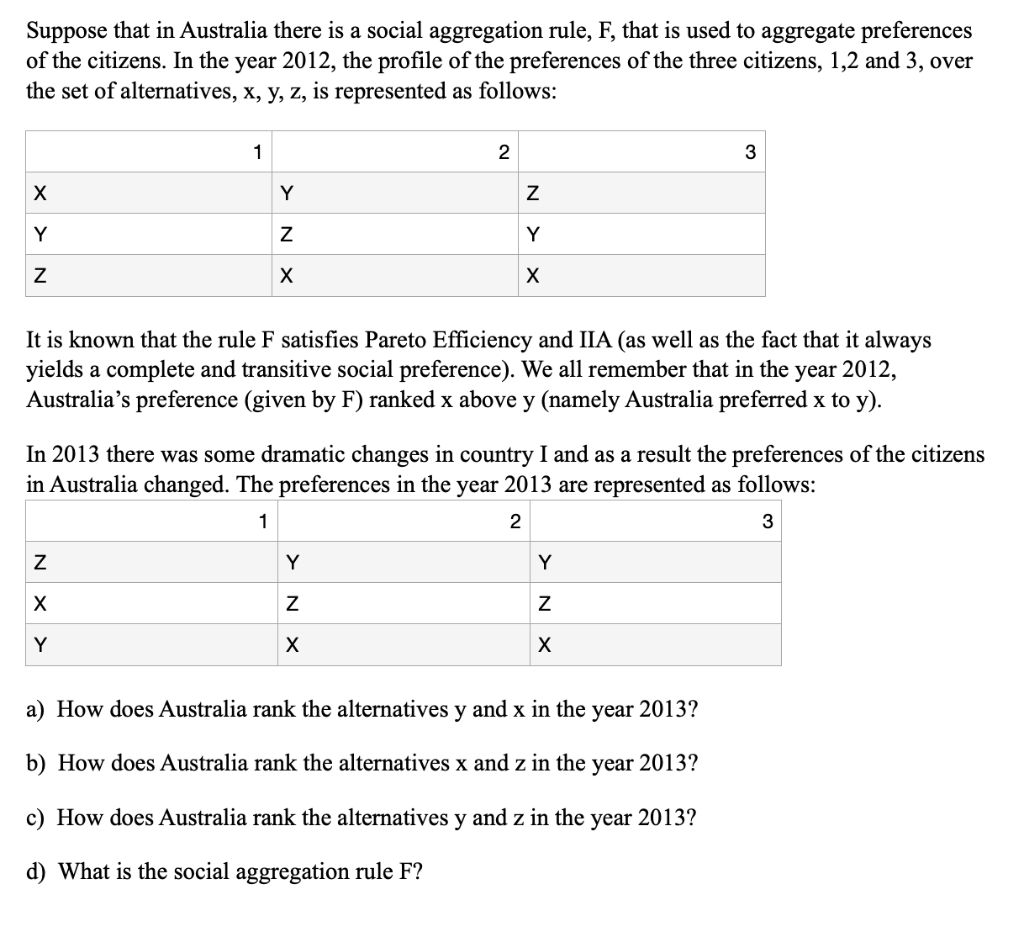
Suppose that in Australia there is a social aggregation rule, F, that is used to aggregate preferences of the citizens. In the year 2012, the profile of the preferences of the three citizens, 1,2 and 3, over the set of alternatives, x, y, z, is represented as follows: 1 2 3 x Y z Y Z Y z It is known that the rule F satisfies Pareto Efficiency and IIA (as well as the fact that it always yields a complete and transitive social preference). We all remember that in the year 2012, Australia's preference (given by F) ranked x above y (namely Australia preferred x to y). In 2013 there was some dramatic changes in country I and as a result the preferences of the citizens in Australia changed. The preferences in the year 2013 are represented as follows: 1 2 3 Z Y Y X z Z Y X a) How does Australia rank the alternatives y and x in the year 2013? b) How does Australia rank the alternatives x and z in the year 2013? z c) How does Australia rank the alternatives y and z in the year 2013? d) What is the social aggregation rule F? Suppose that in Australia there is a social aggregation rule, F, that is used to aggregate preferences of the citizens. In the year 2012, the profile of the preferences of the three citizens, 1,2 and 3, over the set of alternatives, x, y, z, is represented as follows: 1 2 3 x Y z Y Z Y z It is known that the rule F satisfies Pareto Efficiency and IIA (as well as the fact that it always yields a complete and transitive social preference). We all remember that in the year 2012, Australia's preference (given by F) ranked x above y (namely Australia preferred x to y). In 2013 there was some dramatic changes in country I and as a result the preferences of the citizens in Australia changed. The preferences in the year 2013 are represented as follows: 1 2 3 Z Y Y X z Z Y X a) How does Australia rank the alternatives y and x in the year 2013? b) How does Australia rank the alternatives x and z in the year 2013? z c) How does Australia rank the alternatives y and z in the year 2013? d) What is the social aggregation rule F
Step by Step Solution
There are 3 Steps involved in it

Get step-by-step solutions from verified subject matter experts
 Study Help