







Question: Please give a new answer. Dont copy paste from web. Thank you. Given case: Loyola was founded in 1981 in the United Kingdom by two
Please give a new answer. Dont copy paste from web. Thank you.
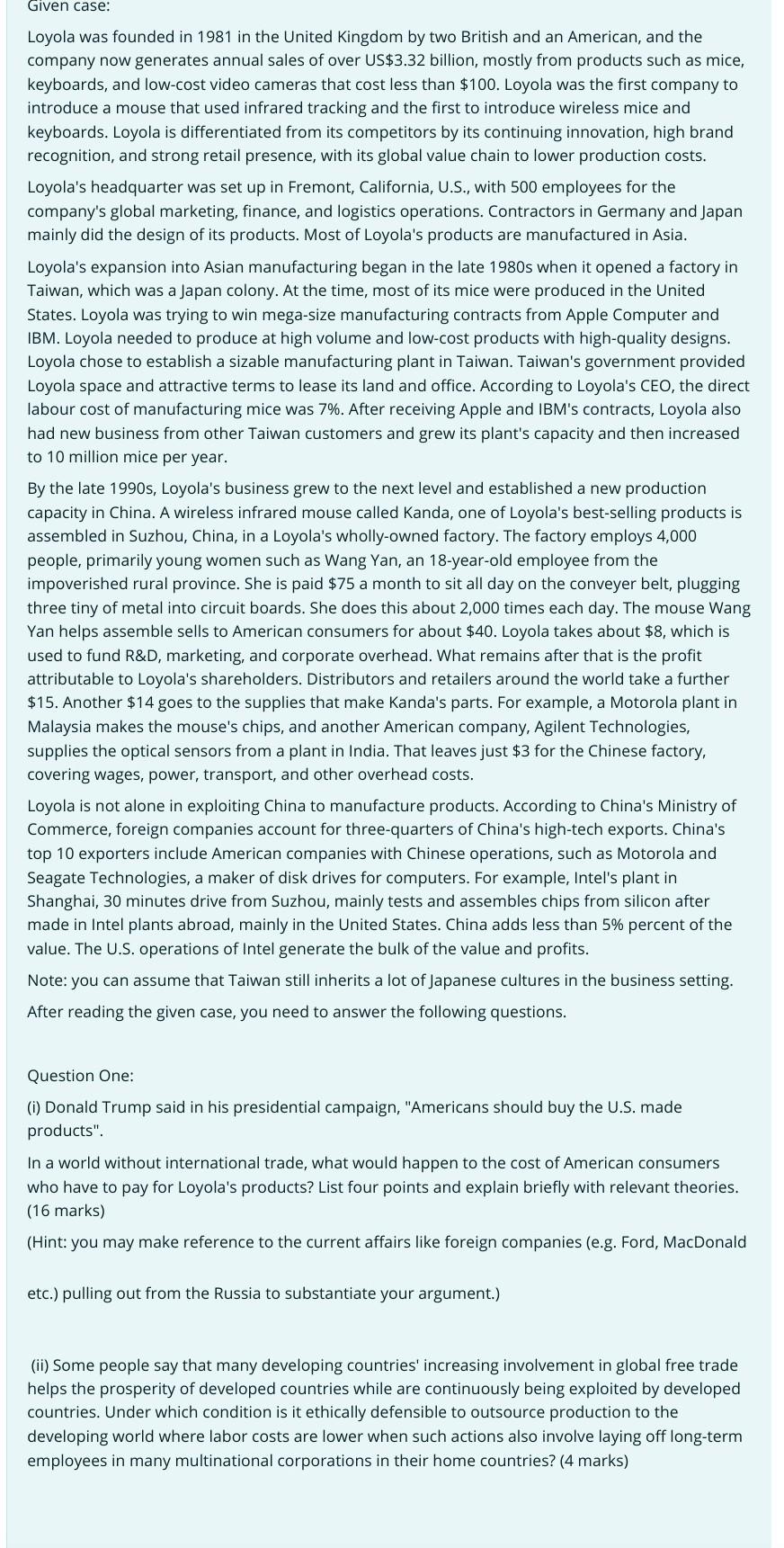
Given case: Loyola was founded in 1981 in the United Kingdom by two British and an American, and the company now generates annual sales of over US$3.32 billion, mostly from products such as mice, keyboards, and low-cost video cameras that cost less than $100. Loyola was the first company to introduce a mouse that used infrared tracking and the first to introduce wireless mice and keyboards. Loyola is differentiated from its competitors by its continuing innovation, high brand recognition, and strong retail presence, with its global value chain to lower production costs. Loyola's headquarter was set up in Fremont, California, U.S., with 500 employees for the company's global marketing, finance, and logistics operations. Contractors in Germany and Japan mainly did the design of its products. Most of Loyola's products are manufactured in Asia. Loyola's expansion into Asian manufacturing began in the late 1980s when it opened a factory in Taiwan, which was a Japan colony. At the time, most of its mice were produced in the United States. Loyola was trying to win mega-size manufacturing contracts from Apple Computer and IBM. Loyola needed to produce at high volume and low-cost products with high-quality designs. Loyola chose to establish a sizable manufacturing plant in Taiwan Taiwan's government provided Loyola space and attractive terms to lease its land and office. According to Loyola's CEO, the direct labour cost of manufacturing mice was 7%. After receiving Apple and IBM's contracts, Loyola also had new business from other Taiwan customers and grew its plant's capacity and then increased to 10 million mice per year. By the late 1990s, Loyola's business grew to the next level and established a new production capacity in China. A wireless infrared mouse called Kanda, one of Loyola's best-selling products is assembled in Suzhou, China, in a Loyola's wholly-owned factory. The factory employs 4,000 people, primarily young women such as Wang Yan, an 18-year-old employee from the impoverished rural province. She is paid $75 a month to sit all day on the conveyer belt, plugging three tiny of metal into circuit boards. She does this about 2,000 times each day. The mouse Wang Yan helps assemble sells to American consumers for about $40. Loyola takes about $8, which is used to fund R&D, marketing, and corporate overhead. What remains after that is the profit attributable to Loyola's shareholders. Distributors and retailers around the world take a further $15. Another $14 goes to the supplies that make Kanda's parts. For example, a Motorola plant in Malaysia makes the mouse's chips, and another American company, Agilent Technologies, supplies the optical sensors from a plant in India. That leaves just $3 for the Chinese factory, covering wages, power, transport, and other overhead costs. Loyola is not alone in exploiting China to manufacture products. According to China's Ministry of Commerce, foreign companies account for three-quarters of China's high-tech exports. China's top 10 exporters include American companies with Chinese operations, such as Motorola and Seagate Technologies, a maker of disk drives for computers. For example, Intel's plant in Shanghai, 30 minutes drive from Suzhou, mainly tests and assembles chips from silicon after made in Intel plants abroad, mainly in the United States. China adds less than 5% percent of the value. The U.S. operations of Intel generate the bulk of the value and profits. Note: you can assume that Taiwan still inherits a lot of Japanese cultures in the business setting. After reading the given case, you need to answer the following questions. Question One: (i) Donald Trump said in his presidential campaign, "Americans should buy the U.S. made products". In a world without international trade, what would happen to the cost of American consumers who have to pay for Loyola's products? List four points and explain briefly with relevant theories. (16 marks) (Hint: you may make reference to the current affairs like foreign companies (e.g. Ford, MacDonald etc.) pulling out from the Russia to substantiate your argument.) (ii) Some people say that many developing countries' increasing involvement in global free trade helps the prosperity of developed countries while are continuously being exploited by developed countries. Under which condition is it ethically defensible to outsource production to the developing world where labor costs are lower when such actions also involve laying off long-term employees in many multinational corporations in their home countries? (4 marks)Step by Step Solution
There are 3 Steps involved in it
1 Expert Approved Answer
Step: 1 Unlock

Question Has Been Solved by an Expert!
Get step-by-step solutions from verified subject matter experts
Step: 2 Unlock
Step: 3 Unlock
 Study Help