Question: please give a short summary about kidnapping Men Rea KIDNAPPING MENS REA Kidnapping mense means the specific intent to confine, significantly restrain, or hold victims
please give a short summary about kidnapping Men Rea
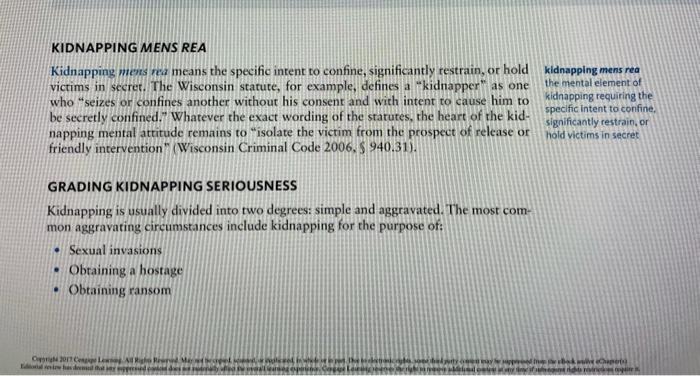
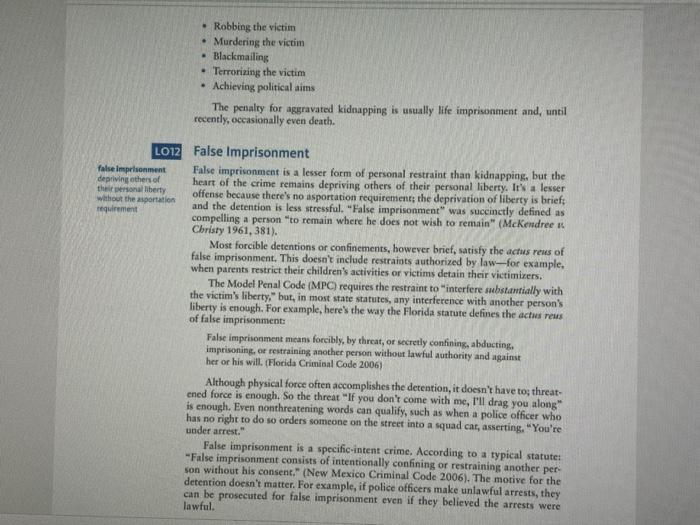
KIDNAPPING MENS REA Kidnapping mense means the specific intent to confine, significantly restrain, or hold victims in secret. The Wisconsin statute, for example, defines a "kidnapper" as one who seizes or confines another without his consent and with intent to cause him to be secretly confined." Whatever the exact wording of the statutes, the heart of the kid- napping mental attitude remains to "isolate the victim from the prospect of release or friendly intervention (Wisconsin Criminal Code 2006, 940.31). kidnapping mens rea the mental element of kidnapping requiring the specific intent to confine, significantly restrain, or hold victims in secret GRADING KIDNAPPING SERIOUSNESS Kidnapping is usually divided into two degrees: simple and aggravated. The most com- mon aggravating circumstances include kidnapping for the purpose of: Sexual invasions Obtaining a hostage Obtaining ransom Oporte Mewah Anwar lebihan . Robbing the victim Murdering the victim Blackmailing Terrorizing the victim Achieving political aims The penalty for aggravated kidnapping is usually life imprisonment and, until recently, occasionally even death. LO12 False Imprisonment false imprisonment False imprisonment is a lesser form of personal restraint than kidnapping, but the depriving others of heart of the crime remains depriving others of their personal liberty. It's a lesser theolliberty offense because there's no asportation requirement: the deprivation of liberty is brief without the portation and the detention is less stressful. "False imprisonment was succinctly defined as requirement compelling a person to remain where he does not wish to remain" (McKendree Christy 1961,381). Most forcible detentions or confinements, however brief, satisfy the actus rews of false imprisonment. This doesn't include restraints authorized by law--for example, when parents restrict their children's activities or victims detain their victimizers. The Model Penal Code (MPC) requires the restraint to "interfere substantially with the victim's liberty, but, in most state statutes, any interference with another person's liberty is enough. For example, here's the way the Florida statute defines the actus reus of false imprisonment: False imprisonment means forcibly, by threat, or secretly confining, abducting. imprisoning, or restraining another person without lawful authority and against her or his will. (Florida Criminal Code 2006) Although physical force often accomplishes the detention, it doesn't have to; threat- ened force is enough. So the threat "If you don't come with me, I'll drag you along is enough. Even nonthreatening words can qualify, such as when a police officer who has no right to do so orders someone on the street into a squad car, asserting. "You're under arrest." False imprisonment is a specific intent crime. According to a typical statute "False imprisonment consists of intentionally confining or restraining another per son without his consent." (New Mexico Criminal Code 2006). The motive for the detention doesn't matter. For example, if police officers make unlawful arrests, they can be prosecuted for false imprisonment even if they believed the arrests were lawful