



Question: please give some insight into the question below. see the scenario attached Create a WH Framework chart, similar to Exhibit 2.1. Refer to L'Oreal's core
please give some insight into the question below.
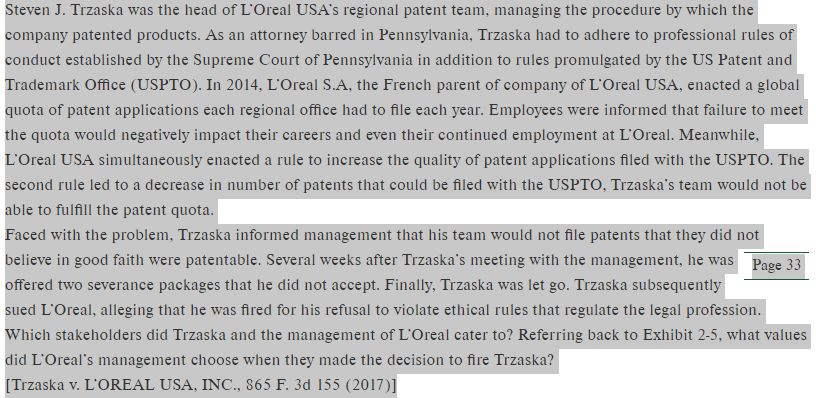
see the scenario attached
Create a WH Framework chart, similar to Exhibit 2.1. Refer to L'Oreal's core values and the primary values in Exhibit 2.3 to determine the guidelines to include in the WH Framework.
give an explanation of how you decided on the list of stakeholders and guidelines to include in your WH Framework. Address the following questions in your explanation:
- Which stakeholders did Traszka and the management of L'Oreal cater to? Why?
- What values did L'Oreal's management choose when they made the decision to fire Trzaska? Why?
Self-Reflection
In addition to your explanation, address the following self-reflection questions:
- How did the WH Framework help you analyze the situation?
- Now that you've put together the framework, how does the WH Framework help managers with making business decisions?
- What type of decisions would the WH Framework chart help you make as a manager?
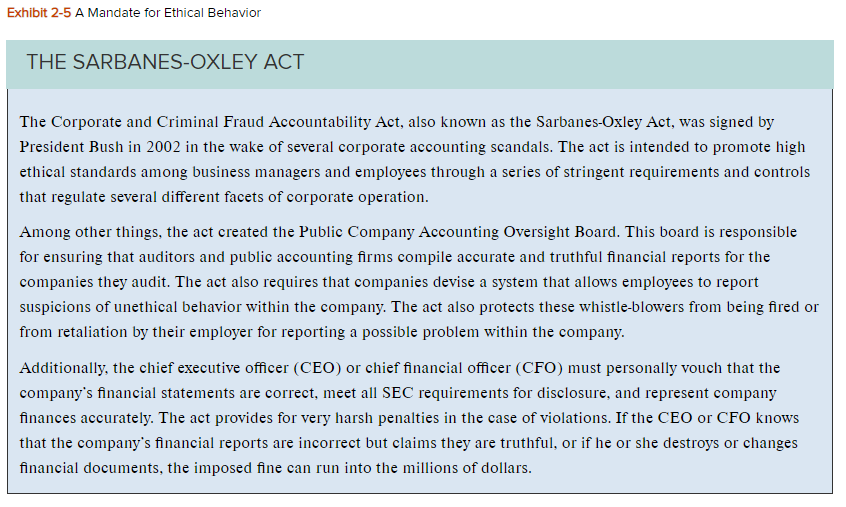
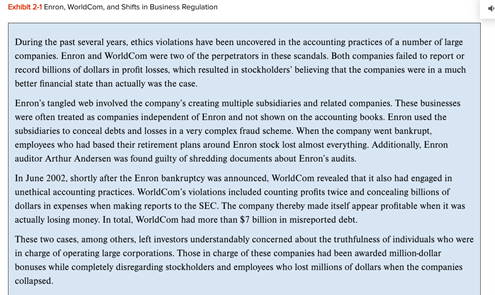
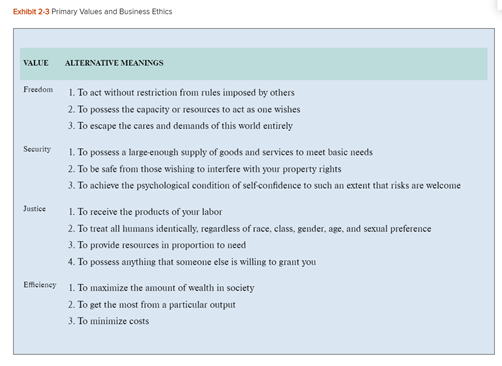
\fExhibit 25 A Mandate for Ethical Behavior THE SARBANESDXLEY ACT The Corporate and Criminal Fraud Accountability Act, also known as the Sarbaneerxley Act, was signed by President Bush in 2002 in the wake of several corporate accounting scandals. The act is intended to promote high ethical standards among business managers and employees through a series of stringent requirements and controls that regulate several different facets of corporate operation. Among other things, the act created the Public Company Accounting Oversight Board. This board is responsible for ensuring that auditors and public accounting rms compile accurate and truthful nancial reports for the companies they audit. The act also requires that companies devise a system that allows employees to report suspicions of unethical behavior 1within the company. The act also protects these Whistleblowers from being red or from retaliation bytheir employer for reporting a possible problem Within the company. Additionally, the chief executive otcer (CEO) or chief nancial ofcer (CFO) must personally vouch that the company's nancial statements are correct, meet all SEC requirements for disclosure, and represent company nances accurately. The act provides for very harsh penalties in the case of violations. If the CEO or CFO knows that the company's nancial reports are incorrect but claims they are truthful, or if he or she destroys or changes nancial documents, the imposed ne can run into the millions of dollars. Exhibit 2-1 Enron, WorldCom, and Shifts in Business Regulation During the past several years, ethics violations have been uncovered in the accounting practices of a number of large companies. Enron and WorldCom were two of the perpetrators in these scandals. Both companies failed to report or record billions of dollars in profit losses, which resulted in stockholders' believing that the companies were in a much better financial state than actually was the case. Enron's tangled web involved the company's creating multiple subsidiaries and related companies. These businesses were often treated as companies independent of Enron and not shown on the accounting books. Enron used the subsidiaries to conceal debts and losses in a very complex fraud scheme. When the company went bankrupt. employees who had based their retirement plans around Enron stock lost almost everything. Additionally. Enron auditor Arthur Andersen was found guilty of shredding documents about Enron's audits. In June 2002, shortly after the Enron bankruptcy was announced, WorldCom revealed that it also had engaged in unethical accounting practices. WorldCom's violations included counting profits twice and concealing billions of dollars in expenses when making reports to the SEC. The company thereby made itself appear profitable when it was actually losing money. In total. WorldCom had more than $7 billion in misreported debt. These two cases, among others, left investors understandably concerned about the truthfulness of individuals who were in charge of operating large corporations. Those in charge of these companies had been awarded million-dollar bonuses while completely disregarding stockholders and employees who lost millions of dollars when the companies collapsed.Exhibit 2-3 Primary Values and Business Ethics VALUE ALTERNATIVE MEANINGS Freedom 1. To act without restriction from rules imposed by others 2. To possess the capacity or resources to act as one wishes 3. To escape the cares and demands of this world entirely Security 1. To possess a large enough supply of goods and services to meet basic needs 2. To be safe from those wishing to interfere with your property rights 3. To achieve the psychological condition of self confidence to such an extent that risks are welcome Justice I. To receive the products of your labor 2. To treat all humans identically, regardless of race, class, gender, age, and sexual preference 3. To provide resources in proportion to need 4. To possess anything that someone else is willing to grant you Emelency 1. To maximize the amount of wealth in society 2. To get the most from a particular output 3. To minimize costs
Step by Step Solution
There are 3 Steps involved in it

Get step-by-step solutions from verified subject matter experts