







Question: Please graph Blanks are: 1: fall or rise. 2: 0.5 billion or 2 billion or 1 billion. 3:increase or decrease 4: 2 billion or 0.8
Please graph
Blanks are:
1: fall or rise.
2: 0.5 billion or 2 billion or 1 billion.
3:increase or decrease
4: 2 billion or 0.8 Billion or 1 Billion
5: Automatic stabilizer, Multiplier, crowding-out or liquidity preference
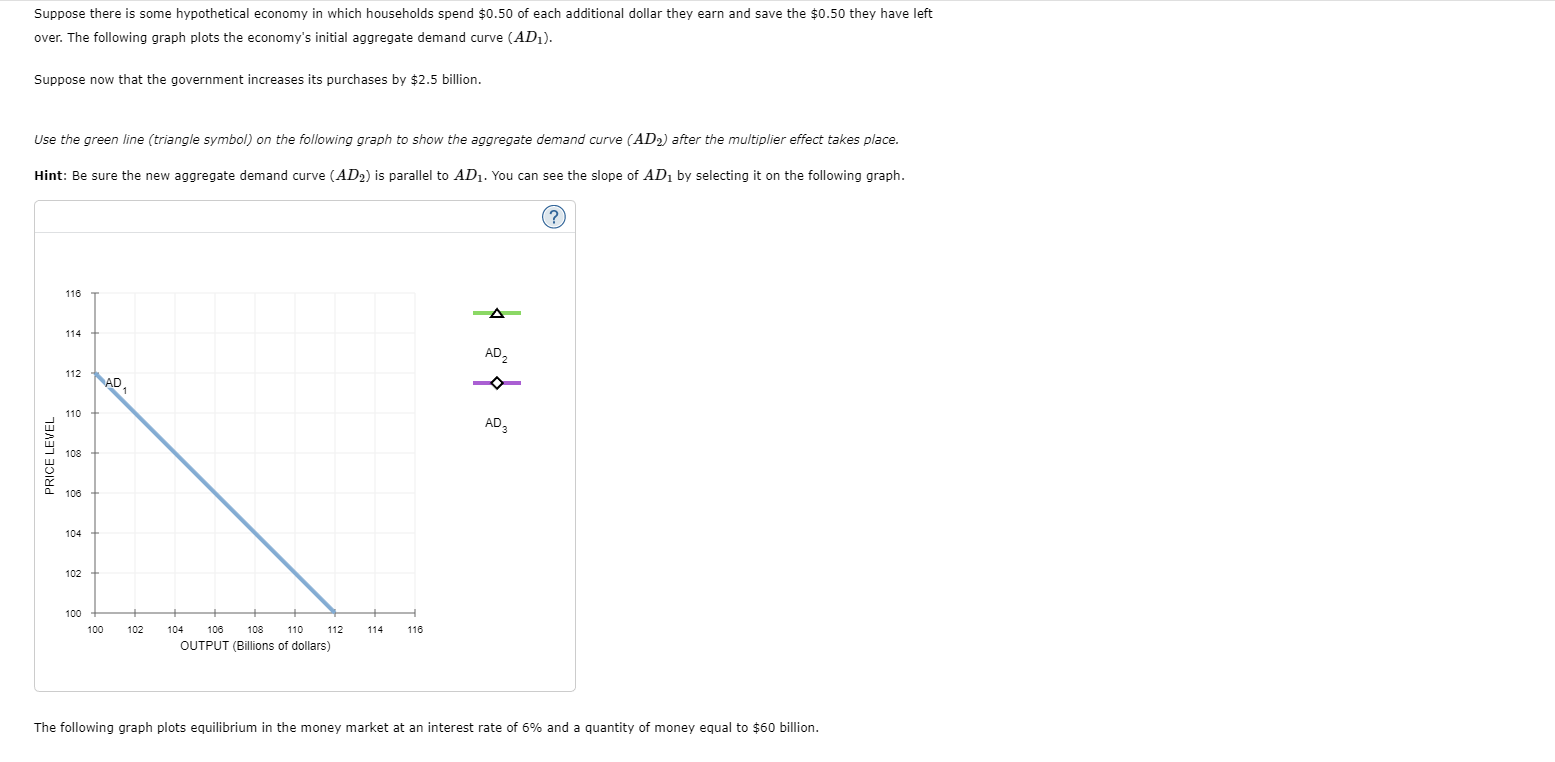
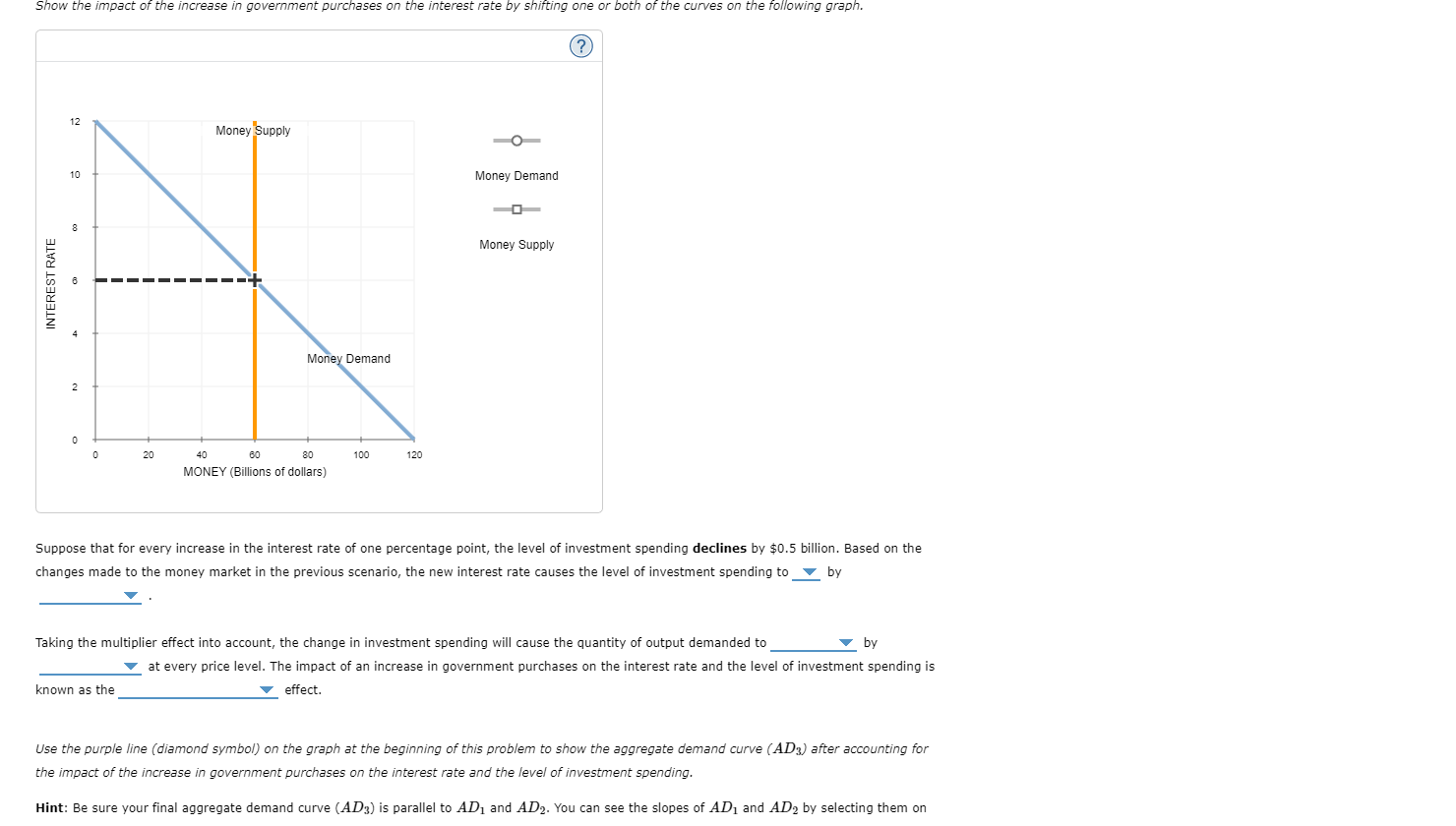
Suppose there is some hypothetical economy in which households spend $0.50 of each additional dollar they earn and save the $0.50 they have left over. The following graph plots the economy's initial aggregate demand curve (AD1). Suppose now that the government increases its purchases by $2.5 billion. Use the green line (triangle symbol) on the following graph to show the aggregate demand curve (AD D2 ) after the multiplier effect takes place. Hint: Be sure the new aggregate demand curve (AD2) is parallel to AD1. You can see the slope of AD1 by selecting it on the following graph. The following graph plots equilibrium in the money market at an interest rate of 6% and a quantity of money equal to $60 billion. Suppose that for every increase in the interest rate of one percentage point, the level of investment spending declines by $0.5 billion. Based on the changes made to the money market in the previous scenario, the new interest rate causes the level of investment spending to Taking the multiplier effect into account, the change in investment spending will cause the quantity of output demanded to by at every price level. The impact of an increase in government purchases on the interest rate and the level of investment spending is known as the effect. Use the purple line (diamond symbol) on the graph at the beginning of this problem to show the aggregate demand curve (AD 3 ) after accounting for the impact of the increase in government purchases on the interest rate and the level of investment spending. Hint: Be sure your final aggregate demand curve (AD3) is parallel to AD1 and AD2. You can see the slopes of AD1 and AD2 by selecting them on Suppose there is some hypothetical economy in which households spend $0.50 of each additional dollar they earn and save the $0.50 they have left over. The following graph plots the economy's initial aggregate demand curve (AD1). Suppose now that the government increases its purchases by $2.5 billion. Use the green line (triangle symbol) on the following graph to show the aggregate demand curve (AD D2 ) after the multiplier effect takes place. Hint: Be sure the new aggregate demand curve (AD2) is parallel to AD1. You can see the slope of AD1 by selecting it on the following graph. The following graph plots equilibrium in the money market at an interest rate of 6% and a quantity of money equal to $60 billion. Suppose that for every increase in the interest rate of one percentage point, the level of investment spending declines by $0.5 billion. Based on the changes made to the money market in the previous scenario, the new interest rate causes the level of investment spending to Taking the multiplier effect into account, the change in investment spending will cause the quantity of output demanded to by at every price level. The impact of an increase in government purchases on the interest rate and the level of investment spending is known as the effect. Use the purple line (diamond symbol) on the graph at the beginning of this problem to show the aggregate demand curve (AD 3 ) after accounting for the impact of the increase in government purchases on the interest rate and the level of investment spending. Hint: Be sure your final aggregate demand curve (AD3) is parallel to AD1 and AD2. You can see the slopes of AD1 and AD2 by selecting them on
Step by Step Solution
There are 3 Steps involved in it

Get step-by-step solutions from verified subject matter experts
 Study Help