







Question: Please guide me on this question 6 Cold Starch Lid is a company which produces cold water starch for the dry cleaning industry. The process
Please guide me on this question
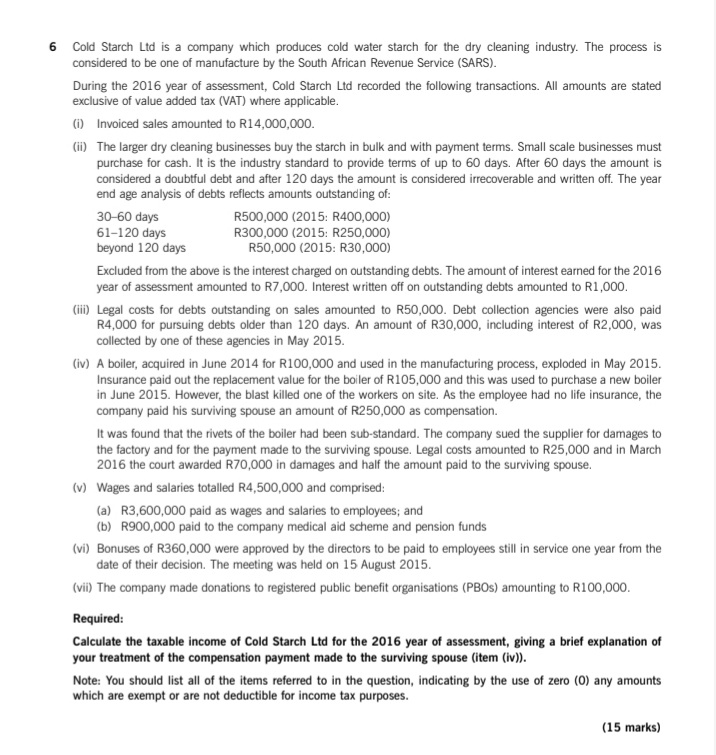
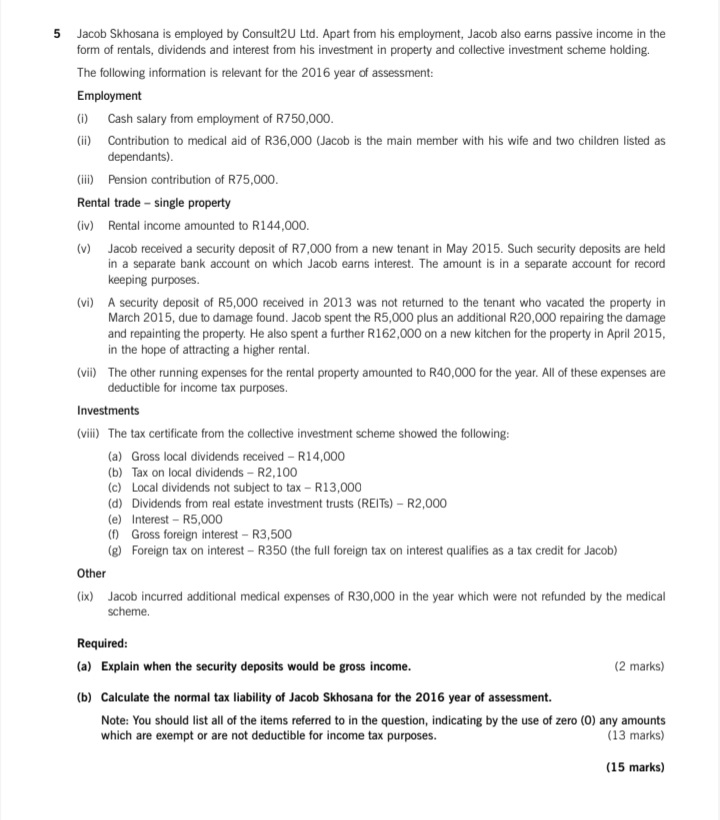
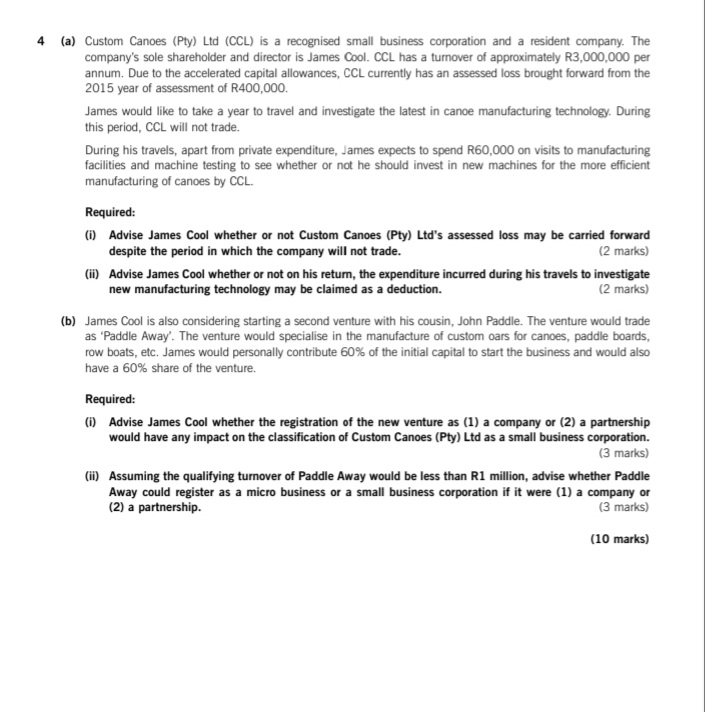
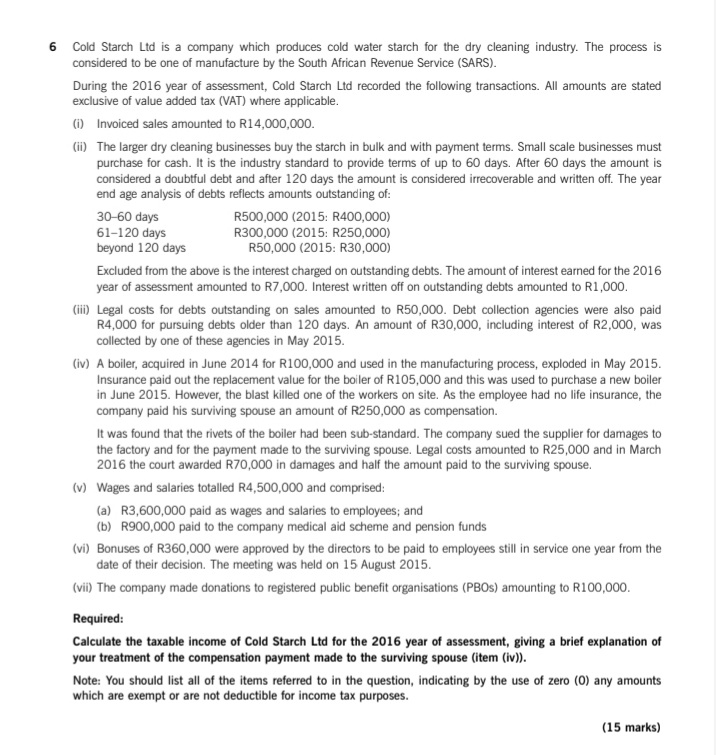
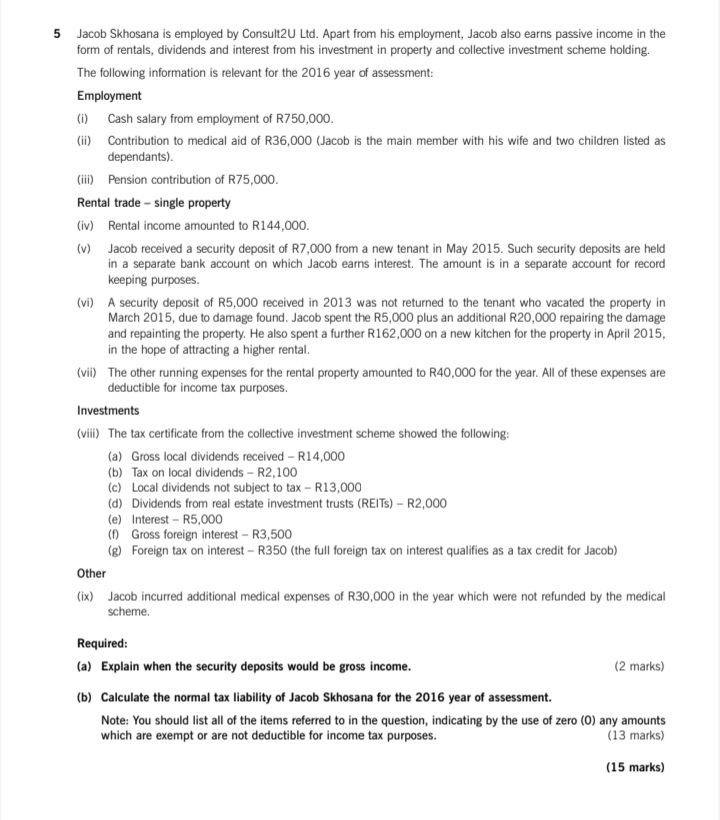
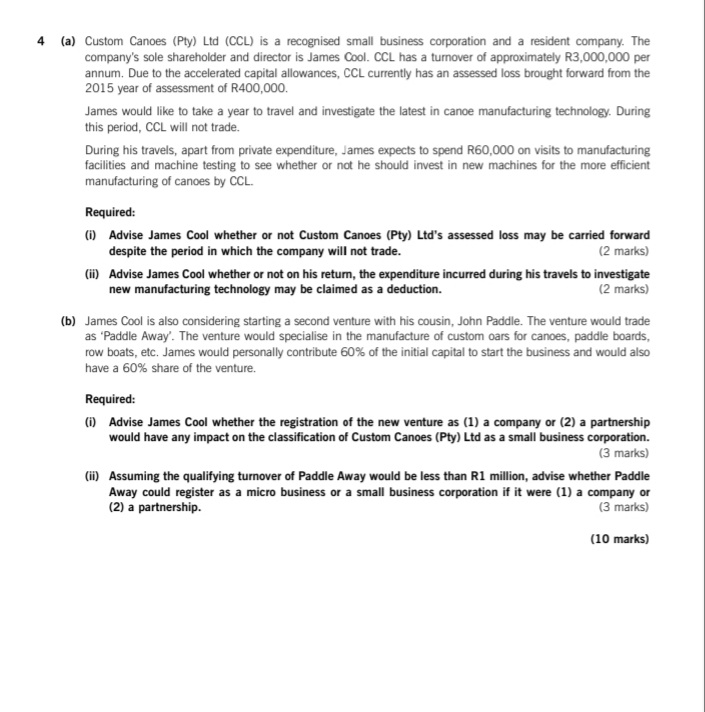
6 Cold Starch Lid is a company which produces cold water starch for the dry cleaning industry. The process is considered to be one of manufacture by the South African Revenue Service (SARS). During the 2016 year of assessment, Cold Starch Lid recorded the following transactions. All amounts are stated exclusive of value added tax (VAT) where applicable. (i) Invoiced sales amounted to R14,000,000. (ii) The larger dry cleaning businesses buy the starch in bulk and with payment terms. Small scale businesses must purchase for cash. It is the industry standard to provide terms of up to 60 days. After 60 days the amount is considered a doubtful debt and after 120 days the amount is considered irrecoverable and written off. The year end age analysis of debts reflects amounts outstanding of: 30-60 days R500,000 (2015: R400,000) 61-120 days R300,000 (2015: R250,000) beyond 120 days R50,000 (2015: R30,000) Excluded from the above is the interest charged on outstanding debts. The amount of interest earned for the 2016 year of assessment amounted to R7,000. Interest written off on outstanding debts amounted to R1,000. (iii) Legal costs for debts outstanding on sales amounted to R50,000. Debt collection agencies were also paid R4,000 for pursuing debts older than 120 days. An amount of R30,000, including interest of R2,000, was collected by one of these agencies in May 2015 (iv) A boiler, acquired in June 2014 for R100,000 and used in the manufacturing process, exploded in May 2015. Insurance paid out the replacement value for the boiler of R105,000 and this was used to purchase a new boiler in June 2015. However, the blast killed one of the workers on site. As the employee had no life insurance, the company paid his surviving spouse an amount of R250,000 as compensation. It was found that the rivets of the boiler had been sub-standard. The company sued the supplier for damages to the factory and for the payment made to the surviving spouse. Legal costs amounted to R25,000 and in March 2016 the court awarded R70,000 in damages and half the amount paid to the surviving spouse. (v) Wages and salaries totalled R4,500,000 and comprised: (a) R3,600,000 paid as wages and salaries to employees; and (b) R900,000 paid to the company medical aid scheme and pension funds (vi) Bonuses of R360,000 were approved by the directors to be paid to employees still in service one year from the date of their decision. The meeting was held on 15 August 2015. (vii) The company made donations to registered public benefit organisations (PBOs) amounting to R100,000. Required: Calculate the taxable income of Cold Starch Lid for the 2016 year of assessment, giving a brief explanation of your treatment of the compensation payment made to the surviving spouse (item (iv)). Note: You should list all of the items referred to in the question, indicating by the use of zero (0) any amounts which are exempt or are not deductible for income tax purposes. (15 marks)5 Jacob Skhosana is employed by Consult2U Ltd. Apart from his employment, Jacob also earns passive income in the form of rentals, dividends and interest from his investment in property and collective investment scheme holding. The following information is relevant for the 2016 year of assessment: Employment (i) Cash salary from employment of R750,000. (ii) Contribution to medical aid of R36,000 (Jacob is the main member with his wife and two children listed as dependants). (iii) Pension contribution of R75,000. Rental trade - single property (iv) Rental income amounted to R144,000. (v) Jacob received a security deposit of R7,000 from a new tenant in May 2015. Such security deposits are held in a separate bank account on which Jacob earns interest. The amount is in a separate account for record keeping purposes. (vi) A security deposit of R5,000 received in 2013 was not returned to the tenant who vacated the property in March 2015, due to damage found. Jacob spent the R5,000 plus an additional R20,000 repairing the damage and repainting the property. He also spent a further R162,000 on a new kitchen for the property in April 2015, in the hope of attracting a higher rental. (vii) The other running expenses for the rental property amounted to R40,000 for the year. All of these expenses are deductible for income tax purposes. Investments (vili) The tax certificate from the collective investment scheme showed the following: (a) Gross local dividends received - R14,000 (b) Tax on local dividends - R2,100 (c) Local dividends not subject to tax - R13,000 (d) Dividends from real estate investment trusts (REITs) - R2,000 (e) Interest - R5,000 (f) Gross foreign interest - R3,500 (g) Foreign tax on interest - R350 (the full foreign tax on interest qualifies as a tax credit for Jacob) Other (ix) Jacob incurred additional medical expenses of R30,000 in the year which were not refunded by the medical scheme. Required: (a) Explain when the security deposits would be gross income. (2 marks) (b) Calculate the normal tax liability of Jacob Skhosana for the 2016 year of assessment. Note: You should list all of the items referred to in the question, indicating by the use of zero (0) any amounts which are exempt or are not deductible for income tax purposes. (13 marks) (15 marks)4 (a) Custom Canoes (Pty) Lid (CCL) is a recognised small business corporation and a resident company. The company's sole shareholder and director is James Cool. CCL has a turnover of approximately R3,000,000 per annum. Due to the accelerated capital allowances, CCL currently has an assessed loss brought forward from the 2015 year of assessment of R400,000. James would like to take a year to travel and investigate the latest in canoe manufacturing technology. During this period, CCL will not trade. During his travels, apart from private expenditure, James expects to spend R60,000 on visits to manufacturing facilities and machine testing to see whether or not he should invest in new machines for the more efficient manufacturing of canoes by CCL. Required: 1) Advise James Cool whether or not Custom Canoes (Pty) Ltd's assessed loss may be carried forward despite the period in which the company will not trade. (2 marks) (ii) Advise James Cool whether or not on his return, the expenditure incurred during his travels to investigate new manufacturing technology may be claimed as a deduction. (2 marks) (b) James Cool is also considering starting a second venture with his cousin, John Paddle. The venture would trade as 'Paddle Away'. The venture would specialise in the manufacture of custom oars for canoes, paddle boards, row boats, etc. James would personally contribute 60% of the initial capital to start the business and would also have a 60% share of the venture. Required: (i) Advise James Cool whether the registration of the new venture as (1) a company or (2) a partnership would have any impact on the classification of Custom Canoes (Pty) Ltd as a small business corporation. (3 marks) (ii) Assuming the qualifying turnover of Paddle Away would be less than R1 million, advise whether Paddle Away could register as a micro business or a small business corporation if it were (1) a company or (2) a partnership. (3 marks) (10 marks)
Step by Step Solution
There are 3 Steps involved in it

Get step-by-step solutions from verified subject matter experts
 Study Help