







Question: Please hand draw and answer all questions BB 314 Unit 2 - Membranes Purpose: Data analysis and logical reasoning are important skills for any future
Please hand draw and answer all questions
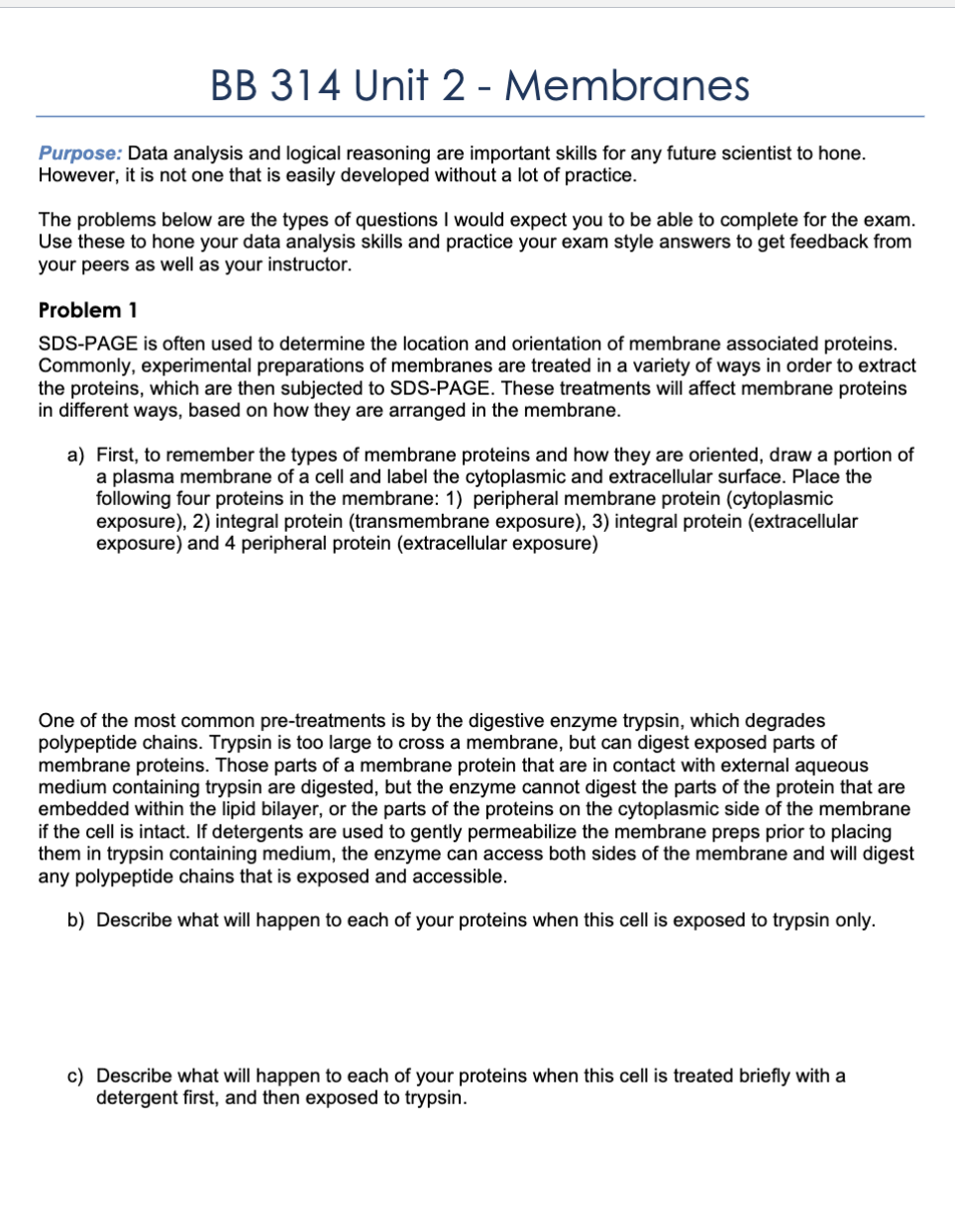
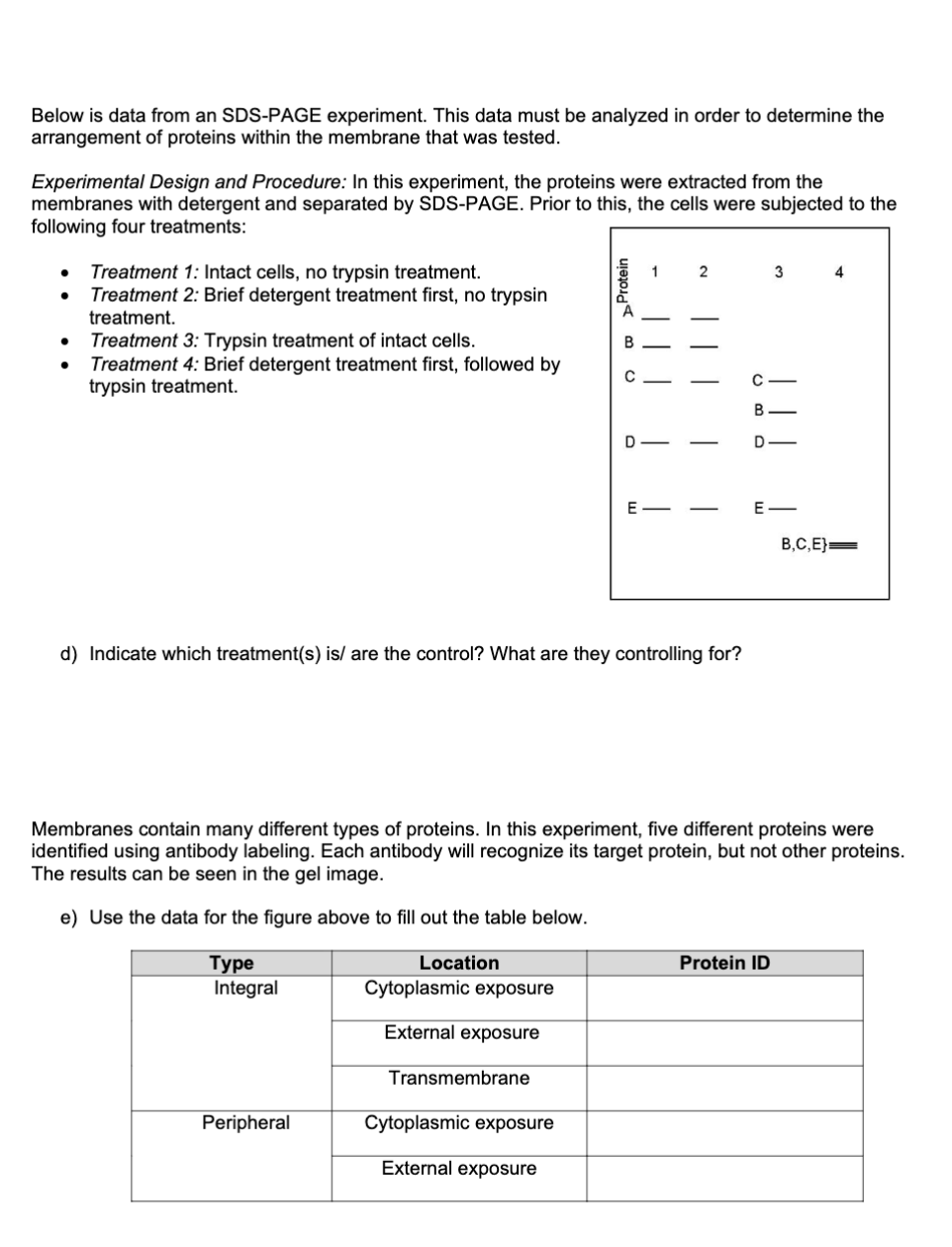
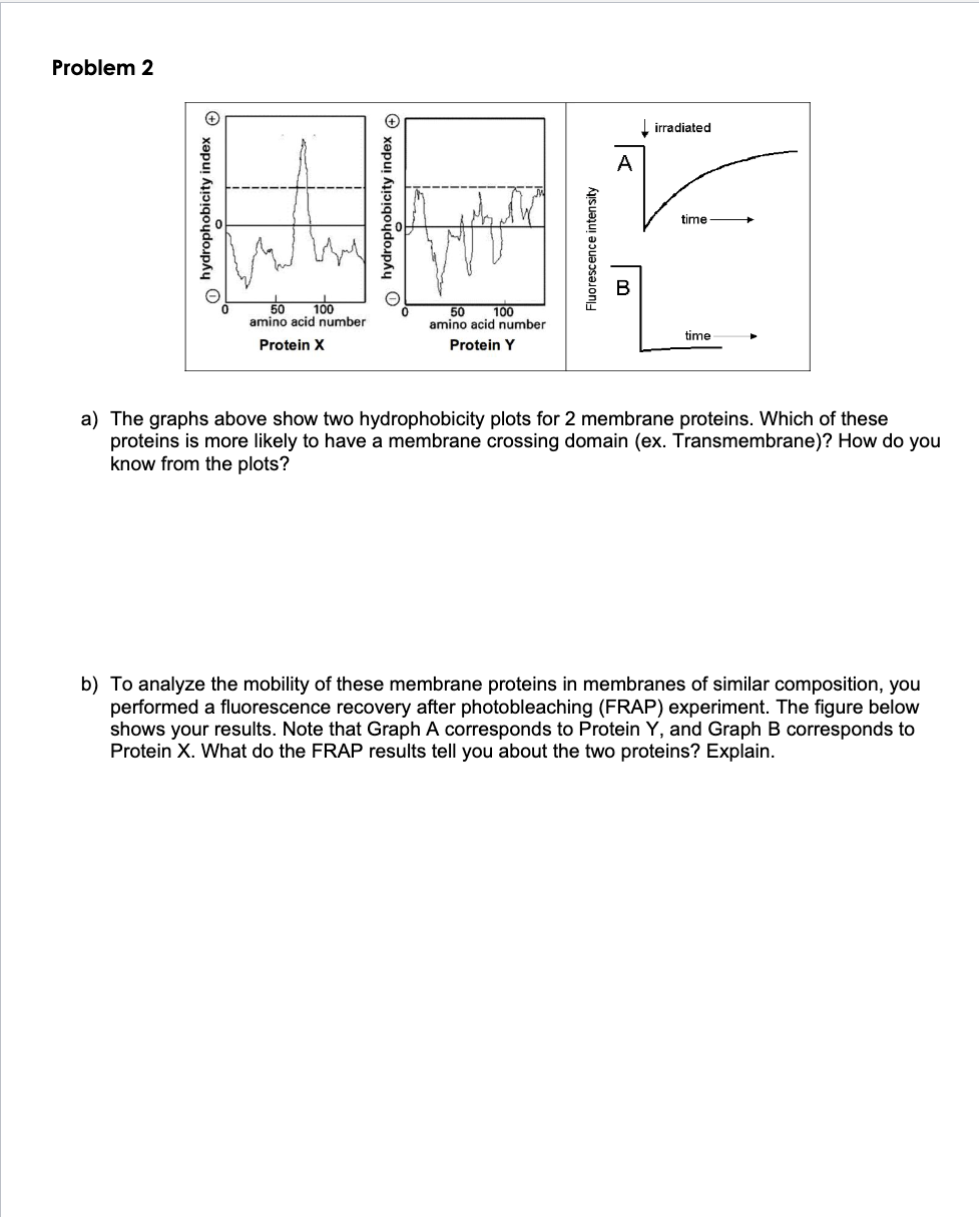 BB 314 Unit 2 - Membranes Purpose: Data analysis and logical reasoning are important skills for any future scientist to hone. However, it is not one that is easily developed without a lot of practice. The problems below are the types of questions | would expect you to be able to complete for the exam. Use these to hone your data analysis skills and practice your exam style answers to get feedback from your peers as well as your instructor. Problem 1 SDS-PAGE is often used to determine the location and orientation of membrane associated proteins. Commonly, experimental preparations of membranes are treated in a variety of ways in order to extract the proteins, which are then subjected to SDS-PAGE. These treatments will affect membrane proteins in different ways, based on how they are arranged in the membrane. a) First, to remember the types of membrane proteins and how they are oriented, draw a portion of a plasma membrane of a cell and label the cytoplasmic and extracellular surface. Place the following four proteins in the membrane: 1) peripheral membrane protein (cytoplasmic exposure), 2) integral protein (transmembrane exposure), 3) integral protein (extracellular exposure) and 4 peripheral protein (extracellular exposure) One of the most common pre-treatments is by the digestive enzyme trypsin, which degrades polypeptide chains. Trypsin is too large to cross a membrane, but can digest exposed parts of membrane proteins. Those parts of a membrane protein that are in contact with external aqueous medium containing trypsin are digested, but the enzyme cannot digest the parts of the protein that are embedded within the lipid bilayer, or the parts of the proteins on the cytoplasmic side of the membrane if the cell is intact. If detergents are used to gently permeabilize the membrane preps prior to placing them in trypsin containing medium, the enzyme can access both sides of the membrane and will digest any polypeptide chains that is exposed and accessible. b) Describe what will happen to each of your proteins when this cell is exposed to trypsin only. c) Describe what will happen to each of your proteins when this cell is treated briefly with a detergent first, and then exposed to trypsin. Below is data from an SDS-PAGE experiment. This data must be analyzed in order to determine the arrangement of proteins within the membrane that was tested. Experimental Design and Procedure: |n this experiment, the proteins were extracted from the membranes with detergent and separated by SDS-PAGE. Prior to this, the cells were subjected to the following four treatments: e Treatment 1: Intact cells, no trypsin treatment. e Treatment 2: Brief detergent treatment first, no trypsin treatment. e Treatment 3: Trypsin treatment of intact cells. e Treatment 4: Brief detergent treatment first, followed by trypsin treatment. d) Indicate which treatment(s) is/ are the control? What are they controlling for? Membranes contain many different types of proteins. In this experiment, five different proteins were identified using antibody labeling. Each antibody will recognize its target protein, but not other proteins, The results can be seen in the gel image. e) Use the data for the figure above to fill out the table below. Type | Location Protein ID Integral Cytoplasmic exposure External exposure Transmembrane Peripheral Cytoplasmic exposure External exposure Problem 2 @ | irradiated 4 4 s 3 = = 2S =
Step by Step Solution
There are 3 Steps involved in it
1 Expert Approved Answer
Step: 1 Unlock

Question Has Been Solved by an Expert!
Get step-by-step solutions from verified subject matter experts
Step: 2 Unlock
Step: 3 Unlock
 Study Help