Question: please help 1. Applied Digital Solutions is expanding its operations to include a new product line for manufacturing bioelectronic computer chip. The project for manufacturing
please help
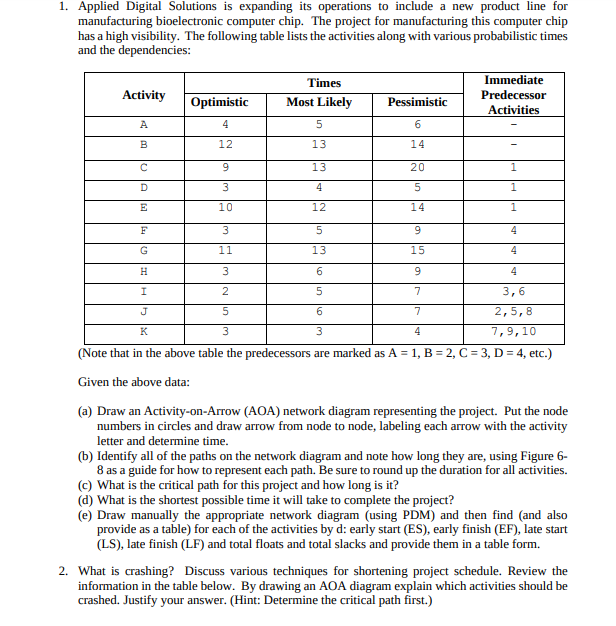
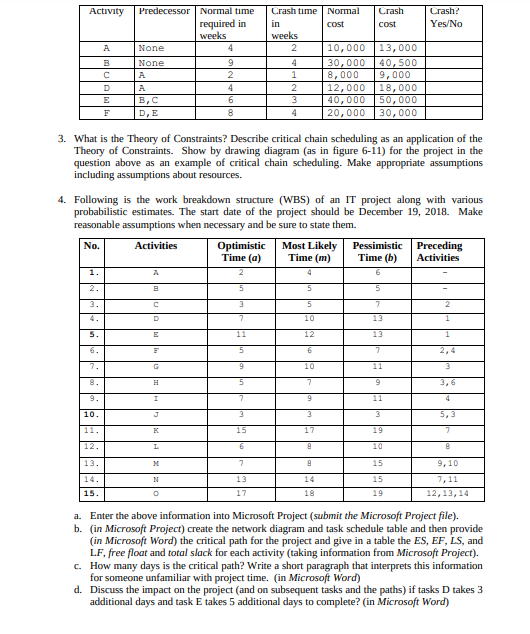
1. Applied Digital Solutions is expanding its operations to include a new product line for manufacturing bioelectronic computer chip. The project for manufacturing this computer chip has a high visibility. The following table lists the activities along with various probabilistic times and the dependencies: Activity Times Most Likely 5 Immediate Predecessor Activities Optimistic Pessimistic A 4 6 B 12 13 14 9 13 20 1 D 3 4 5 1 10 12 14 1 F 3 5 9 4 G 11 13 15 4 3 6 9 4 I 2 5 7 3,6 J 5 6 7 2,5,8 3 3 4 K 7,9,10 (Note that in the above table the predecessors are marked as A = 1, B = 2, C = 3, D = 4, etc.) Given the above data: (a) Draw an Activity-on-Arrow (AOA) network diagram representing the project. Put the node numbers in circles and draw arrow from node to node, labeling each arrow with the activity letter and determine time. (6) Identify all of the paths on the network diagram and note how long they are using Figure 6- 8 as a guide for how to represent each path. Be sure to round up the duration for all activities. (c) What is the critical path for this project and how long is it? (d) What is the shortest possible time it will take to complete the project? (e) Draw manually the appropriate network diagram (using PDM) and then find (and also provide as a table) for each of the activities by d: early start (ES), early finish (EF), late start (LS), late finish (LF) and total floats and total slacks and provide them in a table form. 2. What is crashing? Discuss various techniques for shortening project schedule. Review the information in the table below. By drawing an AOA diagram explain which activities should be crashed. Justify your answer. (Hint: Determine the critical path first.) Activity Crash? Yes/No A B Predecessor Normal time required in weeks None None 9 2 4 B,C 6 DE 8 Crash time Normal Crash in cost cost weeks 2 10,000 13,000 4 30,000 40, 500 1 8,000 9,000 2 12,000 18,000 3 40,000 50,000 20,000 30,000 D E F 3. What is the Theory of Constraints? Describe critical chain scheduling as an application of the Theory of Constraints. Show by drawing diagram (as in figure 6-11) for the project in the question above as an example of critical chain scheduling. Make appropriate assumptions including assumptions about resources. 4. Following is the work breakdown structure (WBS) of an IT project along with various probabilistic estimates. The start date of the project should be December 19, 2018. Make reasonable assumptions when necessary and be sure to state them. No. Activities Optimistic Most Likely Pessimistic Preceding Time (a) Time (m) Time (b) Activities 1. 2. B 5 5 5 3. 3 5 2 7 13 D 7 10 1 5. E 12 13 1 7 6 10 11 3 8. H 7 9 I 9 11 10. 3 5,3 11. 17 19 12. I 6 a 10 B 13. M 7 a 15 9,10 N 14 15 14. 15. 13 17 7,11 12, 13, 14 0 18 19 a. Enter the above information into Microsoft Project (submit the Microsoft Project file). b. (in Microsoft Project) create the network diagram and task schedule table and then provide (in Microsoft Word) the critical path for the project and give in a table the ES, EF, LS, and LF, free float and total slack for each activity (taking information from Microsoft Project). c. How many days is the critical path? Write a short paragraph that interprets this information for someone unfamiliar with project time. (in Microsoft Word) d. Discuss the impact on the project (and on subsequent tasks and the paths) if tasks D takes 3 additional days and task E takes 5 additional days to complete? (in Microsoft Word)









 Study Help