







Question: Please help 1. Consider a revised version of the model in Endogenous Technological Change by Paul Romer (Journal of Political Economy, 1990). The economy
Please help
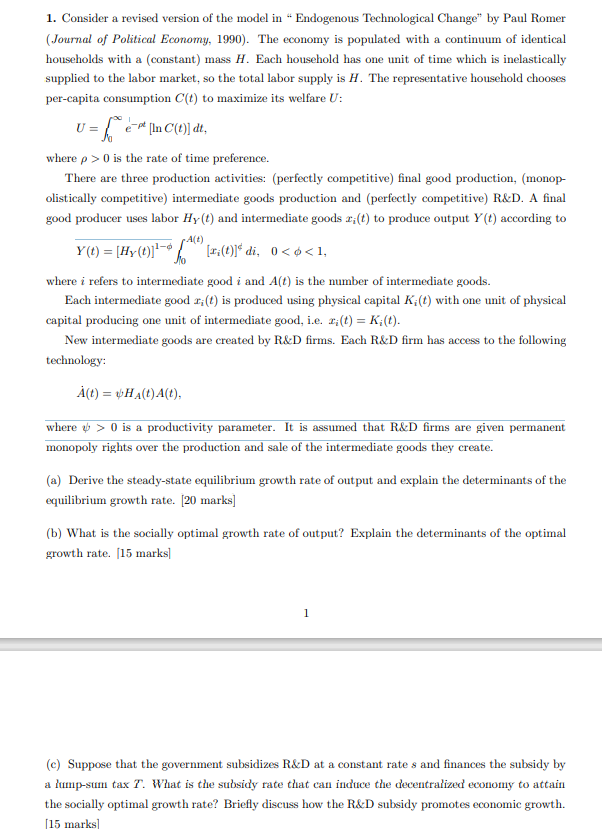
1. Consider a revised version of the model in " Endogenous Technological Change" by Paul Romer (Journal of Political Economy, 1990). The economy is populated with a continuum of identical households with a (constant) mass H. Each household has one unit of time which is inelastically supplied to the labor market, so the total labor supply is H. The representative household chooses per-capita consumption C(t) to maximize its welfare U: U = ext [In C(t)] dt. where p > 0 is the rate of time preference. There are three production activities: (perfectly competitive) final good production, (monop- olistically competitive) intermediate goods production and (perfectly competitive) R&D. A final good producer uses labor Hy(t) and intermediate goods r;(t) to produce output Y(t) according to Y(t) = [Hy(t)]]- [r:(0)1 di, 0 0 is a productivity parameter. It is assumed that R&D firms are given permanent monopoly rights over the production and sale of the intermediate goods they create. (a) Derive the steady-state equilibrium growth rate of output and explain the determinants of the equilibrium growth rate. [20 marks] (b) What is the socially optimal growth rate of output? Explain the determinants of the optimal growth rate. [15 marks] (c) Suppose that the government subsidizes R&D at a constant rate s and finances the subsidy by a lump-sum tax 7. What is the subsidy rate that can induce the decentralized economy to attain the socially optimal growth rate? Briefly discuss how the RAD subsidy promotes economic growth. [15 marks]
Step by Step Solution
There are 3 Steps involved in it

Get step-by-step solutions from verified subject matter experts
 Study Help