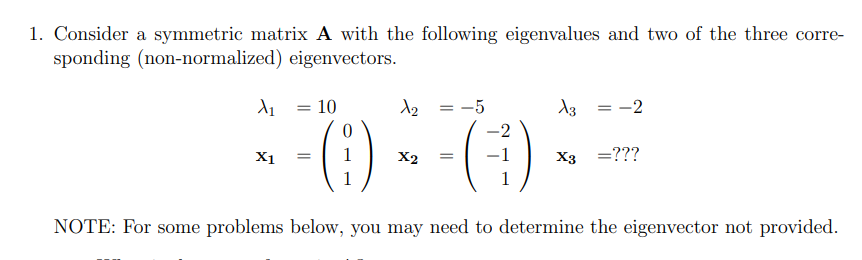
Question: please help!!!! 1. Consider a symmetric matrix A with the following eigenvalues and two of the three corre- sponding (non-normalized) eigenvectors. A1 = 10 =-5

please help!!!!
please help!!!! 1. Consider a symmetric matrix Aplease help!!!! 1. Consider a symmetric matrix Aplease help!!!! 1. Consider a symmetric matrix A
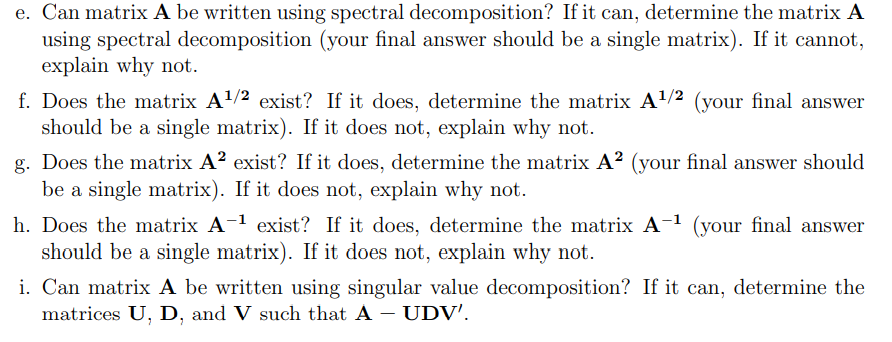
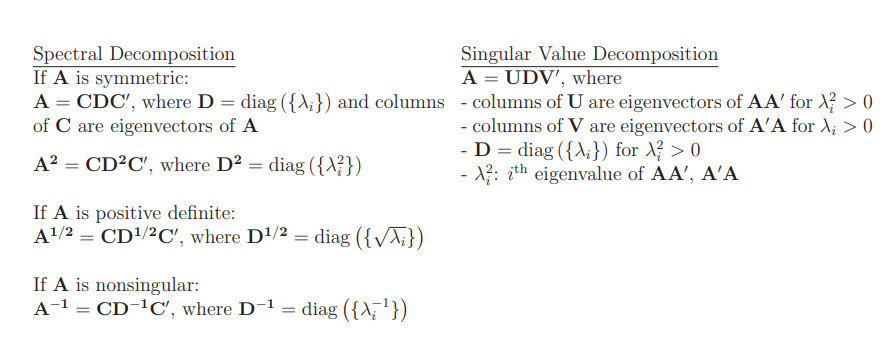
1. Consider a symmetric matrix A with the following eigenvalues and two of the three corre- sponding (non-normalized) eigenvectors. A1 = 10 =-5 13 = -2 O -2 X1 = X2 = X3 =??? NOTE: For some problems below, you may need to determine the eigenvector not provided.e. Can matrix A be written using spectral decomposition? If it can, determine the matrix A using spectral decomposition (your nal answer should be a single matrix). If it cannot, explain why not. f. Does the matrix A152 exist? If it does, determine the matrix A152 (your nal answer should be a single matrix}. If it does not? explain why not. g. Does the matrix A2 exist? If it does, determine the matrix A2 (your nal answer should be a single matrix}. If it does not? explain why not. h. Does the matrix A'1 exist? If it does, determine the matrix A4 (your nal answer should be a single matrix}. If it does not, explain why not. 1. Can matrix A be written using singular value decomposition? If it can1 determine the matrices U, D, and V such that A UDV'. Spectral Decomposition Singular Value Decomposition If A is symmetric: A = UDV', where A = CDC', where D = diag ({} ) and columns - columns of U are eigenvectors of AA' for A? > 0 of C are eigenvectors of A - columns of V are eigenvectors of A'A for > > 0 A? = CD?C', where D2 = diag ({)?}) - D = diag ( {xi}) for A? > 0 - X?: ith eigenvalue of AA', A'A If A is positive definite: A1/2 = CD1/2C', where D1/2 = diag ({vXi}) If A is nonsingular: A-1 = CD-1C', where D-1 = diag ({x; ]})

Step by Step Solution

There are 3 Steps involved in it

1 Expert Approved Answer
Step: 1 Unlock blur-text-image

Question Has Been Solved by an Expert!

Get step-by-step solutions from verified subject matter experts

Step: 2 Unlock
Step: 3 Unlock

Students Have Also Explored These Related Mathematics Questions!