







Question: Please help 1. Take for example, an expected profit maximizing monopolist who faces an uncertain demand. He supplies q units of goods at zero cost
Please help
![unknown. [The price and the supply level can be negative] (a) Assuming](https://s3.amazonaws.com/si.experts.images/answers/2024/07/66890f7de48d5_42966890f7dc3b76.jpg)
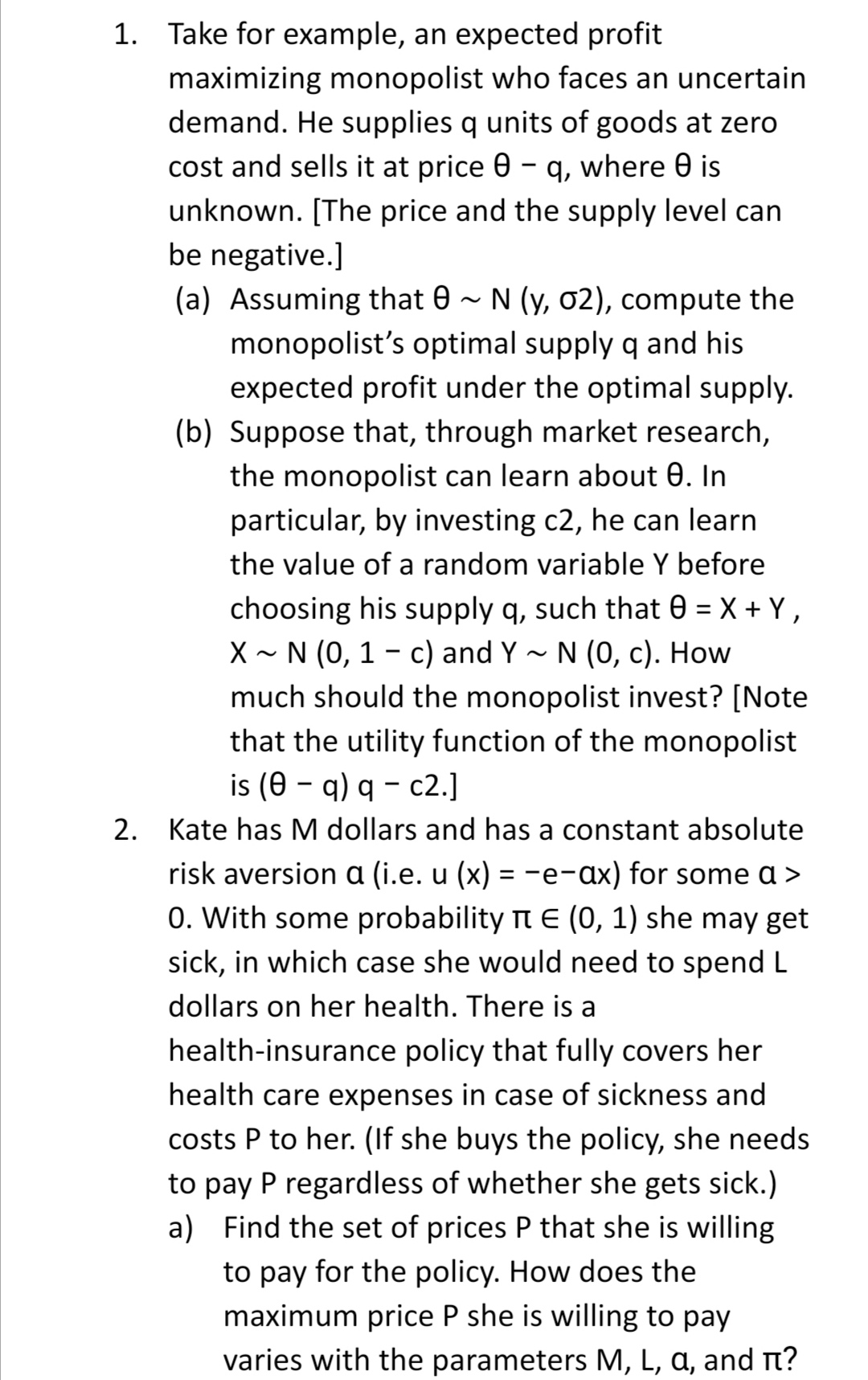
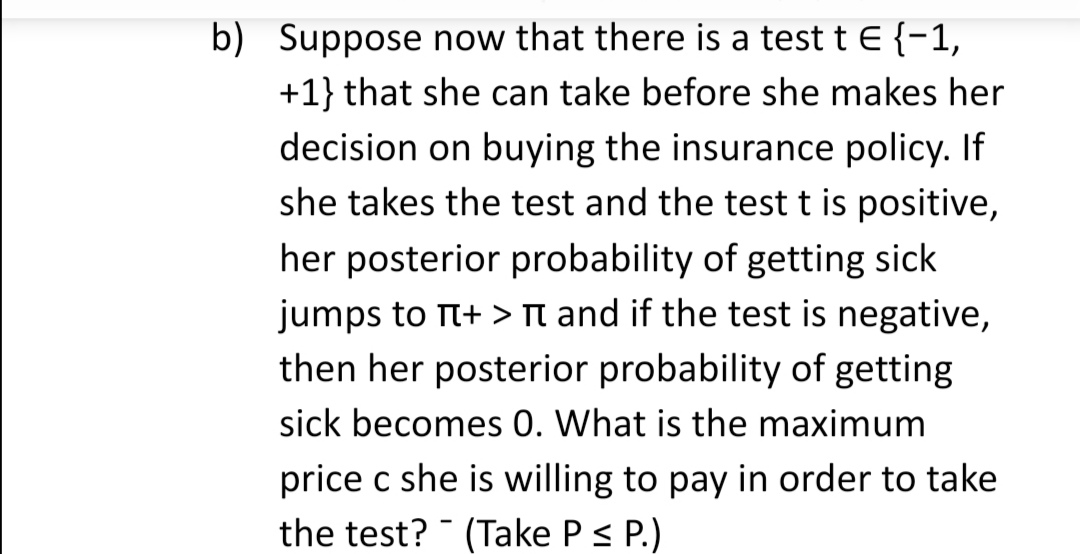
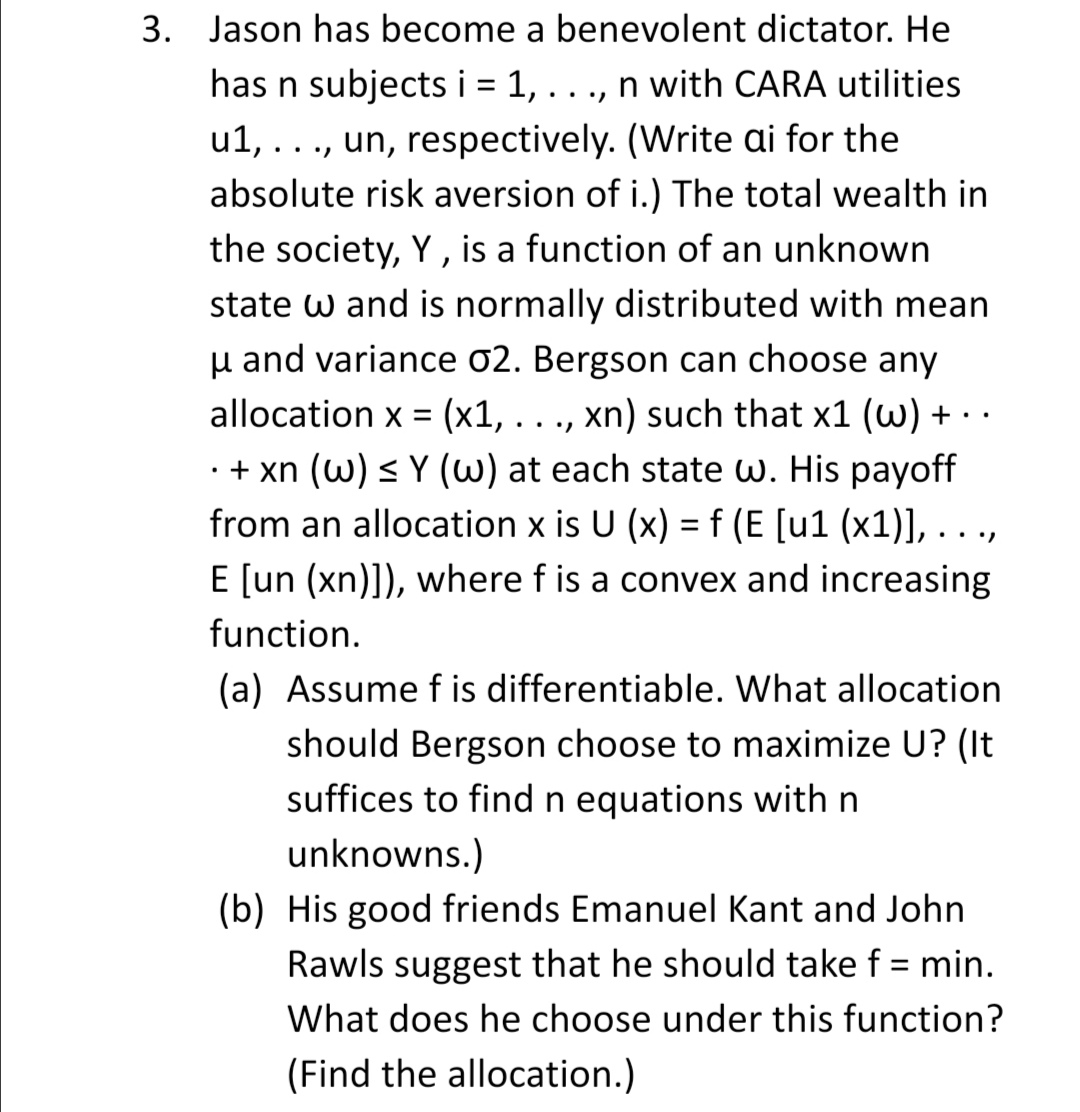
1. Take for example, an expected profit maximizing monopolist who faces an uncertain demand. He supplies q units of goods at zero cost and sells it at price 6 - q, where 9 is unknown. [The price and the supply level can be negative] (a) Assuming that 9 ~ N (y, 02), compute the monopolist's optimal supply q and his expected profit under the optimal supply. (b) Suppose that, through market research, the monopolist can learn about 9. In particular, by investing c2, he can learn the value of a random variable Y before choosing his supply q, such that 6 = X + Y , X~N(0,1-c)andY~N(0,c).How much should the monopolist invest? [Note that the utility function of the monopolist is (6 - q) q - c2.] 2. Kate has M dollars and has a constant absolute risk aversion (:1 (Le. u (x) = -e-C1x) for some a > 0. With some probability T[ E (0, 1) she may get sick, in which case she would need to spend L dollars on her health. There is a health-insurance policy that fully covers her health ca re expenses in case of sickness and costs P to her. (If she buys the policy, she needs to pay P regardless of whether she gets sick.) a) Find the set of prices P that she is willing to pay for the policy. How does the maximum price P she is willing to pay varies with the parameters M, L, a, and TI? b) Suppose now that there is a test t E {-1, +1} that she can take before she makes her decision on buying the insurance policy. If she takes the test and the test t is positive, her posterior probability of getting sick jumps to 11+ > 11 and if the test is negative, then her posterior probability of getting sick becomes 0. What is the maximum price c she is willing to pay in order to take the test? ' (Take P s P.) 3. Jason has become a benevolent dictator. He has n subjects i = 1, . . ., n with CARA utilities u1, .. ., un, respectively. (Write ai for the absolute risk aversion of i.) The total wealth in the society, Y , is a function of an unknown state w and is normally distributed with mean u and variance 62. Bergson can choose any allocation x = (x1, . . ., xn) such that x1 (W) + . . . + xn (W) s Y (w) at each state W. His payoff from an allocation x is U (x) = f (E [u1 (x1)], . .., E [un (xn)]), where f is a convex and increasing function. (a) Assume f is differentiable. What allocation should Bergson choose to maximize U? (It suffices to find n equations with n unknowns.) (b) His good friends Emanuel Kant and John Rawls suggest that he should take f = min. What does he choose under this function? (Find the allocation.)A principal hires an agent at date 0. At date 1, the agent will face one of two tasks, task A or task B. Neither the principal nor the agent knows at date 0 which task the agent will face at date 1. It will be task A with probability p and task B with probability l-p. The agent will learn the task at date I; the principal will never learn which task the agent faced. The agent's effort into either task is private information. The agent's cost of effort when performing task, A is cA(e) = e2 and her cost of effort when performing task B is cB(e) = ae + be2, where a is a parameter that can be positive or negative and b is positive. The principal's benefit from task A is B(e) = e. The principal does not benefit from task B. The principal and the agent are both risk neutral. The principal and the agent observe a signal of effort x = e + 8, where 8 is a noise term with zero mean (given risk neutrality, the specific distribution is unimportant.) The signal x is observed regardless of which task the agent is performing. The principal pays the agent with a linear contract s(x) = ax + B. The agent's reservation utility is normalized to zero. The fixed payment B can be negative. 3. Set up the program that selects the Pareto optimal parameters Cl and B given the agent's incentive compatibility and participation constraints. (Note that effort levels are different depending on which task the agent ends up performing). b. What is the optimal value of a? c. Suppose the principal can rule out task B. If task B is ruled out, x is identically zero when task B would have come up (task A still comes up with probability p). Will it ever be optimal not to rule out task B
Step by Step Solution
There are 3 Steps involved in it

Get step-by-step solutions from verified subject matter experts
 Study Help