







Question: please help 1. Use the EOQ model to determine the optimal number of pairs of shoes per order. 2. Assume each month consists of approximately
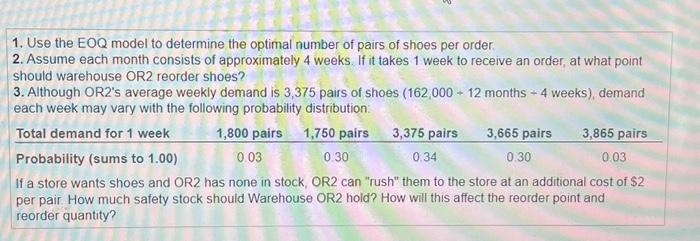
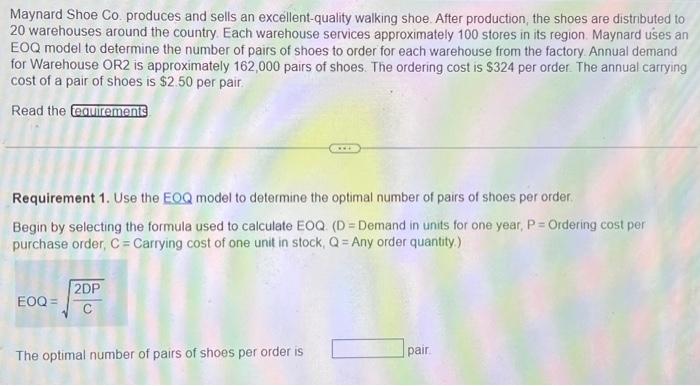
1. Use the EOQ model to determine the optimal number of pairs of shoes per order. 2. Assume each month consists of approximately 4 weeks. If it takes 1 week to receive an order, at what point should warehouse OR2 reorder shoes? 3. Although OR2's average weekly demand is 3,375 pairs of shoes ( 162,000+12 months +4 weeks), demand each week may vary with the following probability distribution: If a store wants shoes and OR2 has none in stock, OR2 can "rush" them to the store at an additional cost of \$2 per pair. How much safety stock should Warehouse OR2 hold? How will this affect the reorder point and reorder quantity? Maynard Shoe Co. produces and sells an excellent-quality walking shoe. After production, the shoes are distributed to 20 warehouses around the country. Each warehouse services approximately 100 stores in its region. Maynard uses an EOQ model to determine the number of pairs of shoes to order for each warehouse from the factory. Annual demand for Warehouse OR2 is approximately 162,000 pairs of shoes. The ordering cost is $324 per order. The annual carrying cost of a pair of shoes is $2.50 per pair. Read the Requirement 1. Use the EOQ model to determine the optimal number of pairs of shoes per order Begin by selecting the formula used to calculate EOQ. ( D= Demand in units for one year, P= Ordering cost per purchase order, C= Carrying cost of one unit in stock, Q= Any order quantity.) EOQ=c2DP The optimal number of pairs of shoes per order is pair
Step by Step Solution
There are 3 Steps involved in it

Get step-by-step solutions from verified subject matter experts
 Study Help