







Question: please help 18. Changes in interest rates, or changes in tax law, are both examples of what type of risk? A) Firm specific B) Systematic
 please help
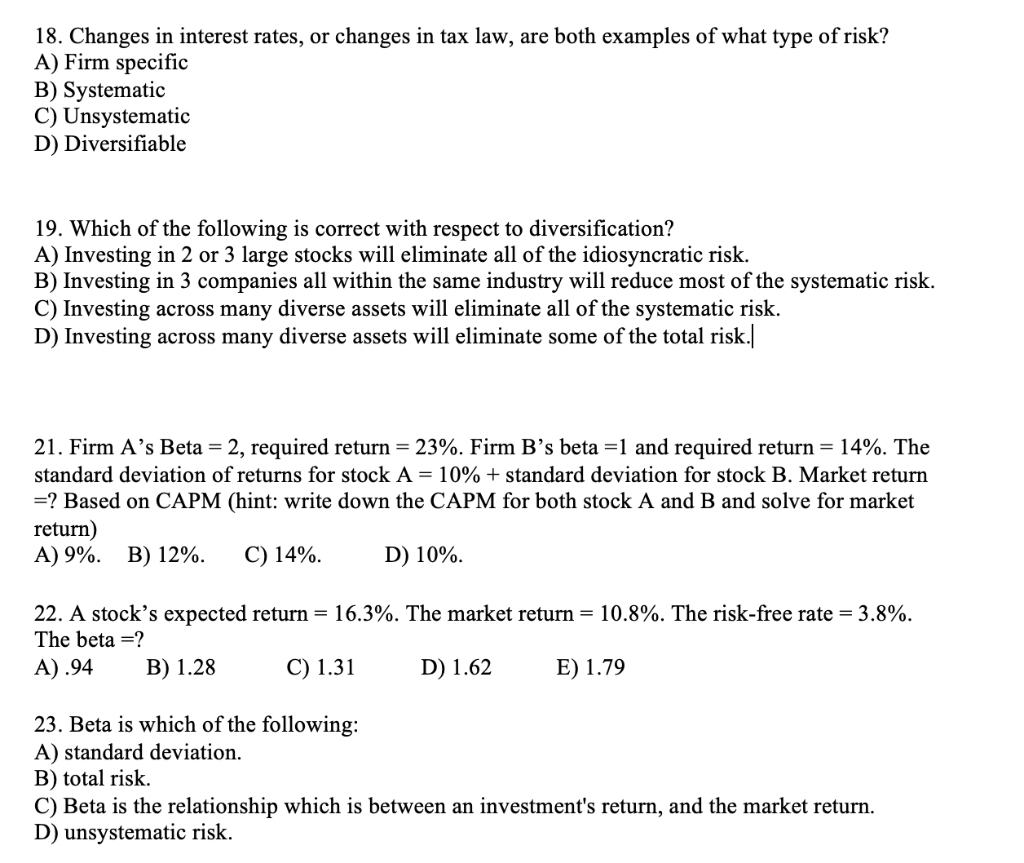
18. Changes in interest rates, or changes in tax law, are both examples of what type of risk? A) Firm specific B) Systematic C) Unsystematic D) Diversifiable 19. Which of the following is correct with respect to diversification? A) Investing in 2 or 3 large stocks will eliminate all of the idiosyncratic risk. B) Investing in 3 companies all within the same industry will reduce most of the systematic risk. C) Investing across many diverse assets will eliminate all of the systematic risk. D) Investing across many diverse assets will eliminate some of the total risk./ 21. Firm A's Beta = 2, required return = 23%. Firm Bs beta =1 and required return = 14%. The standard deviation of returns for stock A = 10% + standard deviation for stock B. Market return =? Based on CAPM (hint: write down the CAPM for both stock A and B and solve for market return) A) 9%. B) 12%. C) 14%. D) 10%. 22. A stock's expected return = 16.3%. The market return = 10.8%. The risk-free rate = 3.8%. The beta =? A).94 B) 1.28 C) 1.31 D) 1.62 E) 1.79 23. Beta is which of the following: A) standard deviation. B) total risk. C) Beta is the relationship which is between an investment's return, and the market return. D) unsystematic risk
Step by Step Solution
There are 3 Steps involved in it

Get step-by-step solutions from verified subject matter experts
 Study Help